Pilates Equipment Depreciation in Mexico: How to Calculate It

Pilates Equipment Depreciation in Mexico: How to Calculate It
For tax purposes, a studio reformer is depreciated on a straight-line basis, typically at an annual rate of 10% on its original investment amount (MOI, by its Spanish acronym)—meaning over roughly ten years. That is not the same as what your equipment is worth on the open market: a well-built reformer can be fully depreciated with the SAT and still continue generating revenue through classes and strong resale value. This guide shows you how to calculate the deduction, which costs are included in the MOI, and what paperwork to keep. It is designed for studio owners, instructors opening their first location, operators adding a reformer room, clinics, and investors.
In Summary
- Tax depreciation is classified as an investment deduction (Article 31 of the Mexican Income Tax Law, LISR): it lowers your taxable income base (ISR), but does not reflect what the equipment is actually worth on the market.
- For office furniture and equipment, the tax schedule establishes a 10% annual rate; your accountant will confirm how to classify each piece of equipment in your studio.
- The MOI includes the purchase price, freight, installation, and other commissioning costs, excluding creditable VAT.
- Keep valid CFDIs, bank payment records, and a fixed asset ledger for the entire lifespan of the equipment and for five years thereafter.
- Choosing a durable reformer extends its real useful life well beyond its tax life and protects its resale value.
Table of Contents
- What it means to depreciate a reformer
- The rate that applies to Pilates equipment
- What is included in the MOI
- How to calculate it, with an example
- Tax depreciation vs. book depreciation
- An incentive worth asking your accountant about
- If you finance the equipment
- The paperwork supporting the deduction
- Real useful life and resale value
- What to do depending on your situation
- Equip your studio with a purchase that depreciates well
- Frequently asked questions
- Sources
What it means to depreciate a reformer
Depreciating means recognizing an asset’s wear and tear over the course of its useful life. In SAT terminology, the phrasing you will see is “deduction of investments,” primarily governed by Article 31 of the Mexican Income Tax Law (LISR). Instead of deducting the entire cost of the equipment on the day you buy it, you deduct it gradually, year by year.
There are two distinct types of depreciation, and it is best not to confuse them:
- Tax: determined by law. It is an annual percentage applied to the original investment amount (MOI), without residual value, and is used to calculate income tax (ISR).
- Accounting (Book): follows standard NIF C-6. Your studio estimates the useful life, residual value, and method, which more accurately reflects the true value of the asset.
A third concept is market value: what someone would pay today for your used reformer. That value depends on the brand, the condition of the wood, the hardware, maintenance, and market demand, and it does not follow any SAT schedule. Castelec emphasizes that tax depreciation does not aim to reflect the economic value of the asset, but rather to determine the tax base. That is why it rarely matches book depreciation.
The Rate That Applies to Pilates Equipment
The current tax depreciation table for 2026, as summarized by CPCON, places office furniture and equipment at 10% annually (an implied useful life of 10 years, Art. 34, Sec. III) and machinery and equipment for general industrial activity also at 10% (Art. 35). Other categories depreciate faster: SatFácil cites 30% for computer equipment, 25% for vehicles, and 35% for tools.
In practice, most studios will depreciate reformers, Cadillacs, chairs, and barrels at 10% per year. The exact classification of each piece of equipment is a decision for your accountant, based on the studio's business activity and the purchase invoice. If your studio operates inside a gym or a clinic, notify your accountant so they can properly classify the reformer room alongside your other assets.
A different reference point is the guide published in the Diario Oficial de la Federación (Official Gazette of the Federation), which recommends a 5-year useful life and 20% annual depreciation for sports and fitness equipment. This is a guideline for useful life, not the statutory tax rate for your annual filing. Use it as a reminder that book useful life is estimated by you, while tax depreciation is dictated by law.
What Is Included in the MOI
The original investment amount (MOI) is not just the list price. According to Article 31 of the LISR on the SAT portal, it includes, in addition to the purchase price of the asset:
- taxes paid on the acquisition or importation, excluding VAT (IVA);
- freight and shipping insurance;
- installation and assembly;
- customs broker commissions and fees;
- services contracted to make the investment fully operational.
This matters because a reformer arrives at your studio via freight and must be assembled. Every peso falling into these categories is depreciated at the same rate as the equipment itself. That is why the invoice and receipts for freight and installation must be issued in your studio’s name and linked to the purchase. In our guide on how to invoice Pilates equipment and deduct it properly and our guide on how to deduct a reformer and calculate the MOI, you will find full details on how this works with our operations.
Repairs follow a different rule. Article 36, Sec. I of the LISR considers as investments only adaptations that involve additions or improvements to the asset; routine maintenance and repairs to keep the equipment operational are not considered capital investments. Replacing a spring or reupholstering a pad is routine maintenance; installing an add-on that expands the equipment's functionality is a separate matter to review with your accountant.
How It Is Calculated, with an Example
The tax formula, according to SatFácil, is MOI × annual rate ÷ 100 ÷ 12 to determine the monthly deduction. It begins the month following acquisition and retains a nominal residual value of $1. Furthermore, Castelec explains that you can start deducting either in the tax year you begin using the asset or in the following year, and that the first and last years are deducted in proportion to the full months of use.
Illustrative Example with Rounded Figures
The figures in this example are fictional and intended solely to demonstrate the calculation method; they do not represent actual product prices.
| Item | Amount |
|---|---|
| Reformer price (excluding VAT) | $80,000 |
| Shipping and installation | $5,000 |
| MOI | $85,000 |
| Annual tax rate | 10% |
| Annual deduction | $8,500 |
| Monthly deduction | $708.33 |
If the equipment begins operating in March and you start deducting within that fiscal year, the first year you deduct the corresponding full months of use according to the rule in Article 31. Your accountant calculates this proportion using the start-of-use date you provide.
Adjustment for inflation
The MOI is adjusted for inflation using the INPC (National Consumer Price Index). DocDigitales illustrates this mechanism with a machine purchased in June 2022 for $150,000: with an INPC of 121.06 on that date and 135.57 in December 2024, the adjusted MOI is roughly $168,000, and the 2024 deduction at 10% comes to $16,800. The INPC is published monthly by INEGI, so the factor changes each tax year.
Tax depreciation vs. book depreciation
If your studio maintains formal accounting, you will see two numbers for the very same reformer. CPCON provides an example featuring a machine with an MOI of $2,000,000, a salvage value of $100,000, and a book useful life of 12 years: accounting depreciation comes to $158,333.33 per year, compared to an annual tax deduction of $200,000 at 10%. This difference is temporary, and CPCON recommends maintaining both records side by side while recognizing the deferred tax.

For a boutique studio, this translates into a simple rule: tax depreciation tells you how much you can deduct; book depreciation tells you what the equipment is worth on your balance sheet. Ask your accountant for a reconciliation between the two once a year.
An incentive worth asking your accountant about
The so-called Plan México includes an immediate deduction incentive for new fixed asset investments. Greenberg Traurig outlines it as follows: it applies to assets acquired through September 30, 2030, with deduction rates ranging from 41% to 91% for 2025 and 2026, and from 35% to 89% for 2027 through 2030, depending on the asset category. It requires a minimum two-year holding period, specific investment tracking records, and does not apply to office furniture and equipment.
If your reformer is classified as furniture, you won't qualify for this incentive; if your accountant classifies it under a different category, you might. This is a specific question to ask them before buying, not after. To substantiate these investments, IDC Online recommends keeping the CFDI invoice, contract or purchase order, proof of payment, serial numbers, photographs, installation reports, and the documented start-of-use date.
If you finance the equipment
Financing does not change how much you depreciate—it only changes when you pay. In a financial lease, Tirant Prime explains that tax deductions are taken through asset depreciation pursuant to Articles 31 and 38 of the LISR, not as a rental expense; the MOI is the total asset value specified in the contract. If you exercise the purchase option, the fair market value paid is added, and depreciation continues until the full recovery period is complete.
For your cash flow, this is a major advantage: you can open with a fully equipped studio and gradually deduct the investment while paying monthly installments. Each financing model (outright purchase, credit, or leasing) is accounted for differently, so be sure to review the contract with your accountant before signing. If you are comparing your options, our Pilates equipment leasing guide and our guide on financing requirements for reformers provide the complete picture.
The paperwork that backs up your deduction
A deduction without supporting documentation will not hold up during an audit. Gather the following records starting on day one:
- Valid investment CFDI. Alegra warns that a CFDI with an incorrect RFC, tax regime, or postal code cannot be used for deductions. Double-check the details before accepting the invoice.
- Banked payment. Wire transfer or card, according to the same guide, not cash.
- Fixed asset tracking. Audit Shop points out that it must include the acquisition date, MOI, location, use, and useful life.
- Proof of freight and installation costs, because they are part of the MOI.
- Depreciation calculation per fiscal year.
Regarding the retention period, ElConta.MX notes that accounting books and supporting documents must be kept for at least five years, and those for fixed assets must be saved throughout the asset's useful life and for five additional years after its full depreciation. Digitize everything and organize it by machine.
Actual Useful Life and Resale Value
Tax depreciation ends when the MOI is fully depleted. The reformer's life does not. To estimate what a piece of equipment is worth when upgrading or expanding, accounting valuation uses either the cost model (historical cost minus accumulated depreciation) or fair value, which CPCON describes as the replacement cost new adjusted for physical wear and obsolescence. If you sell an asset, the difference against the selling price is recorded as a gain or loss after derecognizing the cost and accumulated depreciation.
What increases or decreases that market value is physical: the wood, the hardware, the springs and pulleys, and the weekly hours of use. Equipment used for daily group classes wears out faster than one used for just a few sessions. That is why the purchasing criteria that protects your investment is build quality, not just the entry price.

At Pilates de México, we carry MetaLife, built with certified Lyptus® FAS wood and stainless steel hardware, featuring a frame that supports over 200 exercises and years of daily classes. It is engineered so you buy once and retain resale value when the time comes to expand. For those starting with a tighter budget, we also offer accessible options manufactured in China and other countries, so your first studio doesn't have to start at the highest price point. Your accountant will depreciate both the same way; what changes is how many years it produces revenue and what it's worth in the end.
What to Do Based on Your Situation
Established studio upgrading equipment. Review your fixed asset register: reformers that are already fully deducted can be sold, and after writing off their cost and accumulated depreciation, the difference is recorded as a gain or loss. A new purchase opens a new MOI.
Instructor opening their first studio. Ask your accountant to classify the equipment and advise whether it's best to deduct starting in the fiscal year it is put into service or the following one. To plan your startup budget, check how much it costs to open a studio in Mexico City.
Gym, CrossFit box, or yoga studio adding reformers. Register the room as its own asset group with its own start-of-use date so they are not mixed in with the rest of your furniture and fixtures.
Physical therapy clinic or practice. Document how the equipment relates directly to your professional activity: this is part of the supporting documentation you should keep on file.
Investor without a Pilates background. Model the annual tax deduction into your cash flow and review the profitability of a Pilates studio in Mexico with your accountant.
Equip Your Studio with an Investment That Depreciates Smartly
If you already know how many machines you need, our team will guide you in choosing the right package, financing, and professional installation. You can check out the Infinity line and the Advanced line, our studio packages, and our financing options. Every piece of equipment comes backed by financing, packages, and consulting from a team that knows what it takes to open and fill a studio.
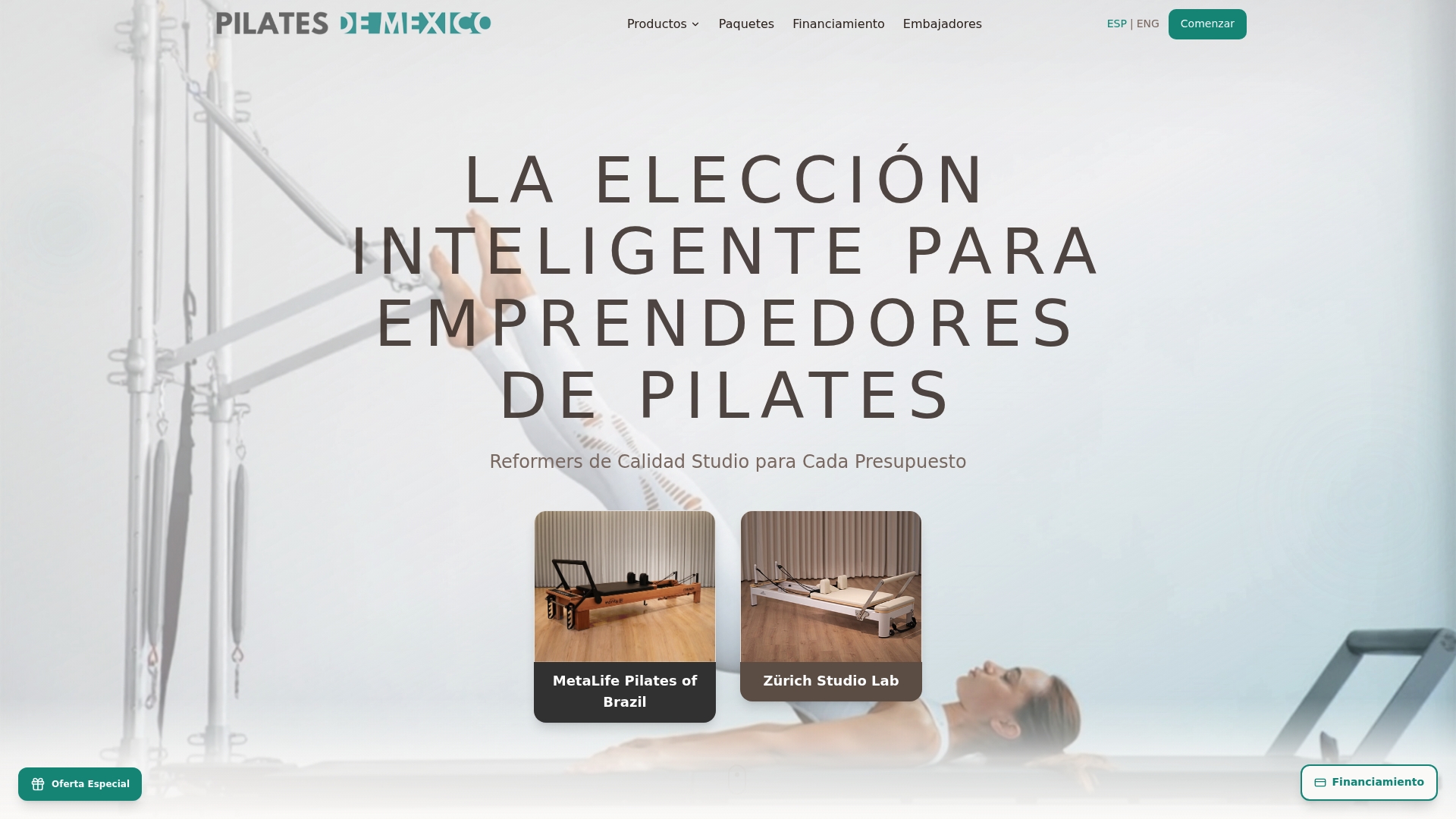
If all you need is your starting figure, our guide on professional reformer prices in Mexico gives you the starting point for your MOI.
Frequently Asked Questions
Over how many years does a reformer depreciate in Mexico?
The tax depreciation rate that accountants use for office furniture and equipment is 10% annually, which equates to about ten years using the straight-line method. The accounting useful life is estimated by your studio under NIF C-6 and may vary. Your accountant will confirm the specific classification for each piece of equipment.
Can I deduct the freight and installation costs of the reformer?
Yes, they are considered part of the original investment amount (MOI) under Article 31 of the LISR, along with the purchase price and taxes paid, excluding VAT. You will need the invoices issued under your studio’s name. They are depreciated at the exact same rate as the equipment itself.
Does the tax depreciation reflect what my used reformer is worth?
No. Tax depreciation determines your ISR (income tax) deduction base; actual market value depends on condition, brand, and demand. A piece of equipment can be fully depreciated in the eyes of the SAT and still hold significant resale value.
How long should I keep the invoice and depreciation calculations?
The ElConta.MX guide recommends keeping them throughout the asset’s useful life plus an additional five years after it has been fully depreciated. Make sure to also keep the bank payment proof and fixed asset control records.
Does depreciation change if I finance the purchase?
Under a financial lease (capital lease), the deduction is claimed through asset depreciation, while interest expenses are treated separately. The exact approach depends on your contract and your tax regime, so be sure to review it with your accountant before signing.
Sources
- Yo-Facturo: tax depreciation of assets in Mexico
- Cofide: asset depreciation and deductions, accounting and tax effects under NIF C-6
- Castelec: fixed asset depreciation in Mexico
- CPCON: fixed asset depreciation 2026, SAT table
- SatFácil: fixed asset tax depreciation 2026
- Official Gazette of the Federation (DOF)
- SAT: Article 31 of the LISR
- APTA: Income Tax Law, Article 36
- DocDigitales: tax depreciation and maximum amounts
- Greenberg Traurig: Plan Mexico tax incentives
- IDC Online: Plan Mexico 2026
- Tirant Prime: financial leasing
- Alegra: deductible expenses in Mexico 2026
- Audit Shop: accounting and tax recording of a fixed asset
- ElConta.MX: retention of accounting documentation
- CPCON: fixed asset valuation under NIF C-6