Gym Equipment Financing in Mexico: Options and Real Cost

Gym Equipment Financing in Mexico: Options and Real Cost
Yes, in Mexico you can buy gym or Pilates equipment on credit, and there is more than one path: bank loans with NAFIN programs, operating leases, capital leases, and direct supplier financing. The best option is the one your studio can comfortably afford from its actual profits, not the one advertising the lowest interest rate. If you are equipping a reformer studio, at Pilates de México financing is built into every machine, along with studio packages and consulting to help you open and fill your classes.
In Summary
- The main routes are: bank credit (with or without NAFIN guarantees), operating leases, capital leases, and supplier financing. Each option changes your monthly payment, the total cost, and who owns the equipment at the end.
- The NAFIN “Tu primer crédito” program offers up to 5 million pesos, fixed annual rates up to 14.50%, and terms up to 60 months, though banks perform their own credit analysis and approval is never automatic.
- A boutique Pilates, yoga, or spin studio may require between $200,000 and $500,000 MXN in equipment, according to a 2025 media estimate. That benchmark helps you calculate your maximum monthly payment.
- Always compare the total cost of credit—not just the interest rate—and make sure your monthly payment fits comfortably within your studio's projected profits.
- If you are purchasing reformers, ask about resale value at the end of the term: it directly impacts the true net cost of your equipment.
Table of Contents
- What “Equipment Financing” Means and Who Uses It
- How Much You Need to Finance: The Benchmark Investment
- Financing Options, One by One
- What Lenders Typically Require for Credit Approval
- Example: What You Actually Pay
- How to Choose Based on Your Situation
- Taxes: What You Should Review with Your Accountant
- How to Avoid Risks When Financing
- Why Working with a Financing Supplier Simplifies the Purchase
- Your Next Step with Pilates de México
- Frequently Asked Questions
- Sources
What “Equipment Financing” Means and Who Uses It
When people talk about gym equipment credit, several different financial structures often get mixed up. It helps to distinguish between them from the start, as each one affects your cash flow, your taxes, and who ultimately owns the equipment.
- Bank or development loan: the bank lends you the money and you purchase the equipment. The equipment is yours from day one, and you pay principal plus interest.
- Operating lease (pure leasing): you rent the equipment. At the end of the term, you return it, renew it, or buy it. The lease payment is recorded as an operating expense.
- Capital lease (financial leasing): the contract is structured so that you ultimately buy the equipment, with a purchase option agreed upon from the start.
- Vendor financing: the equipment supplier allows you to pay in monthly installments, typically with a down payment.
- Business credit card or installment payments: quick and paperwork-free, but almost always the most expensive way to finance an asset.
This applies equally to an expanding Pilates studio, a gym, CrossFit box, or yoga studio adding a reformer room, a physical therapy or rehabilitation clinic outfitting their practice with equipment, and an investor opening a studio as a business without being an instructor.
How Much You Need to Finance: The Benchmark Investment
Before choosing a loan, determine the total amount. An estimate from Revista Flow published in 2025 places the equipment for a new basic gym between $300,000 and $800,000 MXN, a boutique studio (yoga, Pilates, spinning) between $200,000 and $500,000 MXN, and a traditional gym between $400,000 and $1,000,000 MXN. These are general ranges: your exact figure will depend on the number of reformers, whether you add accessories, and the equipment line you choose.
For Pilates, you build the total budget from the ground up:
- The number of reformers that fit in your space and that your class schedule can consistently fill.
- Complementary equipment: cadillac, chair, ladder barrel, and accessories.
- Installation and logistics to your location.
- Working capital for the initial months, which shouldn't be combined with equipment financing if you can avoid it.
If you're still deciding what to purchase first, our guide to Pilates studio equipment will help you prioritize. And if you're launching in the capital, how much it costs to open a studio in Mexico City breaks down all the other expenses.
Financing Options, One by One
Bank Loans Backed by NAFIN
Nacional Financiera (NAFIN) is Mexico's development bank. They don't lend to you directly under this scheme: the loan is granted by an intermediary commercial bank with the backing of the program.
According to the official page for NAFIN's Tu Primer Crédito, the program offers up to 5 million pesos, with a fixed annual rate of up to 14.50%, terms of up to 60 months, and up to 2 million pesos without requiring mortgage collateral. It is designed for individuals with business activity (personas físicas con actividad empresarial) or corporations applying for their first SME loan. The same page notes that it can be processed through Banamex, Banorte, Banregio, BBVA, or Mifel.
Another program, Impulso Nafin + Estados, advertises up to 5 million pesos, terms of up to 60 months, a fixed annual rate of up to 14.75%, no opening fees or prepayment penalties, and up to a 6-month grace period. It requires a formally established business, preferably with two years of operating history, and a solid credit record. This makes it better suited for an established studio upgrading or expanding rather than a brand-new startup.

Terms and programs change regularly. Before making a decision, verify current interest rates, funding amounts, and requirements on official websites and with the participating bank.
Who it's for: studios and clinics with an active RFC tax ID, healthy credit history, and the patience to navigate the application process. It offers the lowest rates, but it's not the fastest route.
Operating Lease (Pure Leasing)
This is a rental agreement. You use the equipment over a set period and, at the end, you return it, upgrade it, or buy it out. It lowers your upfront out-of-pocket costs, which helps keep capital available for your lease, remodeling, and marketing. Since you don't own the equipment, it doesn't create resale value for your business. For this reason, leasing makes more sense if you plan to upgrade models frequently rather than build long-term assets. For a deeper dive, check out our guide on Pilates equipment leasing in Mexico.
Capital Lease (Financial Leasing)
The contract features payments that cover the equipment's value plus finance charges, along with an end-of-term buyout option at a price below the initial purchase cost. Functionally, it works like buying on an installment plan: your studio ultimately owns the equipment. From a tax standpoint, it is treated differently than an operating lease, so it pays to consult your accountant before signing.
Direct Supplier Financing
This is the most straightforward route: the same supplier selling you the equipment designs your payment plan. You avoid assembling applications across multiple institutions and negotiate equipment, installation, and payment terms in a single conversation. At Pilates de México, financing is available on every piece of equipment and can be bundled with equipment packages, as well as studio opening and expansion consulting.
Business Credit Cards and Monthly Installments
This works well for accessories or covering small budget gaps. For major equipment, avoid relying on it as your primary plan: the financing cost is usually the highest of any option, and your available credit line is rarely large enough to outfit a full studio room.
What Is Typically Required for Loan Approval
Each institution has its own checklist, but a standard business application file includes:
- Official government ID of the business owner or legal representative.
- Tax ID (RFC) and an updated tax status certificate (Constancia de Situación Fiscal).
- Proof of business address.
- Articles of incorporation and power of attorney, if registered as a corporation.
- Recent bank statements and, in some cases, financial statements or tax returns.
- Authorization for a credit bureau check.
- A guarantor, co-signer, or collateral, depending on the program.
In the case of NAFIN, the Tu primer crédito program requires you to be an official MSME (MiPyME) or a sole proprietor registered for business activities, and your first business credit must be validated through credit reporting systems. For reformers specifically, check out our guide on reformer financing requirements.
A practical tip: organize your tax and financial documentation before requesting quotes. A studio with clean invoicing and up-to-date tax filings moves through the process much faster. If you are purchasing Pilates equipment, it also helps to understand how to invoice Pilates equipment and deduct it properly.
Example: How Much You Actually Pay
Interest rates alone can be misleading. What truly matters is the monthly payment and the total cash leaving your account. Let’s look at an example calculation using a standard fixed-rate loan amortization formula, based on NAFIN's published cap rate.
Scenario: You finance $500,000 MXN over 36 months at a fixed annual rate of 14.50%. This does not include VAT on interest, processing fees, or insurance.
| Item | Estimated Result |
|---|---|
| Financed amount | $500,000 |
| Monthly payment | $17,200 |
| Total paid over 36 months | $619,000 |
| Financing cost | $119,000 |
If that same amount were financed at a higher rate, both the monthly payment and the overall cost would increase significantly. That is why, whenever you receive offers, you should always request the total cost and the monthly payment over the exact same term to make an apples-to-apples comparison. A program with a promotional rate is not automatically a good loan if the total financial cost—once fees and insurance are factored in—ends up higher.
How to Know If Your Studio Can Handle the Payment
Run these numbers before signing:
- Estimate your monthly revenue based on realistic studio occupancy, not your best-case month.
- Deduct fixed overhead expenses: rent, payroll, utilities, marketing, and maintenance.
- What remains is your net operating income before loan service.
- Compare your monthly payment to that net income. As a rule of thumb, if the payment eats up most of what remains, the plan is fragile: a drop in client attendance lasting just a few weeks could push you into default.
A straightforward example: if your studio generates $40,000 in monthly net profit and the loan payment is $17,200, debt service consumes 43% of your profit. That is manageable if your occupancy is stable, but it leaves very little room to scale. Extending the loan term or financing a smaller amount will lower that payment. To forecast your numbers accurately, explore whether a Pilates studio is profitable in Mexico.
How to Choose Based on Your Situation
An Established Studio Upgrading or Expanding
Your operating track record works to your advantage: you can qualify for programs offering lower rates and longer terms. The primary factors in your decision should be equipment durability and resale value, because a well-crafted reformer still commands strong value on the secondary market when it's time to upgrade. Here, direct financing through a high-durability equipment manufacturer prevents you from paying twice for the same asset. The Infinity and Advanced lines from MetaLife are engineered specifically for this profile, built with certified Lyptus® FAS hardwood and stainless steel hardware.
An Instructor Opening Their First Studio
Your main challenge is that you don't have a business credit history yet. A bank loan can be difficult to secure and time-consuming, which is why direct vendor financing and starter packages are often the most realistic route. There are also more accessible equipment options so your first studio space doesn't have to start at the highest price point. First, define how many reformers you need for your initial class schedule, rather than buying equipment for a full studio right away.
Gym, yoga studio, CrossFit, HYROX, barre, or dance studio
You already have revenue and a physical location, which helps justify the loan. Treat the reformer room as a new line of business: calculate how many classes per week and at what price point it will cover its monthly payment. A multi-unit equipment package is usually more cost-effective than buying piece by piece.
Physical therapy and rehabilitation clinics
The reformer becomes part of your clinical practice, and financing is evaluated based on the clinic's existing revenue. Prioritize robust commercial equipment with technical support and a local warranty, because usage is constant and patients expect the studio to be fully operational at all times.

Investor without a Pilates background
Your question is about ROI, not exercise choreography. Build a financial model factoring in occupancy rates, price per class, fixed costs, and financing payments, and review how much of the equipment value you can recover if you decide to exit. Pre-opening consulting reduces the risk of equipping for demand that fails to materialize.
Taxes: what you should review with your accountant
The way you finance equipment changes how you deduct it for tax purposes. Generally, with an operating lease, rental payments are treated as an expense, whereas with a purchase—whether through a loan or a capital lease—the equipment is registered as an asset and depreciated over several years. Percentages and rules depend on your tax regime and current legislation, so confirm them with your accountant and the tax authority (SAT) before signing. If you are buying reformers, our guide on tax deductions for Pilates equipment at 10% annually and calculating the MOI breaks down the calculations with real examples for studios.
How to avoid risks when financing
- Verify who you are signing with. Confirm that the financial institution is authorized and properly regulated before handing over sensitive documents. Be wary of anyone asking for an upfront fee to “release” or “process” a loan.
- Understand the collateral or guarantee. A co-signer or guarantor strengthens your application, but that person is liable if the business defaults. Assets pledged as collateral can be seized.
- Don't confuse program eligibility with loan approval. Just because a government-backed program (such as NAFIN) supports an initiative does not mean approval is automatic; the intermediary commercial bank conducts its own credit analysis.
- Request the total cost in writing. Make sure it includes origination fees, required insurance, taxes on interest, and prepayment penalties.
- Don't fund your entire startup phase with a single short-term debt. If the loan term is too short, the monthly payments could suffocate your cash flow during the critical first few months.
Why a vendor offering financing streamlines the purchase
When you buy through a multi-party chain (bank, leasing company, distributor, installer), each has its own timeline and requirements. Working with a specialized supplier brings everything under one roof: commercial equipment, financing, professional installation, and expert consulting. At Pilates de México, we carry MetaLife and Zürich Studio Lab, backed by local warranties, expert installation, and customized financing plans, guiding studios from spatial design and paperwork all the way to daily operations. And because high-grade equipment is durable and holds strong resale value, your financing funds an appreciating asset, not a sunk cost.
Your next step with Pilates de México
If you are equipping or expanding a reformer studio, start by defining how many machines you need and what monthly payment your business model can comfortably support. From there, our team will help you build a tailored equipment package and financing plan.
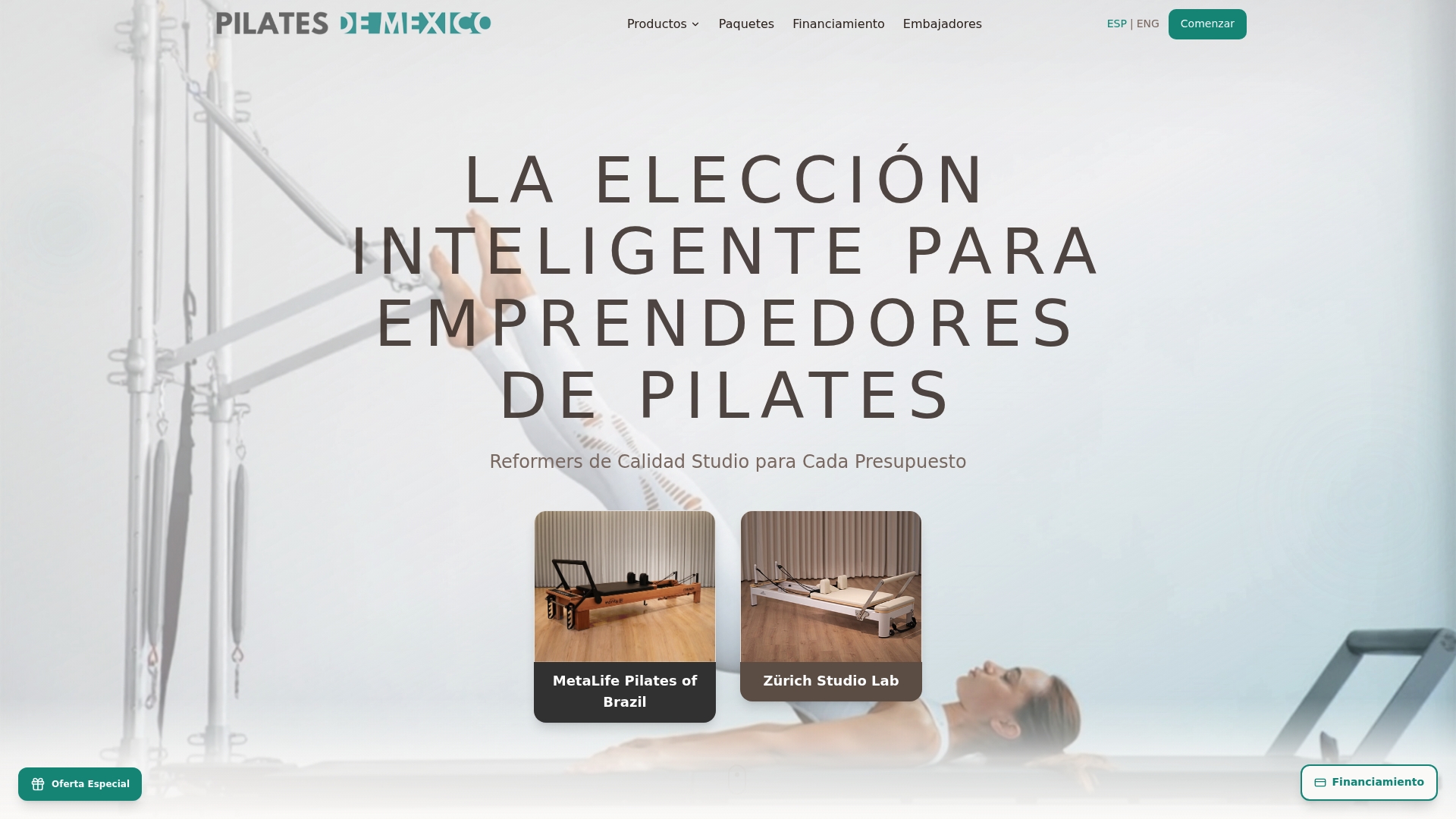
Explore our Infinity and Advanced lines, our accessories, and our financing options. If you want to learn how to scale using structured, manageable debt first, check out our guide to studio expansion financing.
Frequently asked questions
Can I buy gym and fitness equipment on credit?
Yes. You can use commercial bank loans, government-backed development programs (like NAFIN), operating or capital leases, or direct vendor financing. Each option impacts your monthly payment, total interest cost, and who ultimately retains ownership of the equipment at the end of the term.
How much money do you need to open a gym in Mexico?
It depends on the format. A 2025 estimate places the equipment for a boutique studio between $200,000 and $500,000 MXN, and between $400,000 and $1,000,000 MXN for a traditional gym. Added to that are commercial space leasing, remodeling, permits, and working capital.
What do I need to get approved for financing?
Typically, your RFC and tax status certificate (Constancia de Situación Fiscal), official ID, proof of address, bank statements, and, if you are an entity (persona moral), the articles of incorporation and powers of attorney. Many institutions check your credit bureau history and may request a guarantor or collateral.
Is it better to lease or buy equipment on credit?
Leasing reduces your initial cash outlay and allows you to upgrade equipment, but you don't build equity in an asset. Buying on credit, or through a capital lease (financial leasing), ends with the equipment belonging to your studio and holding resale value. For durable equipment like a reformer, purchasing usually gives you more control over long-term costs.
Sources
- NAFIN: Your First Credit
- NAFIN: Impulso Nafin + States
- Revista Flow: Investing in the Fitness Industry, Costs and Financing Options in Mexico