When and How to Expand Your Pilates Studio Without Risking Operations

When and How to Expand Your Pilates Studio Without Jeopardizing Operations
If your average occupancy during peak hours exceeds 75% and you have a consistent waiting list, expand capacity at your current location. If that demand comes from a different geographical area, consider opening a second unit. Before making any commitments, gather three months of occupancy data and prepare a realistic budget: expanding a Pilates studio without this foundation is the most common way to lose liquidity in the first year.
In summary:
- Expansion at the current location is recommended only if peak hour occupancy exceeds 75% for at least eight consecutive weeks, with solid data to support it.
- Opening a second unit only makes sense if demand comes from a different area, the current location is congested, or you seek to diversify risks.
- The total investment to expand a Pilates studio, including equipment, construction, and permits, varies by size and type of equipment but always requires a detailed budget and a margin for contingencies.
- It is crucial to measure the relationship between customer lifetime value and acquisition cost, which should be greater than 3 to 1 before investing in expansion.
- Careful planning of space and equipment, as well as a metric monitoring system, prevents underutilization and ensures profitable and sustained expansion.
Table of Contents
- Indicators and metrics that prove it's time to expand
- Expansion models: expand the current location or open a new one?
- Costs and financing: detailed budget for expansion without surprises
- Design and operations: space and flow to scale without losing quality
- Human resources: how to hire and train instructors for expansion
- Actionable marketing to fill schedules and convert trials into members
- Retention and metrics: what to monitor after expanding
- Expert perspective: common mistakes when expanding
- Equip your expansion with real support, not just machines
- Sources
- Frequently asked questions
Indicators and metrics that prove it's time to expand
Numbers, not intuition, should decide when to open a new Pilates studio or simply add equipment. A studio with solid data knows how to distinguish between a streak of good weeks and a real demand trend.
The threshold used by industry consultants is clear: when peak hour occupancy (generally from 6 to 9 AM and 6 to 9 PM) remains above 75% for at least eight consecutive weeks, the studio is leaving money on the table.
The waiting list is the second sign, but it needs to be measured carefully. It's not enough to count how many people sign up; you need to see how many of those failed reservations later convert into clients when a spot opens up. If a significant percentage of your waiting list ends up enrolling when there's availability, the repressed demand is real and sustained, not incidental.
The third filter is financial: the client lifetime value (LTV) to customer acquisition cost (CAC) ratio must exceed 3 to 1 before committing capital to expansion. If your current operating margin is tight, adding capacity without addressing that foundation only multiplies the problem.
To gather this data without relying on scattered spreadsheets, it's advisable to use a reservation management system that automatically reports:
- Occupancy by schedule and by instructor for at least three months.
- Conversion rate from trial class to membership.
- Waiting list volume and behavior.
- Net margin per room and per class, not just gross revenue.
Expansion Models: Expanding the Current Location or Opening a New One?
The decision between adding equipment to the same location or opening another unit depends less on the desire to grow and more on where the unmet demand truly lies.
- Expanding the current studio requires less initial investment because you leverage existing rent, administrative staff, and established brand reputation. This is the option recommended by most expansion guides: piloting with additional equipment before incurring the costs of a second location reduces the risk of failure linked to unverified demand, according to an analysis of Pilates studio expansion.
- Opening a new unit makes sense when demand comes from a different geographic area, when your current location is already at its physical space limit, or when you want to diversify the risk of depending on a single location and a single lease agreement.
- The risks change in nature depending on the route. Expanding in the same location can lead to underutilization if you misjudged the real demand. Opening another location doubles fixed costs (rent, permits, administrative payroll) and adds the challenge of managing remote teams without losing consistency in class quality.
To decide with numbers, calculate the break-even point for both routes. An additional reformer in your current studio usually recovers its investment with the occupancy of two or three new slots per week. A second location, however, needs to cover rent, full payroll, and equipment from the first month, so the break-even point is measured in months of operation, not isolated time slots. Planning the space, equipment selection, and flow before deciding is what separates an organized expansion from an improvised one.
Costs and Funding: Itemized Budget for Expansion Without Surprises
An expansion budget is built line by line, not as an optimistic global figure. These are the items you cannot skip:
- Equipment (reformers): the most visible item and what defines your studio's actual capacity.
- Construction and space adaptation: impact-resistant flooring, reinforced electrical installation, ventilation.
- Furniture and changing rooms: lockers, benches, mirrors, reception area.
- Permits and licenses: land use, civil protection, in some cases a health license.
- Working capital: at least three months of fixed expenses while the new capacity fills up.
Professional tip: allocate an additional margin for construction contingencies. This is the item that is almost always underestimated, and guides for sustained expansion in the sector repeat it as the most common mistake among those who grow without financial margin, according to Negócio Pilates.
For a reformer studio with six to eight pieces of equipment, the space reference is around 80 to 120 square meters, and the final investment varies greatly depending on the location, the type of equipment chosen, and the scope of the construction. A mat studio, without machines, drastically reduces the equipment budget but relies more on floor design and acoustics to justify the same price per class.
There are hidden costs that rarely appear in the initial budget: the electricity consumption of climate control systems in enclosed rooms, acoustic treatment between rooms when running several classes simultaneously, and liability insurance covering injuries during sessions. The total cost of ownership of a reformer doesn't end with the purchase: it includes annual maintenance, spare parts, and eventual transport if you change locations, and it should be incorporated into the cash flow from the first calculation, not after the first breakdown.
This is where the choice of equipment provider weighs more than it seems. Investing in durable reformers with local technical support, like those offered by Pilates de México for your studio equipment, reduces operational downtime that inexpensive equipment without warranty can cause under intensive use. Direct financing for equipment allows you to accelerate opening without compromising the operational liquidity you need for the first few months of the new capacity.
Design and Operations: Space and Flow for Scaling Without Losing Quality
Poorly calculated layout is the silent reason why a seemingly successful expansion on paper ends with uncomfortable clients and constant class delays.
This margin allows the instructor to circulate safely and the client to get on and off the equipment without bumping into the person next to them. Under-sizing the room reduces effective occupancy, even if the number of machines on paper seems sufficient.
Points to check before opening the expanded room:
- Minimum circulation space of 90 centimeters (35 inches) between reformers for instructor passage.
- Transition zone between classes (five to ten minutes) for cleaning and student changeover without accumulating people at reception.
- Cross-ventilation or air conditioning sized for the heat generated by a full group in motion.
- Flooring with adequate cushioning to reduce impact noise between floors or adjacent rooms.
- Adjustable lighting, warmer for relaxation and more intense for strength exercises.
Pro tip: before opening, run a full pilot class with the maximum anticipated capacity. It's the only way to detect real bottlenecks in changing rooms and reception before your clients do.
Human Team: How to Hire and Train Instructors for Expansion
Growing in space without growing in trained talent is the fastest way to dilute the quality you've built.
Some studios opt for fixed salaries for senior instructors who also take on coordination tasks.
A basic onboarding program should cover:
- Familiarization with your studio's specific equipment (not all reformers adjust the same way).
- Shadowing a senior instructor for at least two weeks before taking their own classes.
- Quarterly continuous training in exercise variations and common injury management.
- Tracking indicators: student retention rate per instructor and punctuality of schedules.
To structure this process from scratch, Pilates de México's instructor hiring guide details profiles and payment schemes applicable to growing studios.
Actionable Marketing to Fill Schedules and Convert Trials into Members
Filling new capacity doesn't happen on its own, and generic marketing rarely works in a business where experience and trust are the real product.
- Design an introductory offer with a clear limit: a package of three to five classes at a reduced price, with an expiration date, creates real urgency without devaluing the full service.
- Prioritize Instagram and partnerships with health professionals (physical therapists, chiropractors, nutritionists) as acquisition channels. Marketing guides for premium studios confirm that these partnerships and visual content generate higher quality referrals than generic advertising.
- Activate referral programs and thematic workshops (posture, rehabilitation, pregnancy) as a constant source of new clients without relying solely on paid ads.
- Measure the cost of acquisition per channel, not just the total. If Instagram costs you half per converted client than local ads, redistribute your budget without fear of diversifying less.
Studios that offer a high level of personalization in their programs achieve retention rates of between 80% and 85% at twelve months, compared to 60% and 65% for those offering generic classes without individual follow-up. That gap alone justifies investing time in designing customized programs before spending more on advertising.
Retention and Metrics: What to Monitor After Expanding
Expanding without a monitoring system is like opening a second kitchen without checking if the first one was profitable. The essential indicators you should review every week are:
- Occupancy per schedule and per room, not just the overall studio average.
- Monthly cancellation or churn rate, ideally below 5%.
- Average revenue per student (ARPU) and its quarterly evolution.
- Real net margin after payroll, rent, and equipment maintenance.
Report these numbers monthly to the administrative team and check for red flags: sustained drop in occupancy at the original location, increased cancellations after expansion, or a net margin that shrinks despite more clients. If two of these signs appear together, pause any new investment until the cause is corrected. Personalizing each student's follow-up and conducting periodic progress evaluations remains the most effective lever for sustaining the retention that justified the expansion in the first place.
Expert perspective: common expansion mistakes
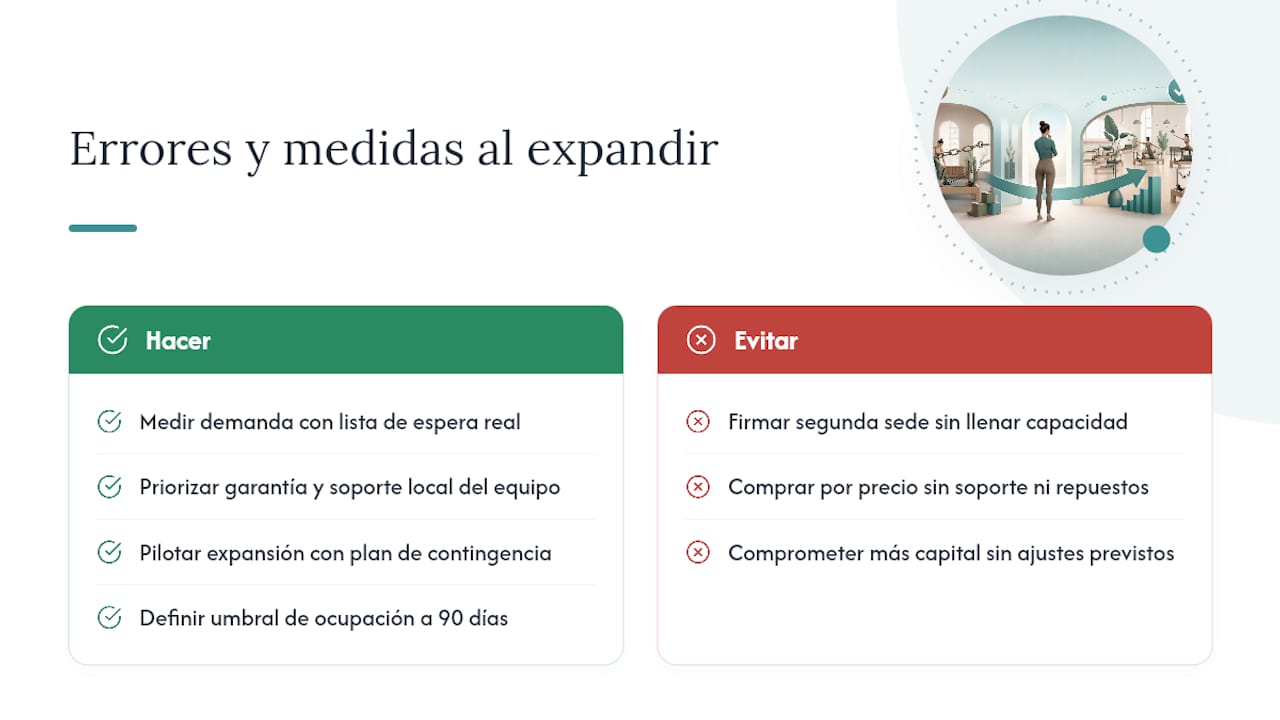
The most common mistake I see repeating is not about money, it's about sequence: studios signing a second location before having fully filled the capacity they already had. The demand seems to exist in the owner's mind, but it was never measured with real waiting list data.
The second mistake is buying equipment based on price instead of support. A cheap reformer without warranty or locally available parts can save money in the first year and cost double in operational downtime in the second. I recommend piloting any expansion with a clear contingency plan: if occupancy does not reach the expected threshold in ninety days, what do you adjust before committing more capital? Anyone who doesn't have an answer to that question is not ready to grow yet.
Equip your expansion with real support, not just machines
The most underestimated part of expansion is getting reliable equipment without compromising the working capital needed to fill the new capacity. There are leading lines of reformers built with certified wood and stainless steel hardware designed for years of daily classes without stopping for maintenance.
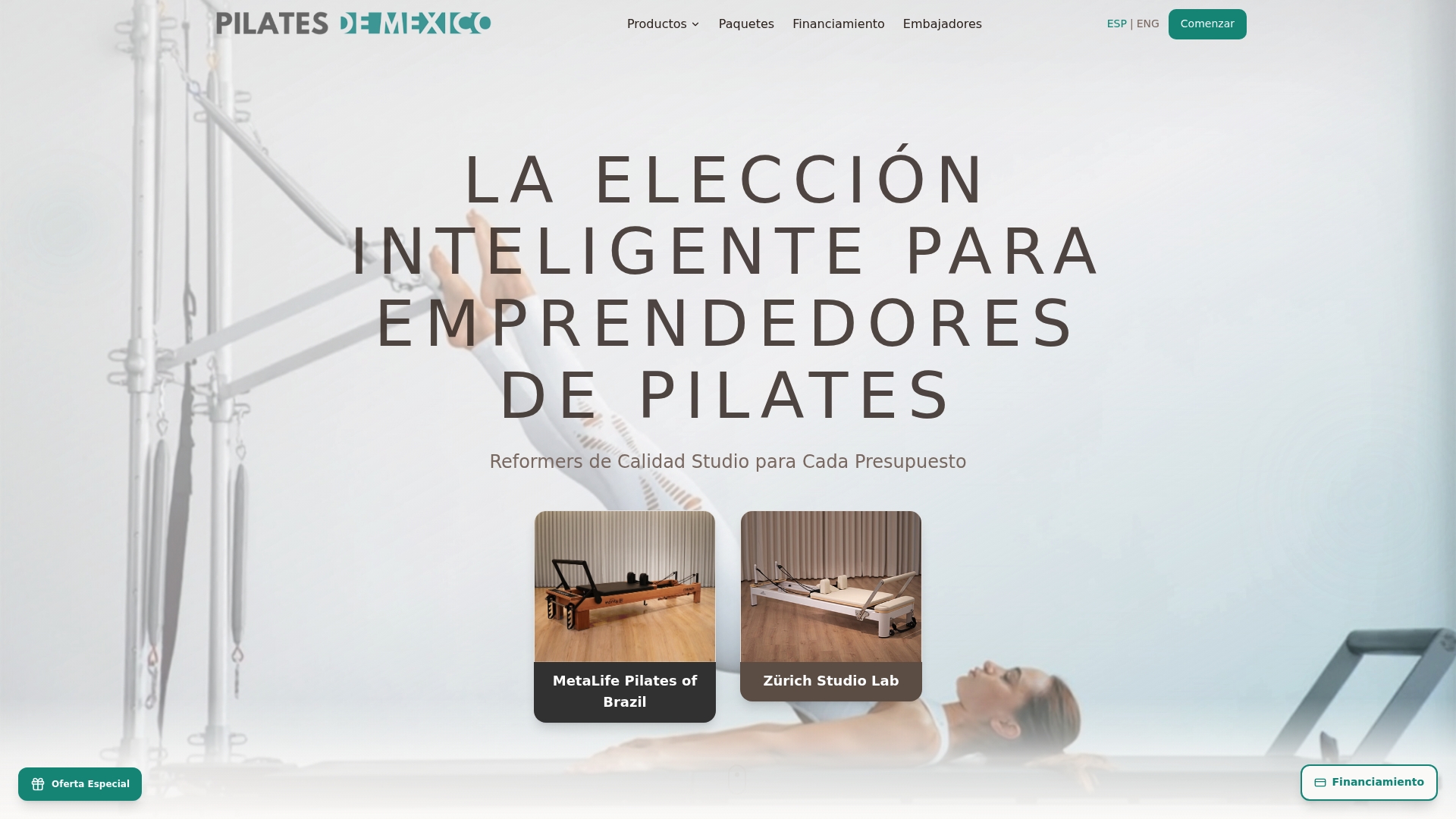
We also offer more accessible options for those who prefer to start without going directly to the premium line, as well as complete studio packages that include various equipment configured for your space. Each purchase comes with direct financing and consulting from a team that understands the true cost of opening and filling a room, not just the cost of the reformer. If you are evaluating a second location or adding equipment to your current room, schedule a consultation to receive a quote adjusted to your square footage and your real budget, not a generic table.
Sources
To delve deeper into the figures and recommendations in this guide, it is advisable to directly review the sources that support them. The cost guide for opening a studio in Mexico details items and space ranges per number of reformers. The analysis on planning before expanding explains why flow and capacity must be decided before the lease agreement. And the note on infrastructure and safety in expansion delves into the real cost of maintaining equipment during intensive use.
- Opening a Pilates studio in Mexico: Costs and key points
- How to expand your Pilates studio safely
- Marketing for Pilates Studios: Attract Premium Clients Who Stay | Pilotium Blog
Frequently Asked Questions
Is it profitable to open a Pilates studio?
Profitability depends more on schedule management and retention than on the size of the studio.
How much does it cost to open a Pilates studio?
The range depends on whether it's a mat or reformer studio, but for a room with six to eight reformers in 80 to 120 square meters, the investment includes equipment, construction, furniture, permits, and at least three months of working capital as a cushion.
What should a Pilates studio have?
Enough space per reformer (with at least 90 centimeters of circulation margin), impact-absorbing flooring, adequate ventilation, functional changing rooms, and a reservation system that reports occupancy and waiting list in real-time.
When is it better to expand a Pilates studio instead of opening a new one?
It is advisable to expand the current location when unsatisfied demand comes from the same neighborhood or area of influence; opening a second unit only makes sense when that demand is in a clearly distinct geographical location.