The Ladder Barrel: Uses, Benefits, and Exercises by Level
The Ladder Barrel: uses, benefits, and exercises by level
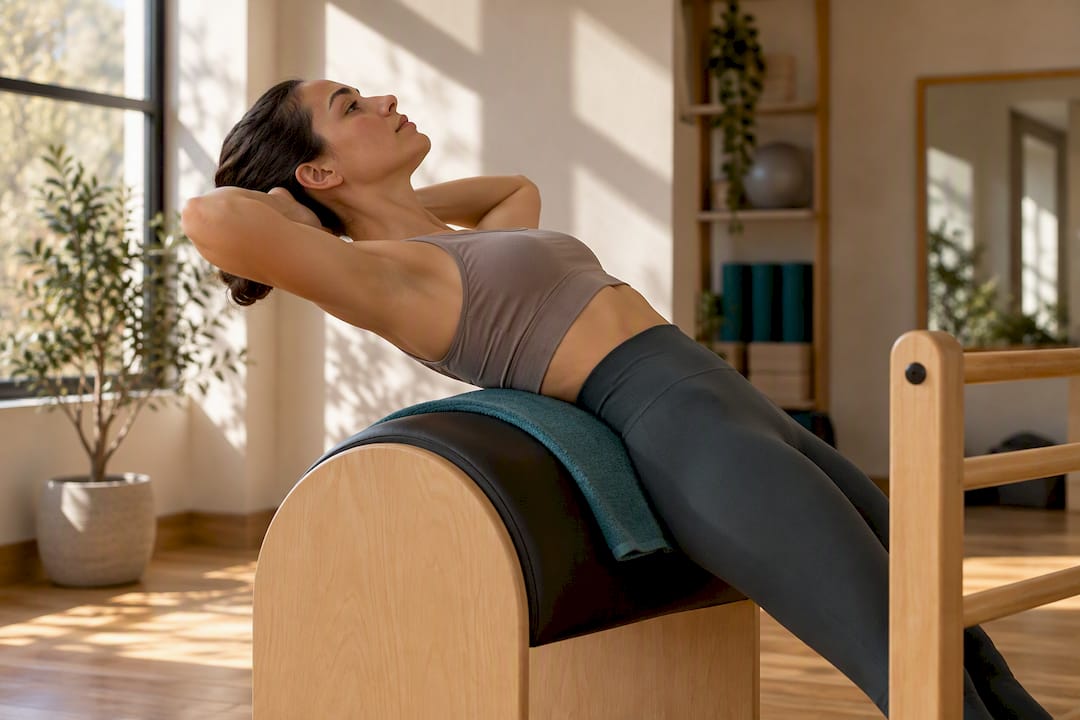
The Ladder Barrel is a curved apparatus designed to mobilize the spine, open the chest, and work on flexibility alongside core control. Its structure combines an inclined barrel with a ladder of rungs that serves as an anchor for legs and hands. Instructors and practitioners with some experience use it to prepare the body before more demanding exercises on the Reformer, and to correct kyphotic postures or rounded shoulders.
In summary:
- The Ladder Barrel promotes thoracic mobility and chest opening, working on core control in movement and avoiding over-stressing the lumbar area.
- Exercises progress from basic postural control for beginners to advanced movements that combine dynamic transitions, with an emphasis on alignment and breathing.
- Correct adaptation of the apparatus requires adjusting the distance between the barrel and rungs according to leg length and ensuring pelvic neutrality in the starting position.
- It is recommended to introduce the Ladder Barrel after verifying pelvic control on the mat and to avoid its use in cases of advanced osteoporosis, recent surgery, severe pain, or advanced pregnancy.
- The choice between Ladder Barrel, Spine Corrector, and Arc depends on size, space, and objective, with the Ladder Barrel being more complete for comprehensive work in equipped studios.
Table of Contents
- What it's for: benefits and training objectives
- Exercises by level: practical examples and execution criteria
- How to adjust and use the Ladder Barrel: setup, rungs, and safety
- Didactic progression: introducing the Ladder Barrel in a 4-session plan
- Practical differences between Ladder Barrel, Spine Corrector, and Arc
- Availability and professional purchase considerations
- Expert perspective on teaching with the Ladder Barrel
- How to acquire the Infinity Ladder Barrel for your studio
- Sources
- Frequently Asked Questions
What it's for: benefits and training objectives
The barrel's curve supports the back in a progressive extension, which allows for working on thoracic mobility without compromising the lumbar area. This support is the key difference compared to stretching on the floor. The body rests on a surface that guides the arch, rather than forcing it.
The chest and shoulder opening achieved on the barrel has direct application for dancers and swimmers, who need thoracic range for specific technical movements. The stretching of the posterior chain (hamstrings, glutes, lumbar fascia) is worked from seated or standing positions on the rungs, with a clear objective in each variation: release tension without losing pelvic neutrality.
The core comes into play differently than it does on the mat: here it stabilizes in movement, not statically. This requires finer control of breath and abdominal support.
Profiles that benefit most include:
- Dancers and athletes who need specific joint range for their discipline.
- People with hyperkyphosis or prolonged sedentary work.
- Students in postoperative spinal rehabilitation, always with medical authorization.
- Instructors in training looking to master transitions before teaching them on the Reformer.
Pro Tip: Before asking for a full extension, check that the student can maintain a neutral pelvis in the starting position. If they compensate with the lumbar area, reduce the range before progressing.
Exercises by Level: Practical Examples and Execution Criteria
Progression on the Ladder Barrel relies less on brute strength and more on postural control. Each level introduces a new component: range, instability, or weight transfer.
-
Beginner
- Stretch over the barrel: the student sits with the lumbar area supported on the edge of the barrel and lets the torso fall back with arms extended. Key cue: exhale on the way down, without blocking the neck.
- Side stretch: sitting sideways on the barrel, the torso leans laterally, holding a rung. This works the lateral line without rotation.
- Modified hip rolls: with feet on the first rung, hips are lifted and lowered with lumbar control. Objective: activate the core without using leg momentum.
-
Intermediate
- Assisted Swan: facedown on the barrel, with hands on the rungs, the torso lifts in controlled extension. The barrel reduces the lumbar load that the mat version would have.
- Teaser on the barrel: sitting with the lumbar curve supported, legs and torso extend into a "V" shape. Requires coordination between deep core and hip flexors.
- Climbing legs: standing in front of the barrel, legs alternate climbing the rungs while the torso remains stable. Works balance and unilateral strength.
-
Advanced
- Dynamic extensions that combine swan with a direct transition to pulling straps on the Reformer, leveraging the movement memory generated on the barrel.
- Teaser transfers to the Cadillac or Reformer, using the same abdominal activation pattern but without the support of the curve.
To measure true control, observe three things: the number of clean repetitions before compensation appears, shoulder-to-hip alignment, and whether the student maintains fluid breathing or holds it. A student who holds their breath is almost always compensating with accessory tension, not functional strength.
How to Adjust and Use the Ladder Barrel: Setup, Rungs, and Safety
Correct adjustment begins with the distance between the barrel and the ladder, which should be adapted to the student's leg length. Longer legs require greater separation for the foot to reach the rung without straining the hip.
In a seated position, the lumbar area should rest on the highest point of the curve, never on the sacrum. When kneeling, the rungs act as a traction point to work hip extension with a stable torso. Facedown, hands adjust to the rung that allows elbows to be slightly flexed, avoiding wrist hyperextension.
Contraindications to watch out for:
- Advanced osteoporosis: avoid deep spinal flexion and impact loads.
- Recent spinal or hip surgery: requires medical authorization before any extension.
- Acute or radiating pain: refer for medical evaluation instead of modifying the exercise.
- Advanced pregnancy: avoid facedown positions and adjust abdominal pressure.
In group classes, it's reasonable to have one student per apparatus and clear turns when the studio has few units. Hygiene matters more than it seems: asking for a personal mat for direct skin contact reduces friction and keeps the equipment in better condition.
Pro Tip: If a new student cannot maintain a neutral pelvis seated on the barrel without support, start with mat exercises that reinforce this awareness before putting them on the apparatus.
Instructional Progression: Introducing the Ladder Barrel in a 4-Session Plan
Before introducing the Barrel, the student must demonstrate basic pelvic control on the mat and tolerance for prolonged supine position.
- Session 1: familiarization with the curve. Stretch over the barrel and side stretch, without aiming for maximum range.
- Session 2: modified hip rolls are added, and leg rungs work is introduced.
- Session 3: assisted swan with close supervision, evaluating lumbar control in extension.
- Session 4: teaser on the barrel and initial transfer of patterns to Reformer or mat.
If the student compensates with cervical tension or loses their breath, go back one session before advancing.
Practical Differences Between Ladder Barrel, Spine Corrector, and Arc
The Ladder Barrel is noticeably larger and designed for full-body work, while the Spine Corrector and Arc are almost always limited to spinal mobility in more compact formats.
- Ladder Barrel: ideal for equipped studios, comprehensive flexibility and strength training, and transition to Reformer.
- Spine Corrector: smaller, useful for specific mobility in reduced spaces or home practice.
- Arc: even more compact version, a good option when budget or space does not allow for a full Barrel.
An equipped studio benefits from the range offered by the Ladder Barrel; a home practice often finds many of those same benefits in the Arc or Spine Corrector without the same physical footprint.
Availability and Professional Purchase Considerations
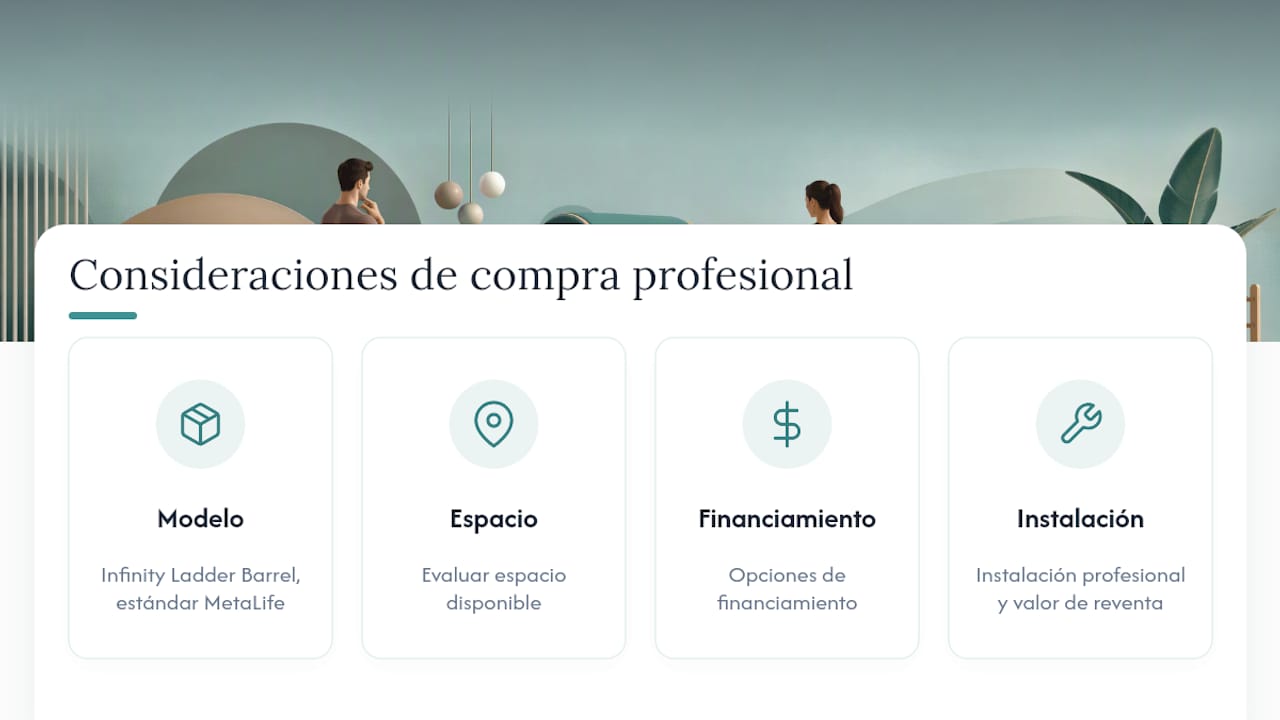
For studios looking to equip this piece, the Infinity Line includes the Infinity Ladder Barrel, manufactured under the MetaLife standard. Before purchasing, it's worth evaluating available space, financing options, and professional installation, as well as the medium-term resale value. This process can be accompanied by advisory services for studios in expansion or opening.
Expert Perspective on Teaching with the Ladder Barrel
The Ladder Barrel is not a show-off apparatus: it is a transitional tool that quickly reveals if a student compensates instead of controlling. Its real value lies in preparing the body for exercises that would be risky on the Reformer without this foundation. Each progression must adapt to individual anatomy, never to a rigid script. It's worth trying it first in private classes and seeking specific training before taking it to large groups.
How to Acquire the Infinity Ladder Barrel for Your Studio
If you've decided to incorporate a Ladder Barrel into your studio, there's a direct route compared to generic intermediaries: local warranty, professional installation, and advisory for the process of opening and filling a studio.
The Infinity Ladder Barrel product sheet includes specifications and the option to request a direct quote. If you are equipping a full studio, the studio packages combine the Ladder Barrel with Reformers to maximize your investment, and financing allows you to stagger payments without delaying your opening. Also explore the Infinity Line and Advanced Line if you want to compare options before deciding. Write today to request your quote and schedule installation with included local support.
Frequently Asked Questions
What are the main benefits of the Pilates barrel?
The barrel, or Ladder Barrel, improves thoracic mobility and chest opening, stretches the posterior chain, and strengthens the core through stability in movement. It also serves as a pedagogical bridge to more challenging exercises on the Reformer.
How many days a week is it recommended to practice on the barrel?
Several weekly sessions are usually enough to gain mobility and control without accumulating spinal fatigue. The ideal frequency depends on the student's level and whether they combine the Barrel with Reformer or mat in the same week.
What Reformer exercises complement the Ladder Barrel well?
Exercises like pulling straps, back extensions, and teaser on the Reformer directly transfer the activation pattern first trained on the Barrel. This is why many instructors use it as preparation before taking those movements to the Reformer.
What is the difference between the Ladder Barrel and the Arc in daily practice?
The Ladder Barrel offers a wider range of full-body work thanks to its size and rungs, while the Arc is more compact and limited to specific spinal mobility. The choice depends on the available space and the class objective.
Where can I buy a Ladder Barrel for my studio?
Pilatesdemexico distributes the Infinity Ladder Barrel within its Infinity Line, with a product sheet and direct quote option. Current prices are available on the site, along with financing options for new or expanding studios.