Secure Your Pilates Studio (Mexico): 2,000,000 MXN, SAT, and Equipment

Insure Your Pilates Studio (Mexico): MXN 2,000,000, SAT and Equipment
To operate a Pilates studio in Mexico, you need at least a civil liability policy with a recommended coverage of MXN $2,000,000, plus multi-risk if you have expensive equipment, and employer's liability (RC patronal) if you hire staff. The annual cost typically varies depending on the size and services. The next step is to get a quote from a brokerage specializing in fitness, and confirm the land use of your premises before signing any lease agreement.
In summary:
- It is essential to have a civil liability policy with a minimum coverage of 2 million pesos and to consider including multi-risk and employer's liability (RC patronal) if staff are hired.
- The validity of the insurance depends on municipal permits, SAT registration, IMSS registration, and operating licenses, making it crucial to verify land use before leasing.
- The annual cost of comprehensive insurance ranges between 8,000 and 20,000 pesos, depending on the studio's size, insured equipment, and chosen coverage, in addition to initial administrative procedures.
- Before signing, it is key to ask about coverage limits, exclusions, covered equipment value, and medical network, as well as keeping equipment documentation and permits up to date.
- Proper documentation of equipment, including invoices, serial numbers, and maintenance records, along with prior planning, ensures effective protection without surprises when making a claim.
Table of Contents
- Types of Insurance for Pilates Studios and What Each Covers
- What Legal Procedures Affect the Validity of Insurance in Mexico?
- How Much Does Pilates Studio Insurance Cost Per Year?
- What to Ask the Broker Before Signing the Policy?
- How to Insure Reformers and High-Value Equipment Without Surprises
- Checklist for Opening with the Right Coverage from Day One
- Resources for Quoting Insurance and Completing Procedures in Mexico
- What Most New Studios Underestimate About Insurance
- Equip Your Studio with Documentary Support Ready for the Insurer
- Sources
Types of Insurance for Pilates Studios and What Each Covers
A comprehensive Pilates studio insurance isn't a single policy, but rather a package of coverages that address different risks. Understanding what each protects prevents surprises when it's time to make a claim.
- Civil Liability for Operations (Responsabilidad civil de explotación): Covers injuries to clients during classes, such as a fall from a reformer or a sprain from a poorly supervised exercise.
- Multi-risk (Multirriesgo): Protects the premises and its contents against fire, flood, violent theft, or damage from natural phenomena.
- Client Accident Insurance (Seguro de accidentes para clientes): Complements civil liability by covering direct medical expenses for the student, without the need to prove studio negligence.
- Employer's Liability (RC patronal): Responds to work accidents involving instructors and administrative staff, virtually mandatory if you have registered employees.
- Equipment and Inventory Insurance (Seguro de equipo e inventario): Covers reformers, chairs, towers, and accessories against theft, accidental damage, or total loss.
Each policy responds to a specific scenario. If a client injures their back due to poor posture on a reformer, operational civil liability comes into play. If two reformers are stolen one night, it's the equipment insurance that pays for their replacement. If an electrical fire damages the floor and walls, multi-risk covers the reconstruction.
Insurers frequently exclude injuries resulting from proven deficient maintenance, activities outside the service contract (e.g., undeclared private classes), or intentional damage. They also limit coverage when equipment lacks documented periodic review, something many owners only discover when they need to make a claim.
What Legal Procedures Affect the Validity of Insurance in Mexico?
A Pilates studio insurance policy is only as valid as the documents supporting it. An insurer can deny payment if the studio was operating without the proper permits, regardless of how much you paid in premiums.
- Registration with SAT under the business activities regime. Without this tax registration, no serious insurer will issue a commercial policy in your name.
- Municipal operating license and land use verification. Fitness studios are usually classified as low-risk establishments, which speeds up the process compared to industrial or higher-risk businesses.
- Operating notice to COFEPRIS when required by the municipality, generally linked to the low sanitary risk classification of the business.
- IMSS registration of instructors if you have directly employed staff. This step reduces your exposure as an employer and is often an implicit condition for employer liability insurance to operate smoothly.
Verifying land use before signing the lease avoids one of the most common problems: signing a contract for premises that do not permit a fitness business, which can lead to closure and, with it, the automatic invalidation of any active policy. Review the practical guide to opening a Pilates studio before proceeding with any paperwork.
How much does Pilates studio insurance cost per year?
Pro tip: always ask for a breakdown of the premium by coverage, not just the total. This way, you can identify which part of the cost corresponds to liability, which to equipment, and which to personnel, and you can negotiate each line separately.
The annual cost range for comprehensive Pilates studio insurance is between $8,000 and $20,000 MXN, but that number varies according to several concrete factors: the location of the premises (areas with higher claims pay more), the number of clients served per week, the total value of the insured equipment, and your previous claims history.
Coverage limits, sub-limits for individual equipment, and the deductibles you accept also change the final price. A higher deductible reduces the monthly premium but means you pay out of pocket for the initial pesos of any small claim.
A small studio with two or three reformers and one instructor usually falls at the lower end of the range. A boutique studio with six or more high-end reformers, employed staff, and high client traffic tends to approach or exceed the upper limit. In addition to insurance, it's advisable to budget between $30,000 and $70,000 MXN for initial administrative procedures like licenses and permits. You can review a complete breakdown of costs to open a Pilates studio to plan your total budget.
What to ask your broker before signing the policy?
Choosing wisely doesn't just depend on price. It depends on asking the right questions before signing, because many exclusions are only discovered by reading the fine print or, worse, at the time of a claim.
- What is the coverage limit per claim and the annual aggregate limit?
- Are there exclusions by type of exercise or modality (Pilates with tower, with accessories, large group classes)?
- Is the equipment covered at replacement value or depreciated value?
- What deductible applies per claim and does it vary by type of incident?
- What medical network does the policy cover and how extensive is it in your city?
The insurer will ask for specific documentation: municipal license, a valued inventory of equipment, and contracts or proof of employment with your instructors. Having these ready speeds up the quote process and avoids weeks of delays.
Regarding payment methods, some insurtechs and sports sector brokers offer annual, monthly, or even per-event schemes, useful if you organize occasional workshops in addition to your regular operation. The monthly option suits newly opened studios with tight cash flow; the annual option is usually cheaper in absolute terms.
Be wary of policies with ambiguously worded exclusions, very low sub-limits per piece of equipment (common when you haven't declared the true value of your reformers), or brokers who cannot clearly explain which medical network applies in your area.
How to insure reformers and high-value equipment without surprises
A reformer is not an office chair. Its replacement value can easily exceed $40,000 or $50,000 MXN per unit, and insurers know this: that's why they ask for specific documentation before agreeing to cover it at its actual value.
- Keep the original invoice for each piece of equipment as proof of acquisition value.
- Request from the supplier the maintenance history and the serial number of each reformer, documents that the insurer often requires to process a claim.
- Ask for an estimate of the current replacement value, not just the purchase price, because import costs and exchange rates affect that number over time.
- Check if your policy requires documented periodic maintenance reviews as a condition for keeping coverage active.
Maintaining a preventive maintenance program with signed records reduces the likelihood of the insurer invoking "lack of care" to deny a payment. Additionally, when equipment is purchased with direct financing from the provider, it usually comes with a warranty and documentary support that makes it easier to justify its value to the insurer, a point many owners ignore until it's too late.
Checklist for opening with the correct coverage from day one
Order matters. Contracting insurance before having confirmed land use, or after receiving clients without valid general liability, are the two most costly recurring mistakes among new studios.
- Verify the land use of the premises with the municipality before signing the lease (1 to 2 weeks).
- Register the business with the SAT under the corresponding regime (1 week with your accountant).
- Create a valued inventory of all equipment, including invoices and serial numbers.
- Get quotes for general liability and multi-risk insurance from at least two different brokers (1 to 2 weeks for comparison).
- Register your instructors with the IMSS if you have directly employed staff.
- Formalize the policy and keep a digital and physical copy at the studio.
With these documents ready, the quote can be resolved in days, not weeks. Also, consult the guide for hiring instructors if you haven't yet defined your staff structure.
Resources for quoting insurance and completing procedures in Mexico
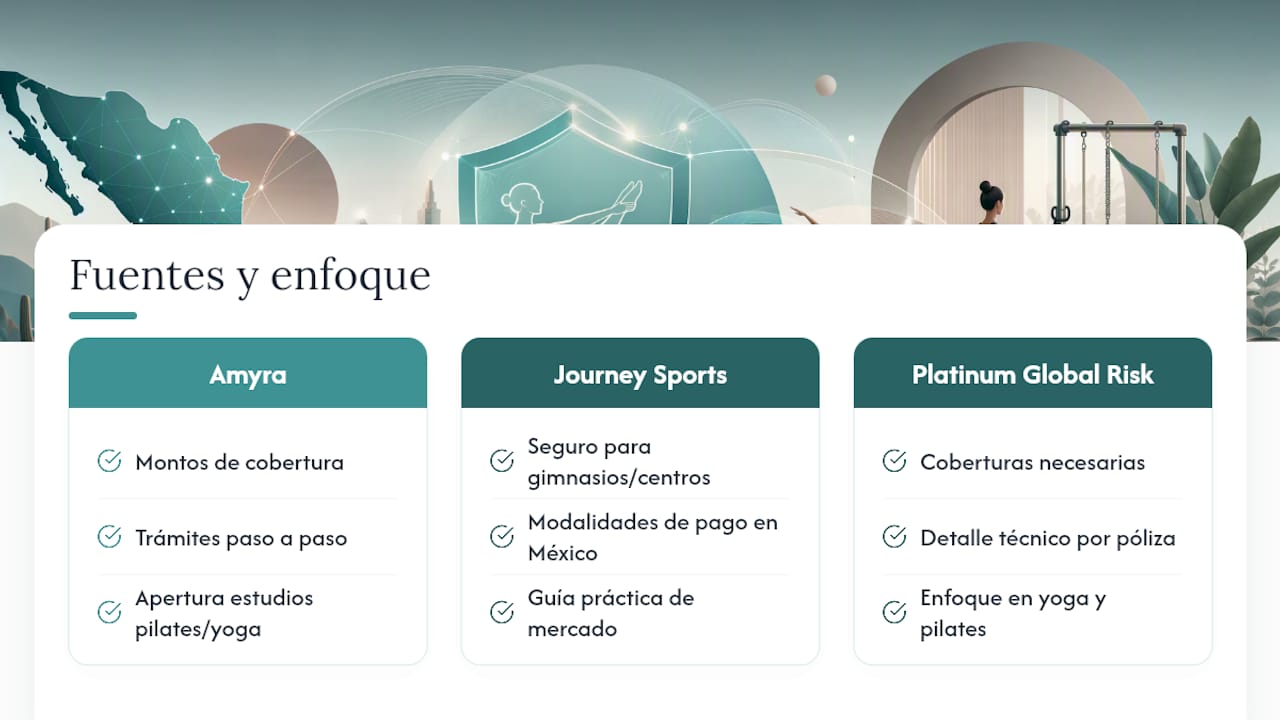
To compare figures and procedures with specialized sources, Amyra's guide on opening Pilates or yoga studios details coverage amounts and step-by-step procedures. Journey Sports explains in its guide on insurance for gyms and fitness centers the payment methods available in the Mexican market. Platinum Global Risk breaks down the necessary coverages for yoga and Pilates centers with more technical detail by policy type.
Always get quotes from at least two brokers or insurers before deciding. Differences in deductibles and sub-limits between offers are often greater than they appear at first glance, and instructor certification can also improve the conditions offered to you.
What most new studios underestimate about insurance
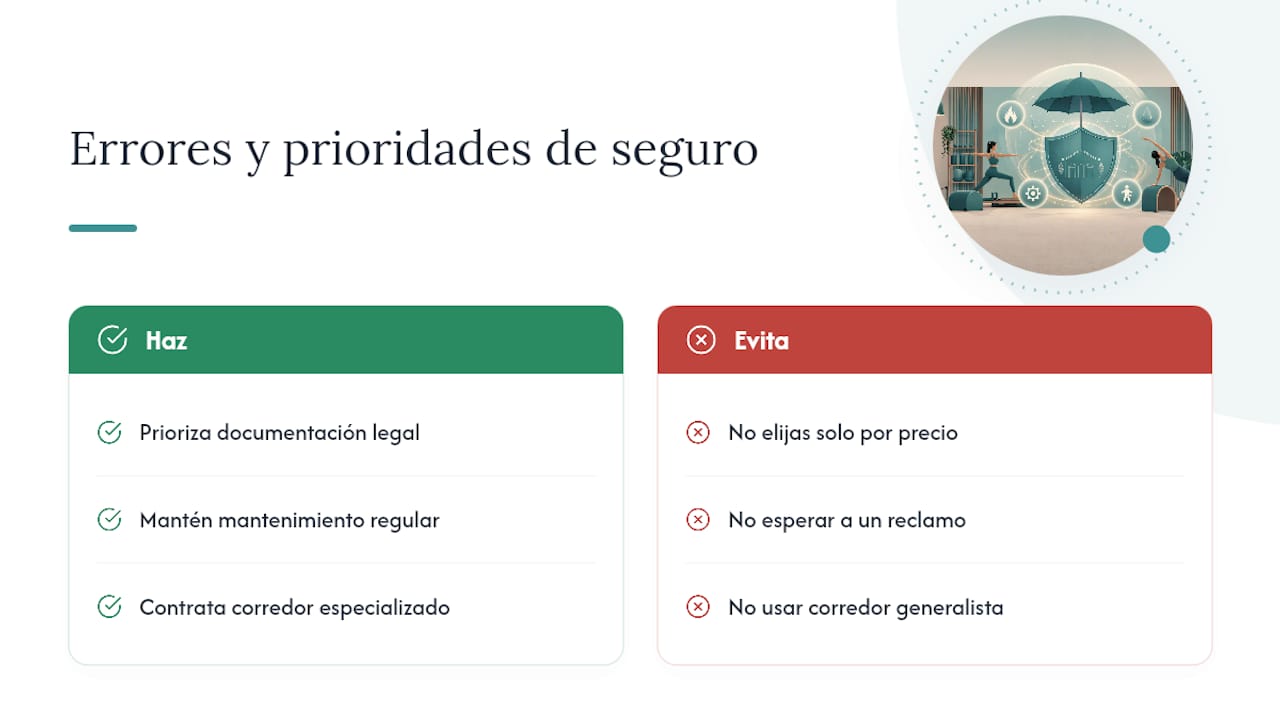
The real priority is not finding the cheapest policy, but having the legal documentation in order before any claim exists. An insurer doesn't review your permits until you need to collect, and that's the worst time to discover a loophole.
Regular equipment maintenance is also not a secondary expense: it reduces incidents and, over time, can lower your premium. Seeking a broker specialized in sports or fitness, instead of a generalist, makes a real difference in the quality of the exclusions you agree to sign. This specific industry knowledge is rarely held by an agent who sells policies for general businesses.
Equip your studio with documentation ready for the insurer
Having an equipment provider that facilitates the paperwork insurers require is key: each reformer should come with a formal invoice, serial number, and warranty support that you can present directly to the broker when valuing your equipment.
If you are about to open or expand your studio, our Pilates studio consulting helps you define what equipment you need according to your budget and how to document it correctly from the purchase. We work with direct financing and multi-equipment packages, so you don't have to resolve the entire investment all at once. Check out our catalog of professional reformers or visit Pilates de México to request an equipment quote and start preparing the documentation your insurance will ask for.
Sources
- Guide to opening a Pilates or yoga studio in Mexico - Amyra
- Insurance for gyms and fitness centers in Mexico - Journey Sports
- Necessary insurance for yoga or Pilates centers - Platinum Global Risk