Reformer with Tower: Technical Guide for Studios and Clinics
Reformer with Tower: Technical Guide for Studios and Clinics
The reformer with tower is the smartest purchase for a studio looking to maximize its repertoire without duplicating machinery. In the space of a conventional reformer, it adds most of the Cadillac work: traction, suspension, vertical push, and upper limb exercises that would otherwise require a separate trapeze table. If you are equipping a high-turnover class studio, managing a rehabilitation clinic, or opening your first studio and need every square meter to perform at its best, this is the equipment you should prioritize.
Three reasons to choose it over any other combination:
- Real space saving: a single unit covers two machines; the footprint in the room does not change compared to a standard reformer.
- Expanded repertoire: access more than 200 exercises, including most of the Cadillac catalog, without additional machinery investment.
- Faster return on investment: greater variety of classes (group, private, rehabilitation) with the same equipment means more revenue per installed unit.
Pilates de México distributes the MetaLife line (Infinity Reformer with Tower) with certification, spare parts availability, and direct financing options for studios. These three conditions—certification, spare parts, and financing—are exactly the quality signals you should demand from any provider.
Table of Contents
- What makes a reformer with tower different from having two separate machines?
- Technical sheet: specific specifications you should ask for before buying
- Wood, aluminum, or steel? How the material affects your decision
- How to choose the right model for your studio, clinic, or professional home use?
- What exercises can you do with the tower: examples by level
- Installation, required space, and preventive maintenance
- Where to see demos and get technical support before and after buying?
- Key points
- What we learn from equipping studios: why we recommend MetaLife
- Packages, financing, and demos: how to work with Pilates de México
- Technical sources and product pages to go deeper
What makes a reformer with tower different from having two separate machines?
A reformer with tower combines the sliding carriage of a classic reformer with a vertical tower equipped with pulleys, bars, and spring anchor points into a single structure. The result is a piece of equipment that simultaneously works in horizontal and vertical planes, something no reformer without a tower can offer on its own.
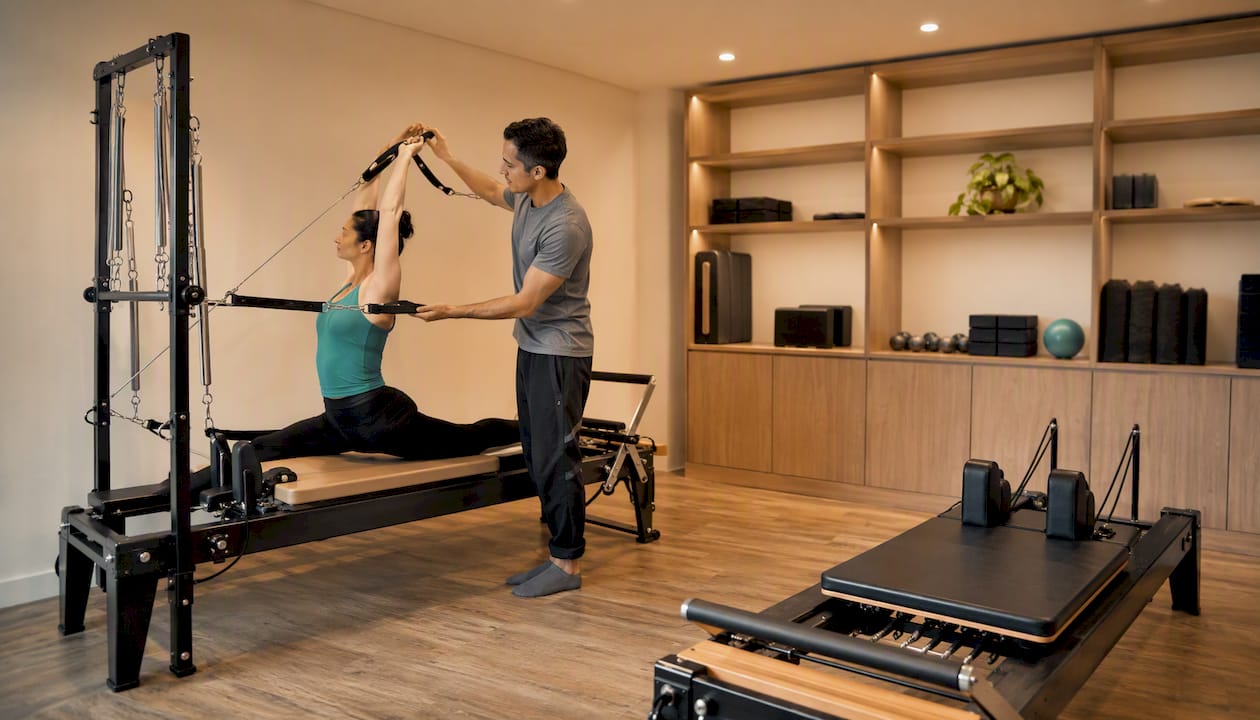
The tower extends movement in three directions that the standard reformer does not cover: traction from above (for back and shoulder work), vertical push (for posterior chain and core), and assisted suspension (for joint mobility and rehabilitation). This ability to adjust the angle of resistance is what makes the equipment a valid tool for both shoulder rehabilitation sessions and functional strength training with athletes.
Compared to having a reformer and a Cadillac separately, the advantage is not only economic. Studio logistics change: fewer pieces of equipment to move, less space between machines, less preparation time between classes. For studios with group classes of four to six people, this operational efficiency translates into more sessions per day.
Professional tip: If your studio has a low ceiling, check the tower height of the model before buying to ensure sufficient space above the top bar.
Technical sheet: specific specifications you should ask for before buying
Before signing any order, request the complete technical sheet for the model. Here's the data you should compare:
Dimensions and Footprint in the Room
| Specification | Typical Range in Professional Models |
|---|---|
| Overall length | typical professional dimensions, 236 cm long |
| Carriage width | common width in mid-range professional models |
| Width with footbar | can reach around one meter |
| Carriage height | adjustable in various ranges depending on model |
| Tower height | standard height that can approach two meters |
| Equipment weight | varies by material and model, with common professional ranges |
Reference dimensions come from professional models such as the Reformer Studio with tower, which measures 236 cm long and 69 cm wide, with carriage height options of 36, 46, or 61 cm and a tower of 202 cm.
Adjustment Specifications That Make a Difference
- Pulley positions on carriage: look for at least 5 positions; high-end models offer up to 7.
- Pulley positions on tower: professional models achieve 12 anchor positions, allowing the resistance angle to be adapted for each exercise.
- Footbar: minimum 4 height and angle positions.
- Carriage springs: 3 intensities (light, medium, strong) with the possibility of combining.
- Tower springs: complete set of long and short springs; long ones work lower limbs and short ones, upper.
- Headrest and shoulder rests: adjustable, with at least two positions each.
Materials and Upholstery
- Frame: certified wood (lyptus, maple, or solid oak) or aluminum with stainless steel hardware.
- Upholstery: high-density EVA, minimum 5 cm thick; check reinforced seams and moisture resistance.
- Anchor points: stainless steel on all spring hooks and pulleys.
Professional tip: Ask for the number of turns and the alloy of the springs. The quality of the spring set determines the fluidity of movement and the lifespan of the equipment; a low-alloy spring loses tension in less than a year with daily use.
Wood, Aluminum, or Steel? How Material Affects Your Decision
The choice of material is not just aesthetic. It affects maintenance, resale value, and the equipment's resistance under intensive use.
Certified wood (lyptus, maple, oak):
- Higher resale value and premium aesthetic, preferred in boutique studios.
- Requires humidity control: avoid direct exposure to steam or high humidity.
- FAS certified lyptus wood, such as that used by MetaLife, offers hardness comparable to oak with a lower environmental impact.
- Maintenance: clean with a dry or slightly damp cloth; maintenance oil every 6–12 months depending on the manufacturer.
Aluminum and metal frame:
- Lighter and more resistant to humidity; ideal for clinics with aggressive cleaning protocols.
- Lower perceived resale value, although structural durability is high.
- Stainless steel hardware in both options: it is essential to check this on the technical sheet, as galvanized steel rusts over time.
Prioritizing certified wood or stainless steel hardware in frames increases resale value and reduces wear in studios with high daily use. High-density EVA upholstery also improves durability and hygiene.
Professional tip: If your studio rotates between reformer and mat classes, choose a model whose tower is detachable or allows conversion to a mat without completely removing the tower. This feature speeds up changes between classes and eliminates the need for additional storage.
How to Choose the Right Model for Your Studio, Clinic, or Professional Home Use?
The decision process has two layers: the questions you should ask the seller and the technical criteria you should prioritize based on your volume of use.
Questions to Ask the Seller Before Buying
- What is the structural warranty, and how much does it cover springs and upholstery separately?
- Are spare parts available in Mexico, or does the waiting time exceed two weeks?
- Does the equipment have NOM certification or equivalent for commercial use?
- What does the installation service include, and is there local technical support?
- What are the actual delivery times, not the estimated ones on the website?
- Is there a financing option in installments for multi-unit orders?
Technical Criteria Based on Volume of Use
For a studio with more than four classes per machine per day, the robustness of the springs and the quality of the upholstery are the factors that most affect operating costs. A failing spring forces the equipment out of service; upholstery that deteriorates in less than two years generates replacement costs not included in the initial budget.
The purchase decision should include not only the initial price but also ease of maintenance and availability of spare parts for studios with high class frequency. Models with accessible spare parts reduce downtime and operating costs.
Warning signs to avoid: absence of detailed technical specifications, inability to confirm spare parts stock, warranty that doesn't specify what it covers, and a price significantly lower than the market without explanation of materials or origin.
For studios opening with a tight budget, Pilates de México offers both the premium MetaLife line and accessible professional options with direct financing, allowing you to equip your studio without compromising structural quality from day one.
What exercises can you do with the tower: examples by level
The tower doesn't duplicate the reformer; it completes it. These are the representative exercises it adds, organized by level:
Beginner level:
- Leg springs supine: hip and core work with long springs from the tower, ideal for joint mobility.
- Arm springs seated: shoulder opening and upper back strengthening with short springs.
- Roll-down with push-through bar: spinal control and assisted abdominal activation.
Intermediate level:
- Pulling straps with tower pulleys: bilateral traction for rhomboids and middle trapezius.
- Side splits with tower spring: adductor work and lateral pelvic stabilization.
- Teaser with pulley assistance: controlled progression towards free teaser.
Advanced level:
- Full Tower series: sequence of hip extension, spinal flexion, and suspended shoulder work.
- Long spine with tower pulleys: spinal decompression and eccentric hamstring strength.
- Push-through bar inversions: advanced thoracic mobility and shoulder strength work.
For rehabilitation, the versatility of the equipment depends on the ability to adjust pulleys and springs: this capability turns the reformer with tower into a valid tool for both shoulder recovery and functional training with athletes.
Professional tip: Use short springs for upper body exercises from the tower and long springs for hip and leg work. Combining a long and a short spring in parallel creates perfect intermediate resistance for rehabilitation progressions.
Installation, required space, and preventive maintenance
Space requirements per unit
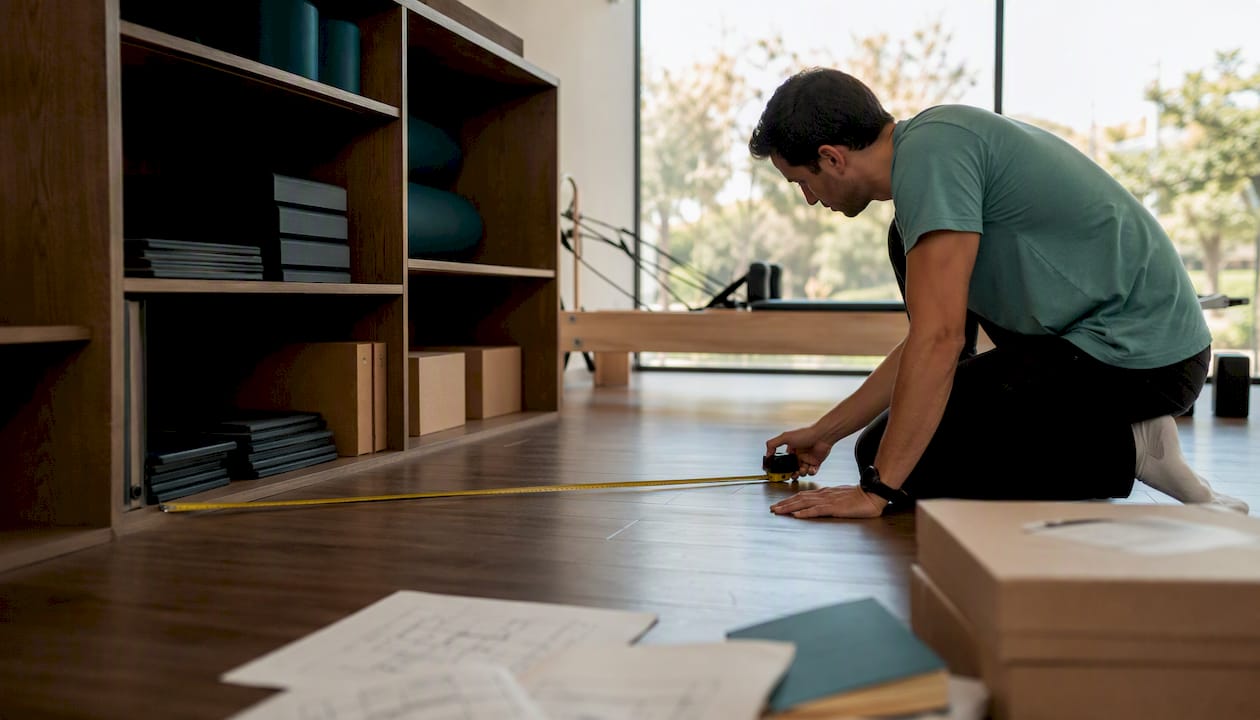
A standard unit needs a minimum footprint of 250 cm long by 120 cm wide to allow safe circulation around the equipment. With the foot bar extended, the width can reach 100 cm, so the side aisle must have at least 60 cm clear. The recommended minimum ceiling height is 230 cm for towers up to 202 cm.
| Parameter | Recommended minimum |
|---|---|
| Unit zone length | 250 cm |
| Unit zone width | 120 cm |
| Side aisle between units | 60 cm |
| Clear ceiling height | 230 cm |
| Distance between units in group room | 69 cm |
Installation checklist
- Verify floor leveling before placing the equipment.
- Check tower attachment to the reformer body according to the manufacturer's manual.
- Tension and test each spring before the first class.
- Inspect pulleys: they should rotate without friction or noise.
- Confirm that shoulder rests and headrest fit without looseness.
Preventive maintenance plan
- Weekly: clean upholstery with a damp cloth and mild disinfectant; visually inspect springs and pulleys.
- Monthly: lubricate carriage rails with the product indicated by the manufacturer; check strap tension.
- Semi-annually: complete spring inspection (look for deformations or loss of tension), review screws and tower anchorages.
- Annually: assess upholstery replacement if it shows cracks or loss of density; request technical review from the supplier.
The accessibility of spare parts and ease of repair are as important factors as the initial price. A supplier who does not guarantee stock of springs or upholstery in less than two weeks represents a real operational risk for a functioning studio.
Where to see demos and get technical support before and after purchase?
The demonstration material a supplier offers says a lot about their level of support. Before buying, distinguish between two types of resources:
Demonstration Material:
- Product videos that show the equipment in actual motion, not just static images.
- Class sequences recorded with the specific model you are interested in.
- Testimonials or references from studios already using the equipment.
Technical Material:
- PDF technical sheet with exact dimensions, weight, spring specifications, and included accessories list.
- Installation and maintenance manual.
- Spare parts catalog with reference and price.
Before signing an order, ask the supplier for a demonstration video of the exact model and the technical data sheet in PDF. If they cannot provide both documents in less than 48 hours, it is a sign that after-sales support will not be agile either.
For after-sales support, verify that the supplier has a direct contact channel (phone or email with a response in less than 24 hours) and that they can confirm spare parts delivery times in writing. Pilates de México includes installation consultancy and local technical support as part of the purchase process, not as an additional service.
Key Points
The reformer with tower is the most efficient option for studios and clinics that need maximum versatility in the smallest possible space, with materials and warranties that support intensive daily use.
| Point | Details |
|---|---|
| Versatility as the main criterion | A single unit covers the reformer and most of the Cadillac repertoire without taking up more space. |
| Materials and durability | Certified wood (lyptus, oak) or aluminum with stainless steel hardware guarantee resale value and resistance to daily use. |
| Springs: order the complete set | Confirm that the model includes long and short springs; the quality of the alloy determines fluidity and lifespan. |
| Warranty and spare parts before price | A supplier without spare parts stock in Mexico represents an operational risk; demand written confirmation. |
| Pilates de México as recommended supplier | Offers the MetaLife line with direct financing, packages for studios, and included installation support. |
What We Learn Equipping Studios: Why We Recommend MetaLife
When a studio owner comes to Pilates de México with the question, "reformer with tower or without tower?", the answer is almost always the same: with tower, unless the ceiling does not allow it. Not because it is the most expensive equipment, but because it is the one that supports the most different classes with a single investment.
What clients ask us most about is not the price. It's the delivery time, if someone will come to install it, and if they can get a replacement spring in two weeks if something goes wrong. That's why we recommend MetaLife: certified Lyptus® FAS wood, stainless steel hardware, and a support network that doesn't disappear after the sale. The studio packages include financing and opening consultancy because we know that equipment is only a part of the real cost of setting up a studio.
The question we ask every client before recommending a model is simple: how many classes a day will this equipment support? The answer defines the level of robustness you need, and from there we build the proposal.
Packages, Financing, and Demos: How to Work with Pilates de México
Equipping a studio with reformers with towers is an investment that pays off class by class, but the starting point matters. Pilates de México offers the MetaLife Infinity Reformer with Tower as the main option for studios and clinics looking for durability and a complete repertoire, and also manages more accessible professional lines for those opening their first studio without the highest budget.
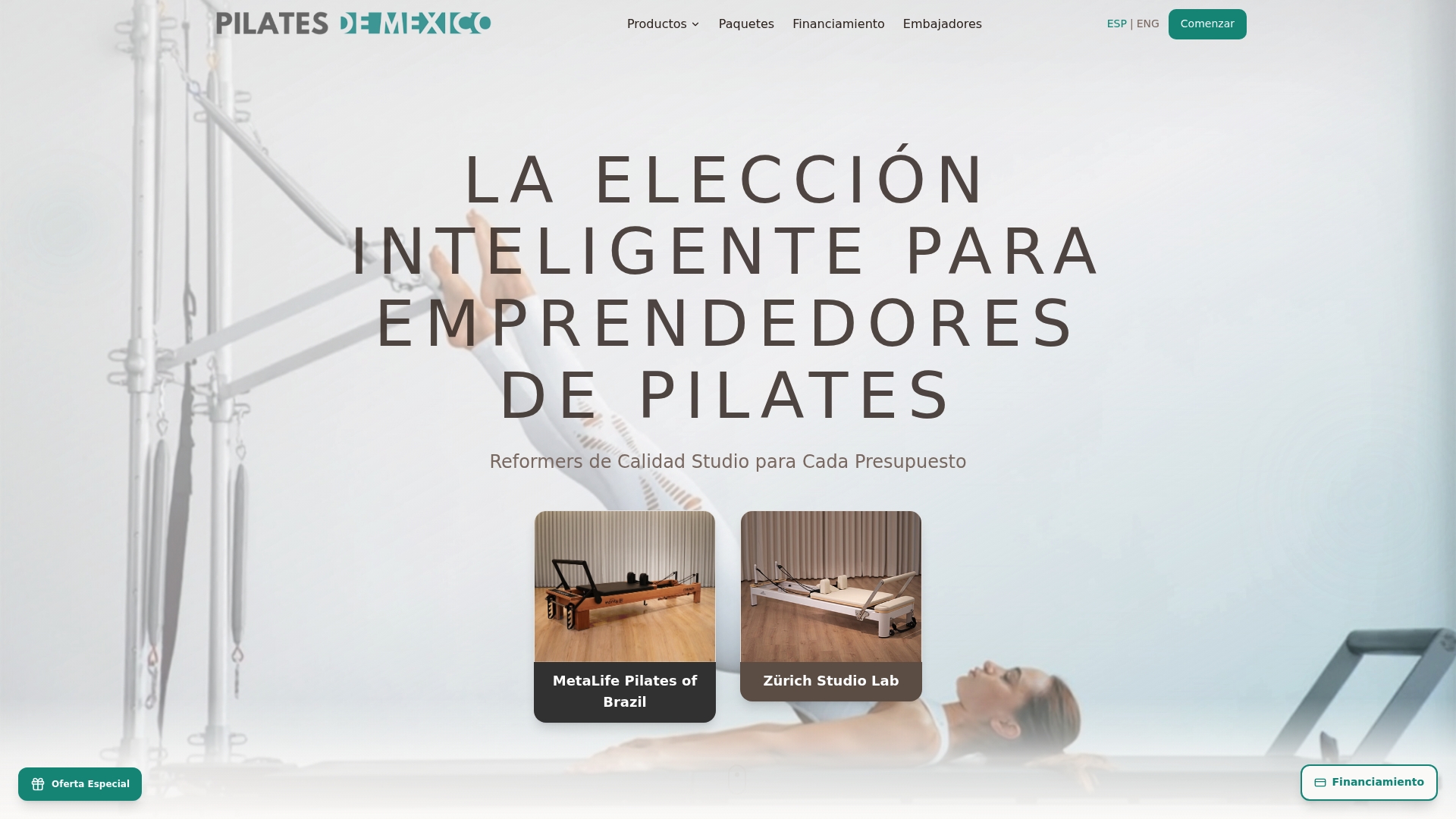
Studio packages include multiple units with volume discounts, installment financing options, and opening consultancy. The process is direct: you request a quote, receive a proposal with specifications and a fixed price, and we arrange installation and initial on-site training. No surprises on the final invoice.
To request a demo, a personalized quote, or information about packages with financing, contact the Pilates de México team at pilatesdemexico.com.
Technical Sources and Product Pages for Further Information
- Infinity Reformer with Tower — MetaLife (Pilates de México): product sheet with spring specifications, materials, and included accessories; a starting point for any comparison.
- Zürich Labs Reformers — Pilates de México: catalog of professional lines with package options and detailed measurements for studio planning.
Recommendation
- Infinity Reformer with Tower — MetaLife
- Balanced Body Zürich Labs Reformers — Pilates de Mexico
- Studio Packages — Pilates de Mexico
- Advanced Reformer — MetaLife Pilates
Why studios across Mexico equip with Pilates de México
- MetaLife reformers — our flagship line: manufactured in Brazil from Brazilian hardwood and the number one selling Pilates Equipment brand in all of South America, featured in over 40,000 studios. Pilates de México is the exclusive distributor of MetaLife in Mexico: local stock, local technicians and a 3-year frame warranty.
- Advanced and Infinity Reformers by MetaLife — the two MetaLife lines most studios in Mexico choose, with towers, accessories and studio-grade upholstery.
- Zürich Labs — our accessible alternative when the budget is tighter.
- Studio packages — complete studio setups, with discounts on packages of 5+ reformers.
- Financing — equipment financing so your opening budget goes further.
- Certifications and workshops — instructor training and continuing education.
We own and operate studios throughout Mexico, so the advice comes from operators, not resellers. Request a quote.