Reformer Upholstery Care: A Practical Guide for Studios
Reformer Upholstery Care: A Practical Guide for Studios
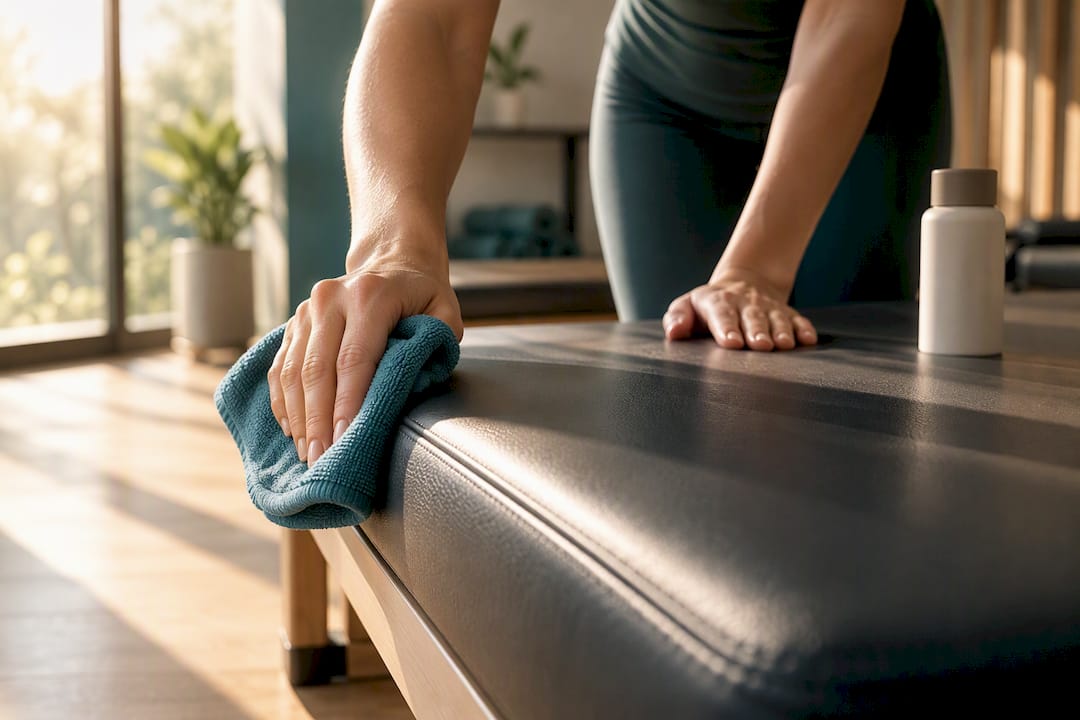
Clean reformer upholstery with a damp cloth and mild soap after each use; never apply bleach, alcohol, or solvents unless expressly authorized by the manufacturer's technical data sheet. Complement this daily cleaning with a weekly inspection for cracks, peeling, and loss of foam tension, and replace the upholstery as soon as you detect structural damage, before it compromises the hygiene or safety of your students.
In summary:
- Daily cleaning with a damp cloth and neutral soap prevents soap from accumulating and causing sticky residues that promote fungi and bad odors.
- Cleaning and disinfecting are not the same; frequent disinfection in rooms with many classes helps reduce microbial load without damaging the upholstery.
- Products such as alcohol, bleach, solvents, or abrasives deteriorate upholstery, so the technical data sheet must always be checked before use.
- Weekly and monthly visual and tactile inspection allows for detection of cracks, loss of firmness in the pads, and other damage requiring repair or replacement.
- Prolonged exposure to sun and humidity promotes accelerated material aging, so it is recommended to avoid direct light and regularly ventilate the room.
Table of Contents
- Daily cleaning: the method that protects reformer upholstery
- Deep cleaning and disinfection: when to go beyond daily wiping
- What products damage reformer upholstery (and why)
- How to detect when upholstery needs repair or replacement
- Springs, carriage, and their direct effect on upholstery
- Protocol template for studios: what to record and who signs
- Protect upholstery from sun and constant humidity
- Care according to material: leather, vinyl, and fabric
- How often to clean, inspect, and replace
- Why excessive or incorrect use shortens upholstery life
- Tools and accessories that facilitate professional care
- Expert perspective: the technical data sheet rules, not habit
- Spare parts, custom upholstery, and financing with Pilates de México
- Sources
- Frequently asked questions
Daily cleaning: the method that protects reformer upholstery
Caring for your reformer's upholstery begins the minute each class ends, not when the studio closes. Four areas concentrate sweat and constant friction: the carriage pads, armrests, footrests, and headrest. These are the first to show wear and also have the most direct skin contact.
The recommended method is simple: a soft cloth dampened with warm water and neutral soap. The care manual distributed by Costco México for equipment in this category is clear on a point that many studios ignore: the cleaner is applied to the cloth, never sprayed directly onto the upholstery. Spraying allows the liquid to seep through the seams into the foam, where it gets trapped and promotes fungi and bad odors.
- First, clean with the soapy cloth, always in the same direction as the seam.
- Rinse with a second cloth dampened only with water to remove all soap residue.
- Allow to air dry before storing the carriage or covering the equipment.
Pro Tip: If you notice the surface feels slightly sticky after drying, there is unrinsed soap residue. That slippery film is exactly what you want to avoid under your hands and feet during a loaded exercise.
Deep Cleaning and Disinfection: When to Go Beyond Daily Wiping
Cleaning and disinfecting are not the same. Daily cleaning removes sweat and visible dirt; disinfection aims to reduce the microbial load, and in a studio with multiple classes a day, it should be done more frequently than on home equipment.
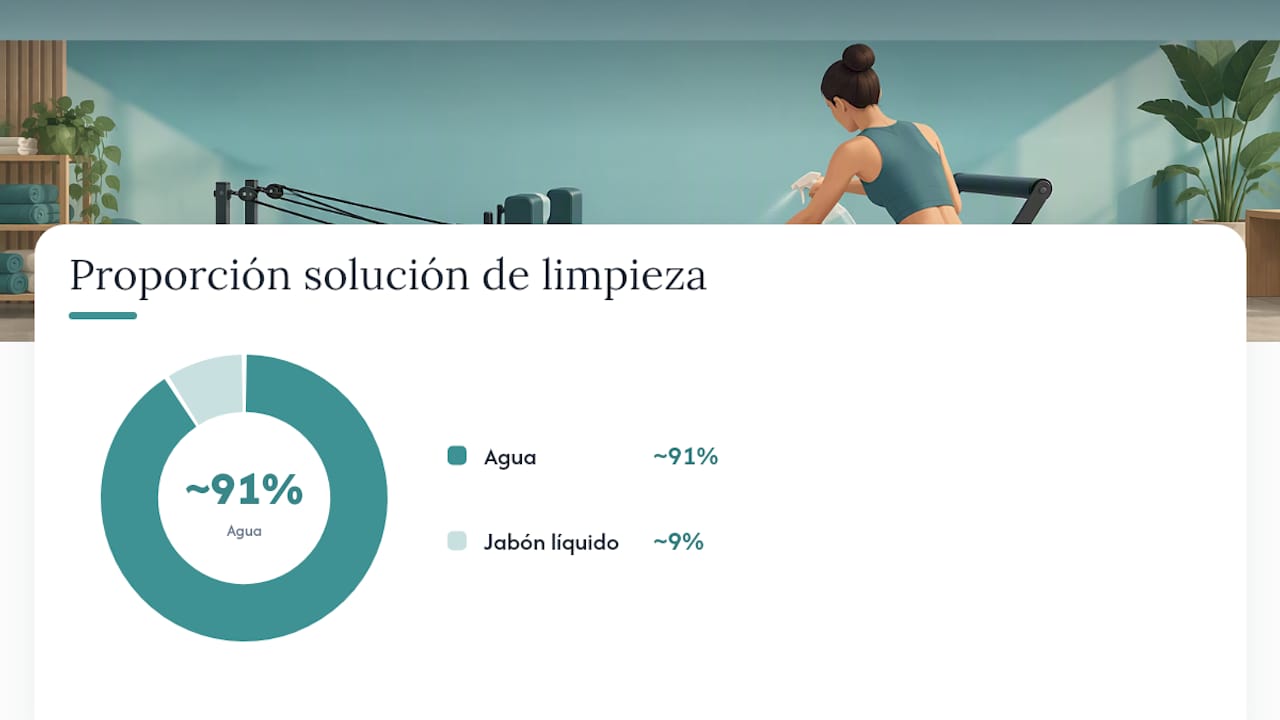
For weekly or monthly deep cleaning, the dilution recommended by several manufacturers is a ratio of one part mild liquid soap to ten parts water, always applied with a cloth and never directly onto the surface, according to the Pilates equipment cleaning instructions from Gratz Pilates. A pH-neutral cleaner performs the same function without attacking the covering.
- Prepare the diluted solution in a separate container, never in a spray bottle that mists directly onto the upholstery.
- Apply with a cloth, allowing the product to act for a couple of minutes on stubborn stains.
- Rinse with a clean cloth dampened only with water to remove all traces of soap.
- Ventilate the room and allow it to dry completely before anyone uses the equipment again.
Moisture trapped under the upholstery is, along with harsh products, the most common cause of premature deterioration in high-traffic studios. Skipping drying time to rush the next class accelerates this wear without it being noticeable for months.
What Products Damage Reformer Upholstery (and Why)
Not all "multipurpose" cleaners are safe for your equipment. Alcohol, bleach, solvents, and abrasives break down the structure of the covering and dry out the foam underneath, leaving the surface stiff and prone to cracking.
- Alcohol: deteriorates polyurethane (PU) coverings and leaves sticky areas or micro-cracks, unless expressly authorized by the manufacturer.
- Bleach and whiteners: discolor and weaken superficial fibers, especially on fabric and leather.
- Strong solvents and stain removers: dissolve internal adhesives that secure the upholstery to the base.
- Scourers or abrasive brushes: create micro-scratches that turn into visible cracks over time.
Before introducing any new disinfectant into your studio's protocol, check the manufacturer's technical sheet. What works for vinyl can ruin leather in a few weeks.
How to Detect When Upholstery Needs Repair or Replacement
A thirty-second visual inspection each day prevents costly surprises. Establish three levels of review with distinct responsibilities:
- Daily: Visually check for visible cracks, loose seams, or sunken areas on the carriage pads.
- Weekly: Press the headrest and footrests with your hand to detect collapsed foam or loss of firmness.
- Monthly: Document the overall condition in writing and compare it with the previous month to detect advancing wear.
Maintenance guides agree that equipment should be inspected regularly and wear parts replaced based on usage, not just when they visibly fail, following Pilates10 Academy's complete Pilates reformer maintenance guide. Open cracks, foam that doesn't regain its shape, and persistent odors after deep cleaning are signs for immediate replacement, not another cleaning. Document every finding with a photo and date, and consult the expected durability of a professional reformer to calculate when to schedule replacement with your supplier.
Springs, carriage, and their direct effect on upholstery
Upholstery care doesn't happen in a vacuum: how you handle the carriage and springs directly influences how long the covering lasts. An unanchored carriage moves abruptly against the stoppers, and that repeated impact eventually displaces the foam directly beneath the upholstery, even if the surface looks intact.
- Always leave at least one spring connected to the gearbar to anchor the carriage when the equipment is not in use.
- Store springs hung or extended flat, never with coils compressed or separated from each other.
- Avoid letting the carriage slam against the stoppers at the end of an exercise; that accumulated impact wears down the internal foam.
This spring storage practice reduces safety risks and preserves the overall stability of the carriage, according to Balanced Body's recommendations on spring storage. Also review the reformer studio safety guide if you manage several pieces of equipment in constant rotation.
Protocol template for studios: what to note and who signs
A verbal protocol is lost every time staff changes. A written, single-page protocol prevents someone new from using bleach "because it seemed reasonable" or spraying cleaner directly onto the seat.
The most practical format includes five columns:
- Upholstery material (PU/PVC, microfiber, leather).
- Authorized product according to the manufacturer's technical sheet.
- Exact dilution (e.g., 1 part soap to 10 parts water).
- Drying time before allowing the next use.
- Responsible party who signs and dates each deep cleaning.
Documenting who did what and when is not unnecessary bureaucracy: it's what allows you to detect if a recent change in cleaning product coincides with the start of a problem. Having short written protocols prevents staff turnover from introducing harmful practices without anyone noticing in time.
Professional Tip: Post the signed template next to the cleaning supplies cabinet, not in a digital folder that no one opens between classes.
When wear and tear can no longer be resolved with cleaning and you need spare parts or custom upholstery, after-sales support for reformers is the next step before a cracked seat is out of service for weeks.
Protect upholstery from sun and constant humidity
Prolonged exposure to direct sunlight dries out and discolors upholstery long before any visible cracks appear. If your studio has windows facing the afternoon sun, reformers placed near the glass visibly age faster than those in the rest of the room, even if they receive the same cleaning.
Polyurethane and vinyl lose flexibility with accumulated heat, and that rigidity then translates into micro-cracks under the constant weight of hands and feet. Genuine leather suffers a different but equally serious damage: it dries out, loses its natural conditioning, and cracks faster than any other material when exposed to sustained ultraviolet rays.
Environmental humidity plays in the opposite direction but with the same end result. A poorly ventilated studio, or a room where sweat is not wiped up and is left to dry on the upholstery, accumulates moisture beneath the surface. This trapped moisture promotes mold and foul odors that can no longer be removed with a superficial cleaning, and ultimately weakens the adhesive that secures the upholstery to the wooden or metal base.
Practical measures are simple and inexpensive compared to the cost of replacing upholstery prematurely:
- Place reformers away from windows with prolonged direct sun exposure, or install curtains or solar film in those areas.
- Ventilate the room after each class, especially in humid climates or basements with poor air circulation.
- Never cover equipment with a cover while the upholstery is still damp; you'll trap that moisture against the surface.
A ground-floor studio with good cross-ventilation rarely faces this problem. One in an enclosed space without windows needs to compensate with a dehumidifier or forced ventilation cycles between classes.
Care according to material: leather, vinyl, and fabric
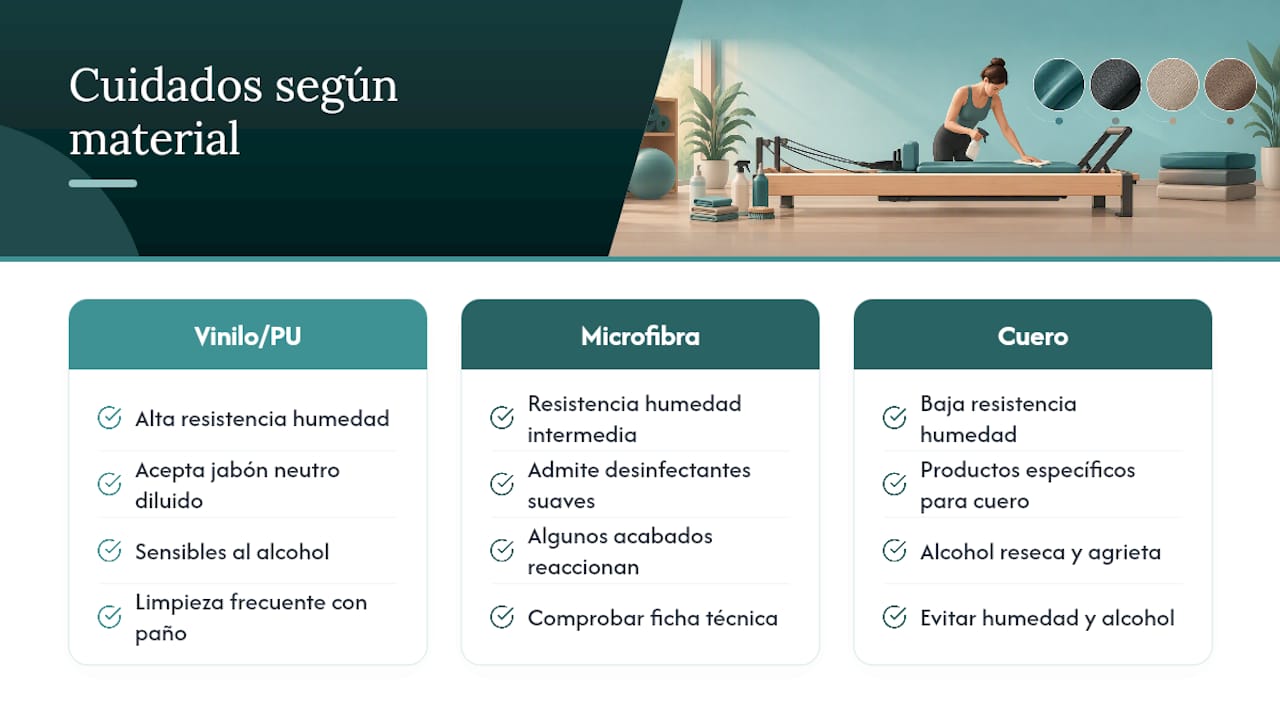
Not all upholstery is cared for in the same way, and treating leather as if it were vinyl is one of the most expensive mistakes seen in studios that grow quickly and purchase equipment from different suppliers.
Vinyl and PU are the most common materials in professional reformers due to their resistance to humidity and mild cleaners. They tolerate diluted neutral soap and frequent cleaning cycles well, always applied to a cloth and never sprayed directly. They are also the most sensitive to alcohol, which dries them out and causes cracking over time.
Microfiber offers an intermediate point: it absorbs less moisture than traditional fabric and allows for mild disinfectants more frequently, although it's advisable to check the technical specifications before introducing a new product, as some microfiber finishes react differently to alcohol-based products.
Genuine leather requires the most specialized care of the three. It needs regular conditioning with products specifically formulated for leather, and it must be kept away from excessive moisture and any alcohol-based cleaners, which dry it out and accelerate cracking, according to the guide on how to choose the right leather for a reformer from Bilinkpilates Factory. If your studio combines equipment with different types of upholstery, the simplest solution is to have two separate protocols on the same template, not a generic one that assumes all material behaves the same.
How often to clean, inspect, and replace
The correct frequency depends on how many classes use each piece of equipment, not on a fixed calendar copied from another studio. A home reformer used three times a week does not need the same rhythm as one in a room that hosts eight classes daily.
As a practical reference for a studio with intense use:
- After each class: quick cleaning with a damp cloth and neutral soap on the four direct contact areas.
- Weekly: deep cleaning with diluted solution, tactile check of firmness on pads and headrests.
- Monthly: documented inspection of seams, cracks, and overall condition, compared in writing with the previous month.
- Every 12 to 24 months: evaluation for replacement of springs, clips, and upholstery based on usage level, adjusting the timeline downwards if the studio operates classes all day.
In very busy studios, cleaning after each use and scheduling deep cleanings and periodic inspections with this frequency prolongs the lifespan of the upholstery and improves the experience of those using the equipment, as noted in Bilinkpilates Factory's Pilates equipment maintenance guide. A home equipment can safely space out these cycles; a reformer that works ten hours a day does not have that margin.
Why excessive or incorrect use shortens upholstery life
Upholstery wear and tear is not just a matter of elapsed time: it depends on how many bodies, how much friction, and how much load each square inch of surface supports. A studio with consecutive classes without a break between sessions subjects the equipment to a pace of use that no amount of cleaning alone can compensate for.
The most common mistake is not a lack of cleaning, but the combination of constant use with reactive maintenance. A studio that only acts when there is already a visible crack has allowed months of accumulated wear to pass that could have been detected earlier.
Three factors disproportionately accelerate this deterioration:
- Repeated load without equipment rotation: if the same reformer is always used in the highest-attendance classes, that equipment ages several times faster than the rest of the room.
- Lack of cleaning between consecutive classes: sweat accumulated during hours of uninterrupted use penetrates the seams and accelerates the deterioration of the internal adhesive.
- Abrupt movements due to overload or incorrect spring adjustment: a carriage that hits the stoppers due to excessive resistance displaces the foam under the upholstery, even if the external surface shows no immediate damage.
A studio that distributes the load among several pieces of equipment and cleans after each class can expect several more years of useful life than one that concentrates all use on two or three reformers without pause. The difference is not in the quality of the material but in how the wear is distributed.
Tools and accessories that facilitate professional care
Having the right items on hand turns the cleaning protocol into a routine of minutes, not a task that staff avoid due to lack of time.
The essentials for any studio:
- Soft microfiber cloths, different from those used for rails or rollers, to avoid mixing mechanical residue with upholstery.
- A pH-neutral cleaner or mild liquid soap dedicated exclusively to upholstery, kept with the dilution instructions.
- Labeled containers for preparing the diluted solution, avoiding spray bottles that might encourage direct spraying on the seat.
- Protective covers or towels during classes with intense perspiration, which reduce direct sweat contact with the upholstery.
- A specific leather conditioner, if your studio has equipment made of this material.
Protective covers and accessories available at Pilates de México reduce daily wear and tear without altering your existing cleaning protocol, and they are a minor investment compared to the cost of replacing upholstery prematurely.
Expert perspective: the technical data sheet rules, not habit
Most avoidable wear and tear on upholstery doesn't come from using the equipment, but from improvising with whatever cleaning product was at hand. The manufacturer's technical data sheet should always take precedence over what has "always been used" in the studio. Documenting every replacement and deep cleaning in writing is not excessive control: it's what reduces long-term costs and maintains a hygiene standard that can withstand a surprise inspection.
Spare parts, custom upholstery, and financing with Pilates de México
There is an option to acquire spare parts and upholstery with technical support and specific consulting for studios in Mexico, including lines like Infinity and Advanced.
If you've identified wear that cleaning won't fix, the next step is to explore the available reformer lines and accessories to find replacement upholstery compatible with your current equipment. For studios renovating several rooms at once, we also offer financing options that allow you to replace upholstery and spare parts without depleting your operating capital in a single month. Write to us with your reformer model, and we'll confirm which upholstery and protective accessories fit your equipment.
Sources
- User guidelines / care and cleaning (equipment manual distributed by Costco Mexico)
- How to store your springs when not in use (BalancedBody)
- How to choose the right leather for your Reformer | Bilinkpilates Factory
- Pilates reformer maintenance: complete guide (Pilates10 Academy)
Frequently Asked Questions
How often should I clean reformer upholstery?
Clean with a damp cloth and mild soap after each class, and reserve a deep cleaning with a diluted solution weekly or monthly, depending on the studio's usage volume.
Can I use alcohol or bleach to disinfect upholstery?
No, unless the manufacturer expressly authorizes it in their technical data sheet. Equipment care manuals warn that these products deteriorate the PU coating and leave surfaces sticky or cracked.
How do I know if I need to replace upholstery instead of repairing it?
Open cracks, foam that doesn't regain its shape when pressed, and odors that persist after deep cleaning are signs for immediate replacement. Consult Pilates de México's after-sales support to get upholstery compatible with your model.
Does leather upholstery require different care than vinyl?
Yes. Genuine leather requires regular conditioning and should be kept away from alcohol and excessive moisture, while vinyl tolerates mild cleaners and more frequent cleaning cycles better.
Does intensive reformer use damage upholstery faster?
Yes, when combined with irregular cleaning and lack of equipment rotation. Distributing class load among several reformers and cleaning after each session significantly reduces accumulated wear and tear.