Reformer or Mixed: Decide on Your Studio Layout with Data and Plans
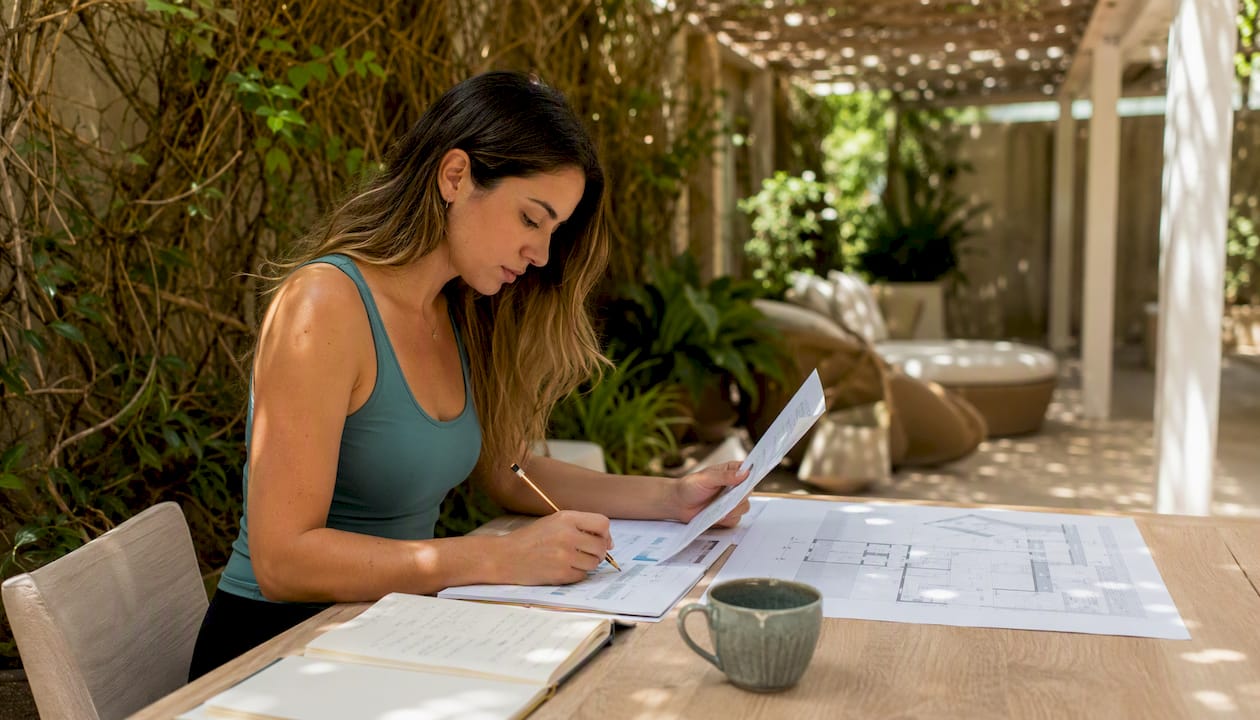
Reformer or Mixed: Decide on Your Studio Layout with Numbers and Floor Plan
The best option for most studios opening in Mexico is a mixed studio, at least in the initial phase. A format that combines reformers with a mat area allows for faster return on investment, attracts a wider client profile, and adjusts the offering according to real demand. If you already have a consolidated client base, a space larger than 80 m², and are willing to charge between $500 and $900 MXN per session, an exclusively Reformer studio offers the highest margin per spot.
- Mixed studio: initial investment from $600,000 MXN, mat area adds $100,000–$300,000 MXN; average ticket per session for mat and reformer, higher client turnover, and lower risk of empty spots.
- Reformer-only studio: $600,000–$1,600,000 MXN investment in equipment alone, typical instructor/student ratio, higher class revenue but total dependence on machine occupancy.
The decision isn't just about budget. It defines your operational structure, your staff, and your scalability for the next three to five years.
Table of Contents
- Reformer or Mixed? Pros, Cons, and Key Figures to Compare
- Checklist for Deciding Based on Your Specific Project
- How many reformers do you need based on your studio's square footage?
- How much does it cost to set up the studio and how to finance it in Mexico?
- How Operations Change Depending on Whether You Choose a Reformer or Mixed Studio
- Studio Design Also Sells: Retention and Rate Perception
- Immediate Steps to Move Forward from the Decision
- Key Points
- What No One Tells You Before Signing the Lease Agreement
- PilatesdeMexico: Packages, Financing, and Budget for Your Studio
Reformer or Mixed? Pros, Cons, and Key Figures to Compare
| Dimension | Exclusively Reformer Studio | Mixed Studio |
|---|---|---|
| Initial Investment | $600,000–$1,600,000 MXN in equipment | From $600,000 MXN; mat area adds $100,000–$300,000 MXN |
| Cost per Spot | High (mandatory machine per student) | Low in Mat area; medium in Reformer area |
| Capacity per m² | 1 reformer every 4.5–9 m² of operational space | Higher density in Mat area; reformers based on available space |
| Programming Flexibility | Limited to machine classes | High: combines large Mat groups with smaller Reformer groups |
| Revenue per Class | $500–$900 MXN/session; groups of 8–10 students | Variable; Mat $240–$400 MXN, Reformer $500–$900 MXN |
| Staff Requirements | Certified Reformer instructor per group | Can combine profiles; greater hiring versatility |
| Scalability and Resale | High resale value for premium equipment | Reformers maintain value; Mat area is easy to expand |
| Estimated Time to Break-Even | 18 months (depends on occupancy) | 12–24 months in a well-managed mixed model |
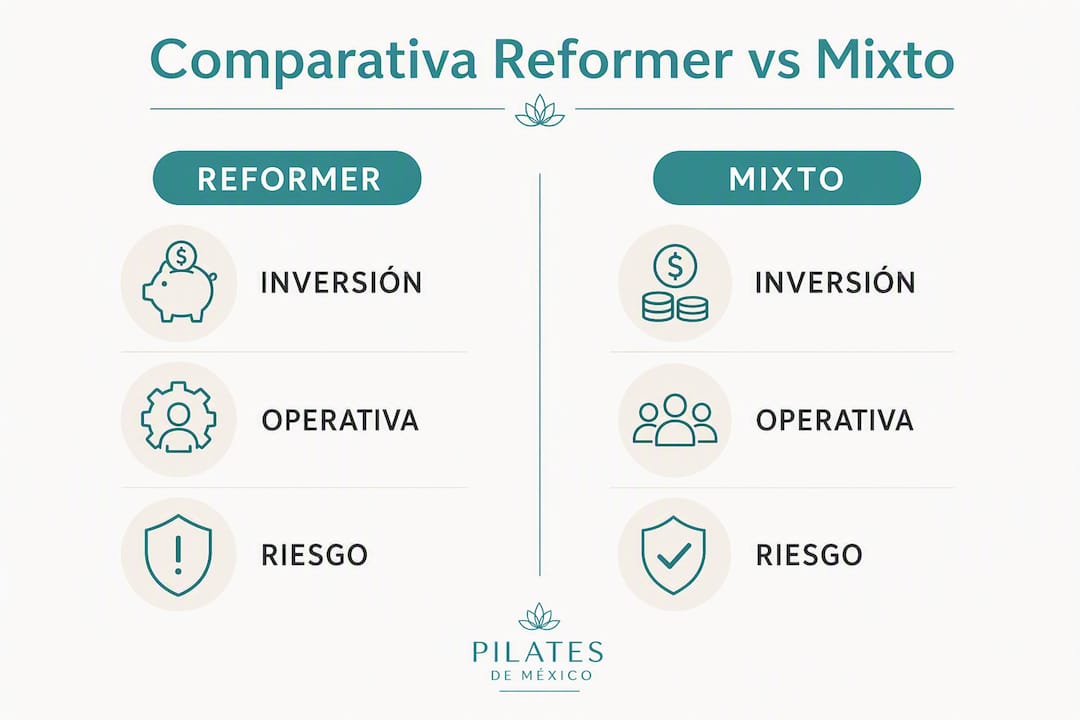
Choose Reformer-only if your local market supports boutique rates and you have a waiting list from day one. Choose mixed if you are building clientele or if your space is less than 80 m² usable space.
The main risk in both models is underestimating fixed costs: rent, specialized staff, and annual maintenance. Aiming for an occupancy rate of 75–85% per machine is the standard reference for the numbers to work out.
Checklist for Deciding Based on Your Specific Project
- Analyze the local market. Research existing studios within a 3 km radius, their pricing, and the formats they offer. If there are no boutique Reformer studios, there's an opportunity; if there are three, a mixed studio differentiates you by price.
- Define your target client profile. A therapeutic or rehabilitation client is more tolerant of Reformer pricing. A general fitness client seeks variety and an accessible price, which favors a mixed studio.
- Calculate your target capacity. With 6 Reformers and two daily classes of 8 students, you have a capacity for 96 spots/day. At 75% occupancy, you bill for 72 spots. Multiply by your rate to get the gross daily income.
- Apply the break-even formula per machine. Income per class × classes/week × occupancy rate, minus prorated fixed costs. Conservative example: 6 Reformers × 2 classes/day × 5 days × 8 students × $600 MXN × 75% occupancy = $216,000 MXN/week gross. Compared to a fixed monthly cost of $120,000–$160,000 MXN (rent + staff), the margin exists, but only if occupancy is maintained.
- Evaluate your cash flow for 6–12 months. A prudent business plan should consider the first few months with low occupancy (40–50%) while you build your client base.
- Decide on the number of instructors. A Reformer-only studio with 8 machines needs at least one certified instructor per class. A mixed studio can start with one and add more as demand increases.
Professional tip: If in doubt, start with 4–6 Reformers and a mat area. Adding machines is easier than removing them once the space is already laid out.
How many Reformers do you need based on your studio's square footage?
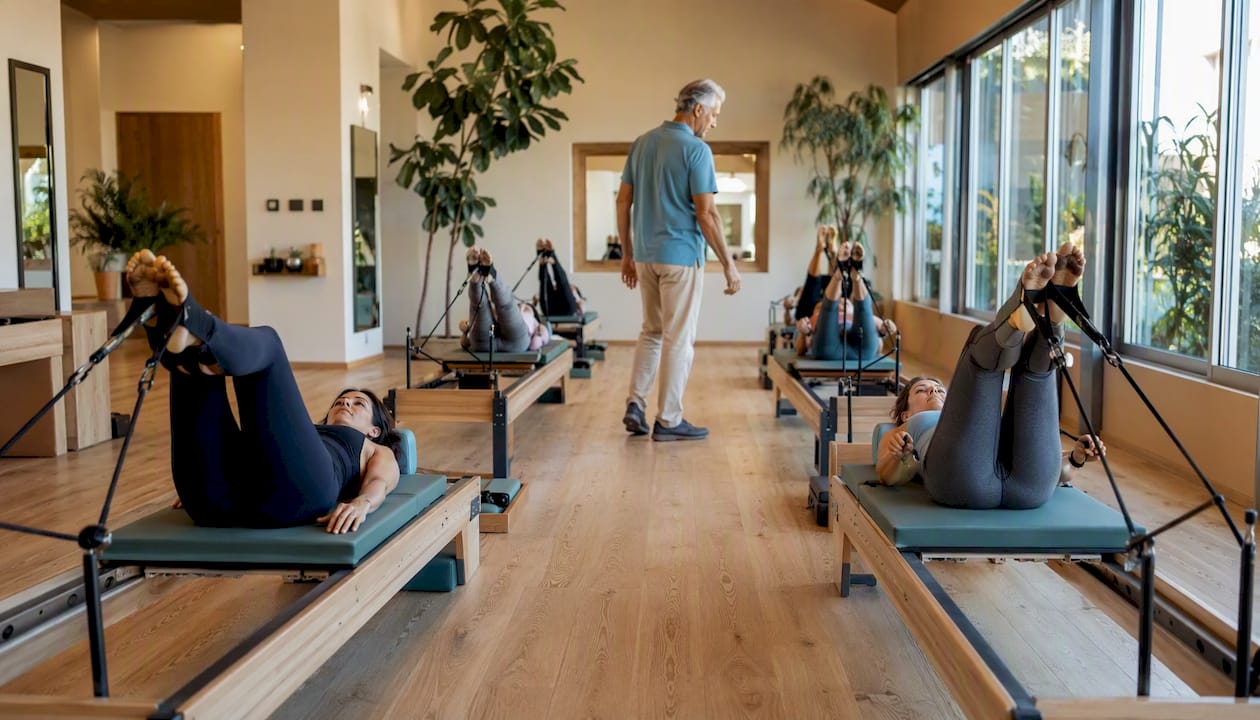
The practical rule is between 4.5 and 9 m² of operational space per Reformer, with at least 45–60 cm free on each side for the instructor to move unobstructed.
| Usable square meters available | Recommended Reformers | Observations |
|---|---|---|
| 40–50 m² | 4–6 | Compact studio; integrated Mat area difficult |
| 60 m² | 6–8 | Mixed format viable with a 15–20 m² Mat area |
| 80 m² | 8–10 | Comfortable mixed format or functional Reformer-only |
| — | 10–14 | Boutique Reformer or mixed with differentiated zones |
Parallel distribution (machines in parallel rows): maximizes capacity and facilitates instructor supervision from the front. This is the most efficient layout per square meter, although it reduces the feeling of spaciousness.
Semicircle distribution: improves mutual visibility among students and eye contact with the instructor. It occupies more space per machine, but enhances the perception of a premium class and is common in boutique studios.
Professional tip: The minimum recommended ceiling height is 2.80 m; for accessories like Jump Board or Cadillac, ≥ 3 m is ideal. Verify this information before signing the lease agreement, not after.
How much does it cost to set up the studio and how to finance it in Mexico?
Investment ranges vary depending on the model. A complete Reformer studio can require between $600,000 and $1,600,000 MXN just for equipment; the mat area adds an additional $100,000 to $300,000 MXN. The conditioning of the premises (technical flooring, lighting, climate control) can add another $200,000–$600,000 MXN depending on the state of the space.
| Concept | Estimated Range |
|---|---|
| Reformers (6–10 units) | $600,000–$1,600,000 MXN |
| Mat area (mats, accessories) with a wide investment range | |
| Premises conditioning with variable investment | |
| Furniture and reception | $120,000–$160,000 MXN |
| Annual maintenance with variable cost depending on use and equipment |
To finance the investment in Mexico, the most common options are:
- Financial leasing: the machine appears on the balance sheet; tax-deductible installments; at the end of the contract, you can acquire it for residual value.
- Operating lease (Renting): fixed monthly fee that includes maintenance; the machine does not enter the balance sheet; ideal if you prioritize liquidity.
- Bank loan: greater flexibility of use, but requires guarantees and usually demands personal or business collateral.
- Direct supplier financing: some distributors offer their own payment terms with competitive conditions and without bank intermediaries. Always ask about the actual APR, the maximum term, the guarantees required, and if after-sales service is included.
Also, consult the ICO (Official Credit Institute) lines for SMEs and freelancers in Mexico, which finance equipment projects with favorable conditions.
How operations change depending on whether you choose a Reformer or mixed studio
The recommended ratio for Pilates reformer classes is one instructor for every 8–10 students. This means that with 10 reformers, you need one instructor per class, and if you want two simultaneous groups, you need two certified instructors. In the mixed model, a Mat class with 15–20 students can be managed by a single instructor, which reduces the per-person staffing cost.
Essential operational checklist:
- Hire instructors with specific Reformer certification (general Pilates training is not enough).
- Establish a monthly preventative maintenance protocol for springs, upholstery, and rails.
- Define a cancellation policy with at least 12–24 hours' notice to protect revenue per machine.
- Use a reservation management system with an automated waiting list, such as Managgio, to reduce empty spots during peak hours.
Recommended weekly programming pattern:
- Peak hours (7:00–9:00 AM and 6:00–9:00 PM): Group Reformer classes at maximum price.
- Mid-range (10:00 AM–2:00 PM): Semi-private classes (2–4 students) at an intermediate rate.
- Off-peak (2:00–5:00 PM): Private classes, internal training, or equipment maintenance.
Studio Design Also Sells: Retention and Rate Perception
A well-designed studio retains clients and justifies higher rates. Opening and design consulting reduces costly distribution errors and aligns the client experience with the rate you want to charge.
- Dimmable lighting: Allows for adapting the ambiance between dynamic classes and recovery sessions.
- Non-slip technical flooring: Mandatory for safety and quality perception.
- Acoustics: Sound-absorbing panels prevent echoes and improve instructor-student communication.
- Brand-consistent color palette: Neutral and warm colors convey calm and professionalism.
- Visible and well-maintained waiting area: The first 30 seconds in the studio define price perception.
Professional tip: Photograph the studio with natural light before installing the machines and after. Images of the empty space and the equipped space are the most effective for social media and Google Business Profile.
Immediate Steps to Move Forward from the Decision
Profile A: Small studio with a limited budget. Start with 4–6 reformers and a mat area. Prioritize leasing to preserve liquidity and add machines in the second year if occupancy exceeds 80%.
Profile B: Premium boutique. Invest from the start in 8–12 professional-line reformers, room design with technical consulting, and a pricing policy starting from $700 MXN/session. The break-even is longer, but the margin per spot is higher.
Profile C: Clinic with a therapeutic focus. The mixed model with 4–6 reformers and a functional training area is the most versatile. It allows catering to both rehabilitation patients and general fitness clients.
Immediate actions (next 4–8 weeks):
- Measure the actual usable square footage of the premises and verify the clear height.
- Request at least two equipment quotes with a breakdown per unit, warranty, and after-sales service.
- Consult with your bank or provider about leasing or direct financing conditions.
- Request a layout consultation before confirming the final distribution.
Key Points
The mixed room is the safest option for most openings in Mexico: lower initial investment, greater flexibility, and faster break-even.
| Point | Details |
|---|---|
| Estimated Initial Investment | Reformer room: $600,000–$1,600,000 MXN in equipment; mixed room from $600,000 MXN with an additional Mat area of $100,000–$300,000 MXN. |
| Square Meters per Machine | Each reformer needs between 4.5 and 9 m² of operational space plus 45–60 cm free space on each side. |
| Target Occupancy | Aim for 75–85% occupancy per machine for sustainable numbers. |
| Rate per Session | Reformer: $500–$900 MXN; Mat: $240–$400 MXN. The choice of format directly defines the average ticket. |
| Pilates de México | Offers equipment packages, direct financing, and technical consulting for studios in Mexico. |
What No One Tells You Before Signing the Lease Agreement
The decision between Reformer-only and mixed is usually presented as a budget issue. It is not. It is a business model decision that determines your fixed cost structure for years to come.
The most frequent mistake I see in opening projects is not choosing the wrong format: it is choosing the correct format but in the wrong location. A boutique Reformer with 10 machines in a 60 m² space with a 2.60 m ceiling is a design problem that no equipment can solve. And a mixed studio in an area where the target customer already pays $800 MXN per session at the studio next door is a missed opportunity.
Pre-planning, including layout consulting, local market analysis, and 12-month cash flow simulation, is not an expense. It's the difference between opening with confidence and opening with crossed fingers.
Pilates de México: Packages, Financing, and Budget for Your Studio
Once you've made the decision, the next step is to execute it with the right equipment and no surprises in the final price. Pilates de México offers studio packages designed for owners outfitting entire studios, with volume discounts, direct financing without bank intermediaries, and technical consulting included with every order.
The MetaLife Infinity line is built with certified Lyptus® FAS wood and stainless steel hardware, which translates into lower annual maintenance and higher resale value when it's time to expand. For studios starting with a tighter budget, there are also accessible professional options without sacrificing durability.
To request a quote, send your studio's usable square footage, the number of reformers you are considering, and your target session rate. With these three pieces of information, the Pilates de México team can prepare a proposal for equipment, layout, and financing options tailored to your specific project.
Recommendation
- Infinity Reformer with Tower — MetaLife
- Advanced Reformer — MetaLife Pilates
- Zürich Labs Reformers by Balanced Body — Pilates de México
- Studio Packages — Pilates de México
Why studios across Mexico equip with Pilates de México
- MetaLife reformers — our flagship line: manufactured in Brazil from Brazilian hardwood and the number one selling Pilates Equipment brand in all of South America, featured in over 40,000 studios. Pilates de México is the exclusive distributor of MetaLife in Mexico: local stock, local technicians and a 3-year frame warranty.
- Advanced and Infinity Reformers by MetaLife — the two MetaLife lines most studios in Mexico choose, with towers, accessories and studio-grade upholstery.
- Zürich Labs — our accessible alternative when the budget is tighter.
- Studio packages — complete studio setups, with discounts on packages of 5+ reformers.
- Financing — equipment financing so your opening budget goes further.
- Certifications and workshops — instructor training and continuing education.
We own and operate studios throughout Mexico, so the advice comes from operators, not resellers. Request a quote.