Reformer Maintenance That Prevents Expensive Repairs
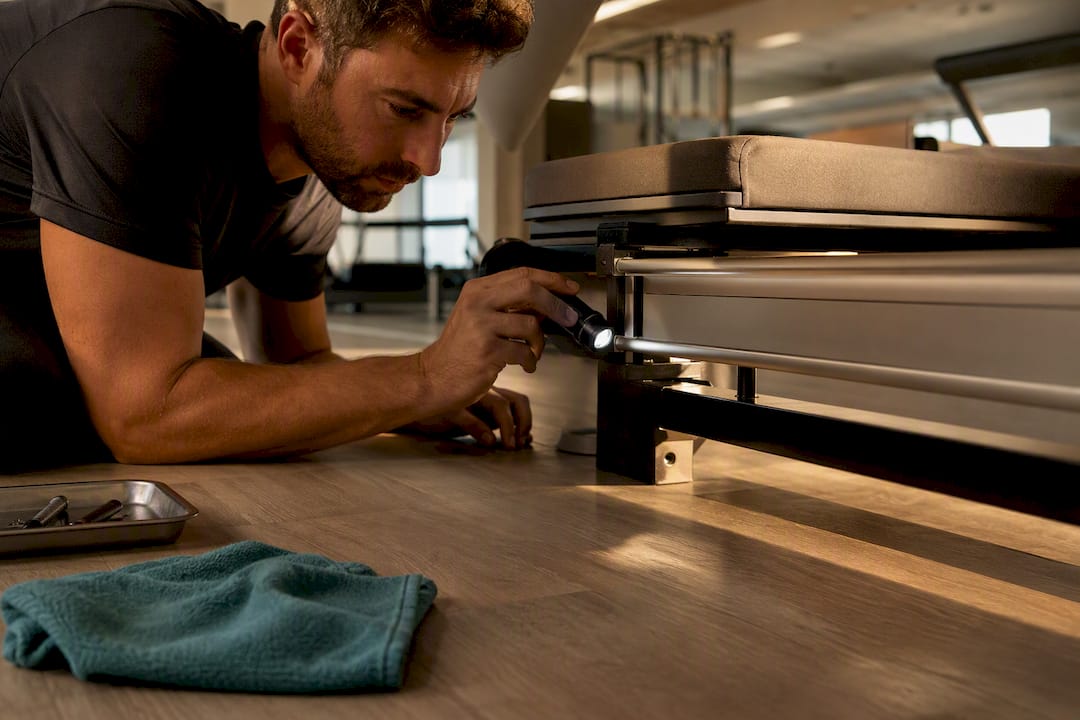
Reformer Maintenance That Prevents Costly Repairs
None of these tasks require specialized tools or hours of work, but they do demand consistency.
In summary:
- Daily cleaning with a microfiber cloth and neutral soap prevents damage and extends the reformer's lifespan, being sufficient to keep it in good condition.
- It is crucial to weekly inspect straps, handles, and upholstery, and monthly check spring tension and the condition of screws and bolts to detect wear early.
- Only axles and rollers should be lubricated with lithium grease in small quantities, avoiding rails with upholstery, and applying lubrication sparingly depending on frequency of use.
- Consumable parts such as straps and springs should be replaced upon detecting cracks, deformations, or rust, always using original spare parts to maintain calibration.
- In case of persistent noises or serious malfunctions, it is essential to contact the distributor or authorized technical service, providing precise model and fault details to prevent further damage.
Table of Contents
- Daily Cleaning: The Habit That Extends Reformer Life the Most
- Weekly and Monthly Inspections: The Checklist That Prevents Surprises
- Lubrication: Which Points Need It and Which You Should Never Touch
- Spare Parts and Replacements: When to Change and Where to Get Them
- When to Escalate to the Distributor or Authorized Technical Service
- Practical Perspective from the Maintenance Manager
- Spare Parts, Packages, and Technical Support with Pilates de México
- Sources
- Frequently Asked Questions
Daily Cleaning: The Habit That Extends Reformer Life the Most
Post-class cleaning is the reformer maintenance task with the greatest impact and lowest cost. A microfiber cloth and neutral soap are enough to remove sweat and body oils from upholstery and straps before they dry on the surface, as recommended by Elina Pilates. Diluted vinegar in water works as an alternative for more stubborn stains, always in low concentrations.
There are products that should never touch a reformer:
- Bleach or chlorine, which discolors and cracks the vinyl upholstery.
- Ammonia, which attacks stainless steel hardware over time.
- Concentrated solvents or alcohols, which dry out leather and nylon straps.
- Abrasive scourers, which scratch surfaces and accelerate wear.
After cleaning, completely dry each surface before storing the equipment or covering it. Moisture trapped between the upholstery and the frame is one of the most common causes of silent corrosion on rails and hardware, something rarely noticed until damage has already occurred.
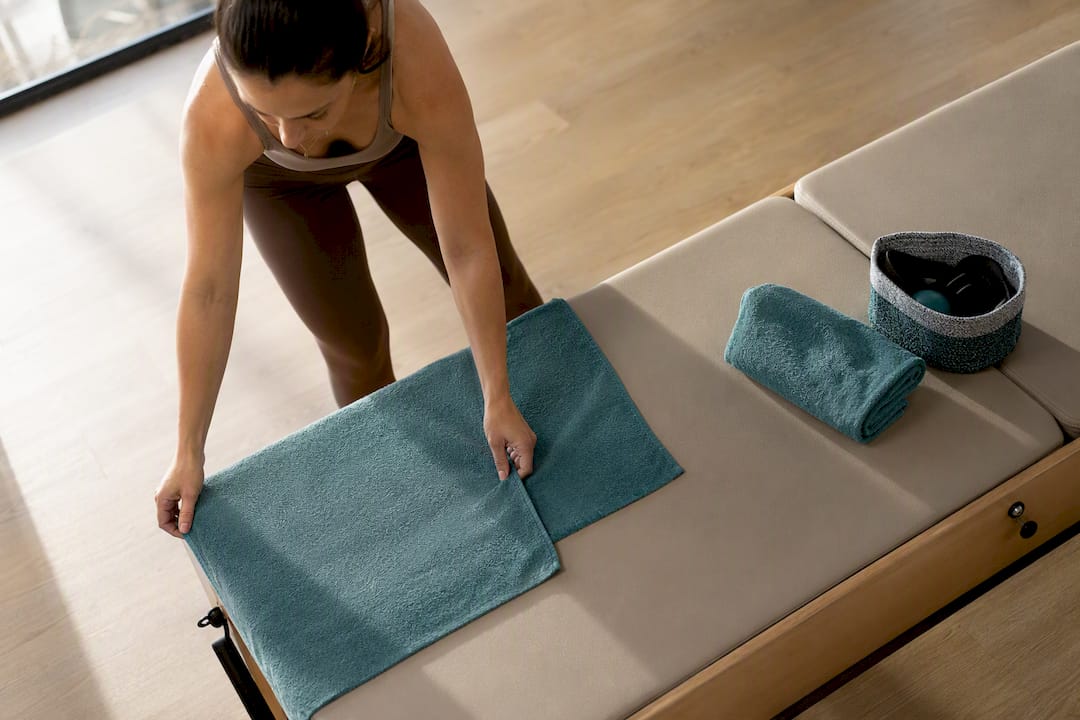
Pro tip: Have lightweight covers or towels available for clients who sweat heavily. Placing them before class prevents moisture from accumulating in the padding and cuts your daily cleaning time in half.
Weekly and Monthly Inspections: The Checklist That Prevents Surprises
A well-maintained reformer doesn't rely on luck; it relies on an inspection routine with clear frequencies. The logical sequence is this:
- Daily: quick visual check of straps, handles, and padding for cuts or loose stitching.
- Weekly: spring tension, condition of hooks and pulleys, and carriage travel on the rails.
- Monthly: pull cables, anchor hardware, and general frame leveling.
- Annually: complete review by trained personnel or the distributor's technical service.
To measure the carriage's "play," gently push it side to side with the springs unhooked: a visually perceptible lateral displacement, beyond a millimeter or two, already indicates wear in rollers or rails that warrants attention. Cables should be free of fraying or rust spots, and pulleys should rotate without resistance or metallic noise.
A specialized practical maintenance course emphasizes keeping a simple log: inspection date, component checked, finding, and action taken. This history not only helps plan for spare parts in advance but also provides the evidence a technician needs to diagnose a recurring problem without starting from scratch every time.
Lubrication: Which Points Need It, and Which You Should Never Touch
Axles, guides, and rollers are the points that truly require lubrication on a reformer. Too much product or the wrong type of lubricant can do more harm than no lubrication at all.
- Apply dry lubricant or lithium grease in small amounts to axles and bearings; never use liquid oils that drip and attract dust.
- Avoid any lubricant on rails where the carriage comes into contact with padding or straps: grease contamination stains fabrics almost irreversibly.
- Wipe off excess with a dry cloth immediately after application, before dirt accumulates on the treated surface.
- Cover nearby padding with a cloth before lubricating adjacent parts to prevent accidental splattering.
Frequency depends on usage: a reformer in a commercial studio with several classes daily needs lubrication approximately every 30 days, while home or clinical equipment with lower rotation can space out the task to every two or three months. If you notice squeaks when moving the carriage even after lubricating, the problem is likely not a lack of lubricant, but wear in the bearing itself, and that is a case for technical review.
Spare Parts and Replacements: When to Change and Where to Get Them
Straps, springs, handles, and hardware are the consumable parts most frequently needing replacement in a reformer with regular commercial use. None of them last forever, and waiting for them to fail during a class is the worst time to find out.
- Change leather or nylon straps when visible cracks appear or flexibility is lost, not just when they break.
- Replace springs that show permanent deformation, rust on the coils, or noticeable loss of tension compared to a new one of the same gauge.
- Check handles and grips for wear at the attachment point, where most friction is concentrated.
- Adjust or replace loose hardware in anchors before play transfers to the entire structure.
The practical rule is simple: if the part compromises user safety or exercise performance, it is replaced; if it only affects aesthetics, it can be repaired or postponed. Always use original spare parts or manufacturer-approved equivalents, because a strap or spring of a different specification alters the calibrated resistance of the equipment. The Pilates de México reformer spare parts guide details which parts to order according to the model and safe steps for installation without voiding the warranty.
When to Escalate to the Distributor or Authorized Technical Service
There are signs that do not allow for improvisation. Persistent noises when moving the carriage, vibrations that do not disappear after lubrication, or a broken spring during use are reasons to immediately contact the distributor or manufacturer, as recommended by a specialist consulted by Pilates10 Academy. Trying to solve these issues with improvised solutions usually worsens the damage and voids warranty coverage.
Before requesting support, please prepare the following information to expedite diagnosis:
- Exact model and serial number of the reformer.
- Approximate date of purchase or last technical review.
- Description of the noise or malfunction, including during which exercise it occurs.
- Short photo or video of the affected component.
Using original spare parts and certified service is not a formality. It preserves the equipment's tension calibration and the safety of the user class after class. The Pilates de México after-sales support guide explains what to expect from the process once assistance is requested.
Practical perspective from the maintenance manager

When time is of the essence, prioritize what affects safety over what affects aesthetics: a spring with play weighs more on the list than discolored upholstery. It's a common mistake to treat reformer maintenance as an "when there's time" task, and that procrastination is precisely what turns a five-minute check into a multi-day repair.
Training studio staff in basic checks, even if it's a five-minute visual inspection before opening, multiplies early detection capability without adding workload to a single person in charge. Consistent maintenance is not an additional expense. It's why a well-maintained reformer can continue to operate reliably for a decade or more, while a neglected one starts to fail in half that time.
Spare parts, packages, and technical support with Pilates de México
Pilates de México solves what most studios discover late: getting the exact spare part for a specific model without relying on slow imports or generic parts that alter the equipment's calibration. We handle both the MetaLife line, built with certified Lyptus® FAS wood and stainless steel hardware, as well as more accessible professional options for studios just starting out.

We also offer direct financing and packages for studios equipping several rooms at once, with consulting included on what it really costs to open and fill a reformer space.
To request a quote, have your current equipment model and approximate number of weekly classes on hand. This way we can recommend the right package for you. Check out the Zürich Labs line options or consult our financing options for your next expansion.
Sources
- How to care for your Pilates Reformer | Maintenance and cleaning
- Complete reformer maintenance
- Pilates reformer maintenance: Complete guide with tips from Astrid Rosell
Frequently Asked Questions
How often should a reformer be cleaned?
The upholstery, straps, and handles should be cleaned after each class with a microfiber cloth and neutral soap to prevent sweat from deteriorating the material.
What are the main parts of a reformer that need to be checked?
Key parts for maintenance include the carriage, rails, resistance springs, pulleys, traction cables, and straps or hand grips.
How much does it cost to replace reformer parts?
The cost varies by model and part; Pilates de México details current prices for original spare parts in its spare parts guide.
How frequently should a reformer be used to justify weekly checks?
A studio with daily classes needs weekly inspections of springs and rails; occasional home use can space out these checks to monthly intervals.
What should be done right after finishing a class on the reformer?
Paddings and straps are cleaned with a cloth and neutral soap, dried completely, and a quick visual inspection of screws and springs is performed before the next class.