Reformer Floor: Requirements, Materials, and Costly Mistakes
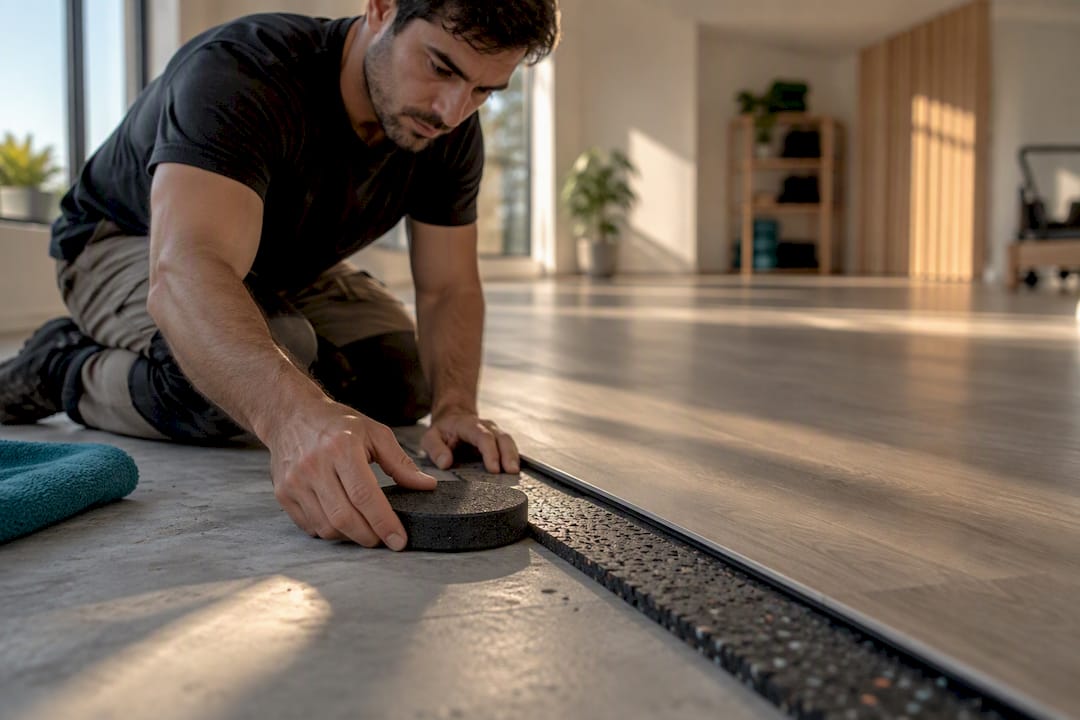
Reformer flooring: requirements, materials, and costly mistakes
Reformer flooring must meet two conditions above all else: absolute flatness and structural stability. If the room is above another occupant, the technical goal is an IIC of 55 or higher. But the real priority is not the floor: it's choosing quiet reformers and isolating each base with anti-vibration pads before considering any costly construction work.
In summary:
- To avoid excessive vibrations and noise, it is essential that the floor has absolute flatness and structural stability, especially if there are occupants below.
- Investing in quiet reformers with sealed bearings reduces noise at the source by 10 to 15 dBA, proving more cost-effective than insulation work.
- Before undertaking construction, it is recommended to place high-density anti-vibration pads under each reformer and evaluate the distance from shared walls.
- A space of 6 to 8 m² per reformer is adequate, considering circulation and margin in front of the springs, for a typical number of eight machines in a room.
- Noise level measurement should be taken one meter from each machine, including impact and transition, with technical reports certifying the required values.
Table of contents
- What flooring to use for reformers? Seven strategies by order of impact
- Technical values to ask your architect or contractor for
- How much space does each reformer need in your studio?
- Materials and construction solutions for subflooring
- Installation checklist and maintenance schedule
- How Pilates de México and MetaLife support installation
- The investment almost no one gets right from the start
- Quiet reformers, complete packages, and tailored financing
- Sources
- Frequently asked questions
What flooring to use for reformers? Seven strategies by order of impact
Not all interventions are equally valuable. Some solve 80% of the problem for a fraction of the cost of a renovation; others only make sense once you've exhausted the cheaper options. This is the order we recommend following, from most to least cost-effective:
- Choose the reformer before thinking about the floor. The steel frame and sealed bearings make a 10 to 15 dBA difference compared to economic machines, which is more than any floor treatment alone will achieve.
- Isolate each base with anti-vibration pads. It's the cheapest intervention with the highest immediate return.
- Evaluate a floating platform only if there are occupants below. A completely decoupled floor (floating floor) is justified when the IIC 55+ target cannot be met with individual pads.
- Place reformers away from shared walls. The impact of the carriage against the end of the rail travels as structural noise, and nearby walls amplify that transmission.
- Prioritize economical improvements over heavy construction work. Pads and relocation first; slab reinforcement and decoupled platforms later, only if the numbers demand it.
- Treat reverberation, not just impact. High ceilings mean that echo, more than volume, is what truly bothers instructors and neighbors.
- Maintain a review schedule. A well-lubricated and leveled reformer does not lose its original acoustic profile over the years.
Pro tip: Before spending on floor reinforcements, ask your supplier for a demonstration with the reformer operating at normal speed. If it already sounds loud in the store, no amount of base isolation will fully fix it.
Technical values to ask your architect or contractor
When you translate these priorities into a construction contract, you need concrete figures, not adjectives. These are the values that any technical proposal should include:
- IIC 55 or more in the floor/ceiling assembly, mandatory if there is commercial or residential activity below the room.
- STC 50 to 55 in walls shared with other premises or units.
- NRC of 0.80 to 0.85 in ceiling and wall panels to control reverberation.
- dBA per machine: target of 45 to 55 dB. A quality commercial reformer operates in this range; low-end equipment can reach 60 or 68 dB.
- Above 60 dB sustained, intervention is no longer optional.
The measurement should be taken one meter from the machine, capturing both continuous movement and transitions and the “roll-back” of the carriage, because that is where the maximum impact energy is concentrated. Ask the contractor's report to include both moments, not just an average.
How much space does each reformer need in your studio?
A technically perfect floor is useless if the room's layout creates coupling between machines. Before signing any construction contract, verify this:
- Reserve between 6 and 8 m² per reformer position, including circulation; for eight units, calculate between 60 and 80 m² of studio space.
- Leave a margin in front of each machine's wells and avoid aligning reformers against walls shared with other premises.
- Confirm clear height and delivery access before purchasing: a reformer does not fit through just any door or go up just any staircase.
- Measure the actual flatness of the existing floor. A tolerance greater than 3 mm per meter usually generates vibration and uneven wear on the rails.
Materials and construction solutions for the subfloor
The most frequent mistake in new studios is thinking that "softer" equates to "quieter." It's the opposite: an excessively soft floor introduces elastic deformation that accelerates bearing and rail wear, and on top of that, it doesn't solve impact noise. The base needs to be firm; isolation is achieved with specific elements, not with a generically cushioned floor.
For anti-vibration pads under each reformer, look for high density and a thickness between 8 and 12 mm: below that, they lose absorption capacity; above that, they begin to compromise equipment stability. Rubber pads of that thickness can reduce several decibels according to on-site measurements (https://commercial-acoustics.com/sound-advice/how-to-soundproof-a-pilates-studio/), a significant gain for a part that costs a fraction of any construction work.
When these pads don't meet the target IIC, the next layer is a floating floor: a platform decoupled from the structural slab by continuous, not just point, isolators. It's a more expensive solution with longer installation times, so reserve it for upper floors with occupants below.
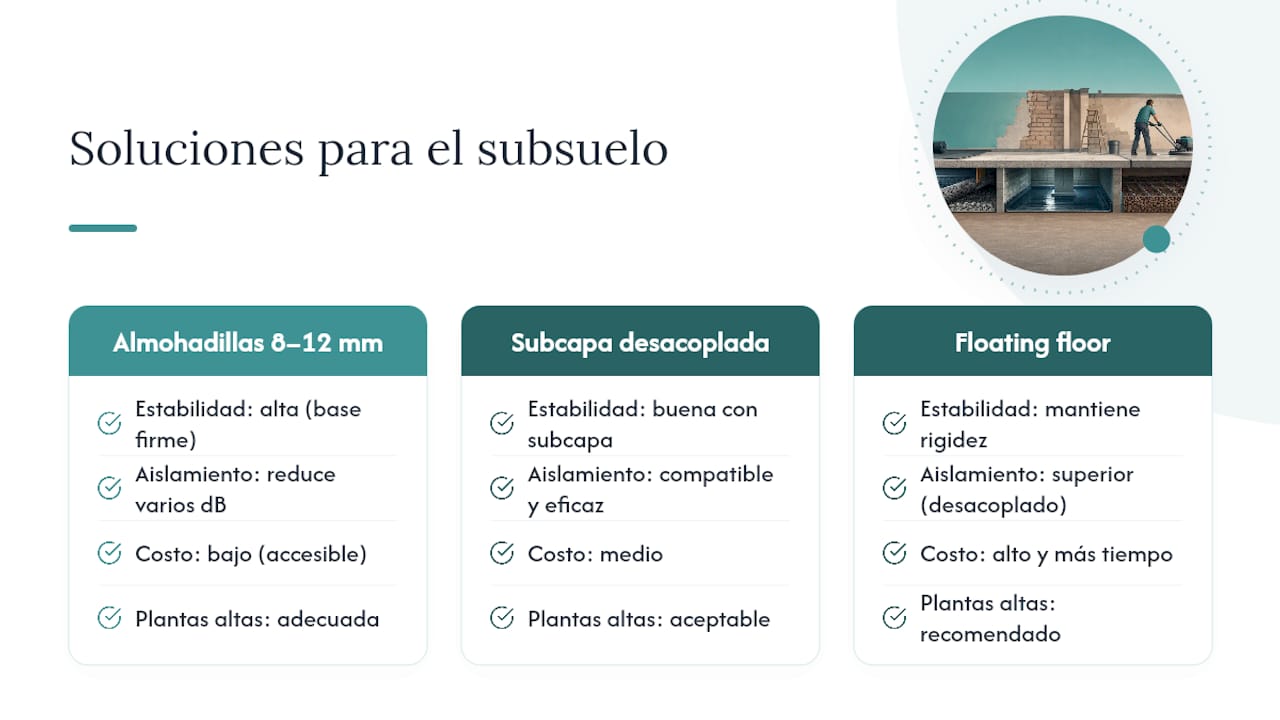
For the final finish, stable vinyl and flooring installed over a decoupled subfloor are the best options that combine durability, cleanliness, and compatibility with the base insulation. Avoid finishes that deform with the humidity of classes or that require abrasive cleaning products.
Installation Checklist and Maintenance Schedule
A well-executed installation saves years of neighbor complaints and premature equipment wear. Follow this order:
- Before buying: verify the flatness of the existing floor, and if the room is above another occupant, request a prior IIC measurement.
- During installation: place anti-vibration pads under each leg, level each machine individually, and avoid rigid anchors that transmit vibration directly to the slab.
- Quarterly: lubricate rails and pulleys, inspect springs and bearings, and replace insulators that show permanent compression. Tightening loose bolts and re-leveling the equipment solves most of the humming noises that appear with daily use.
- Record dBA readings at each review. If you detect a sustained increase above your baseline, it's time to hire a professional acoustic study before it becomes a problem with neighbors or with your operating license.
Pro Tip: Keep a simple record in a spreadsheet with date, machine, and dBA reading. In six months, you'll be able to distinguish normal use noise from an actual bearing failure.
How Pilates de México and MetaLife Support Installation
Sizing the room and choosing the right equipment are not separate decisions. Our internal guide on how to arrange 6 to 8 reformers in spaces from 40 to 80 m² stems from the same logic we apply in every consultation: first the equipment, then the floor.
MetaLife reformers arrive with certified Lyptus® FAS wood and stainless steel hardware, designed for years of daily classes without bearing wear becoming a noise issue. To support installation, we offer:
- Room consultation to define layout, clearances, and insulation needs before construction.
- Multi-equipment packages with special conditions for studios opening several positions at once.
- Direct financing and professional installation, without relying on third parties for assembly.
The Investment Almost No One Gets Right From The Start
Most new owners spend on flooring first and adjust equipment later, when the budget is already committed. It should be the other way around: buying reformers with good bearings from day one costs more initially, but it avoids neighbor complaints, contract renegotiations, and emergency renovations that end up costing more than the equipment's price difference.
If you're renting the premises, negotiate an explicit noise clause in the lease agreement before signing, not after the first complaint. And don't forget that a well-insulated floor and well-maintained equipment are part of the studio's resale value the day you decide to expand or sell.
Silent Reformers, Complete Packages, and Tailored Financing
We offer reformers with steel frames and sealed bearings that reduce noise at the source before you need to spend on floor insulation.
If you are equipping a room from scratch, the Infinity Line and the Advanced Line cover different budgets without sacrificing the bearing quality that determines how much you will need to invest in flooring. For studios opening multiple positions at once, studio packages include special volume conditions, and direct financing allows you to stagger equipment payments while controlling your construction budget. Request a quote with a technical visit, and we will help you define what your room needs before you buy a single square meter of flooring.
Sources
To delve deeper into the technical specifications of this article, consult the guide on soundproofing Pilates studios, the case study on reverberation treatment in gyms, and the reference for noise levels by reformer type.
Frequently Asked Questions
What type of flooring is best for installing reformers?
A rigid, level, and stable floor, not one that is excessively soft or cushioned. Structural stability prevents premature wear of bearings and rails, and acoustic isolation can be achieved with specific anti-vibration pads under each machine, rather than a generically soft floor.
Do I need soundproofing if my studio is on the ground floor with no neighbors below?
Not with the same urgency. The IIC 55+ objective applies when there are occupants below the room; for an isolated ground floor, anti-vibration pads and good equipment maintenance are sufficient to keep noise under control.
How much noise does a higher-quality reformer reduce compared to an economical one?
The difference can be up to 10 or 15 dBA, which is often greater than any improvement that can be achieved by only treating the floor or walls. That's why equipment selection comes before construction work on the priority list.
How much space should I allocate for each reformer in my studio?
Between 6 and 8 m² per position, including circulation and space in front of the machine's springs. For eight reformers, estimate a room between 60 and 80 m².
How much does a Pilates de México reformer cost?
Prices vary according to the line (Infinity or Advanced) and the chosen package, and are available directly in the product catalog. We also offer direct financing to stagger equipment payments.