Reformer Delivery Times in Mexico: A Real Guide
Reformer Delivery Times in Mexico: A Real Guide
In Mexico, a reformer can be delivered in 1–2 business days if it's in local stock and payment is confirmed before the cutoff time. For imported equipment, the typical range is 4–8 weeks by air or sea. These three ranges cover most cases faced by studio owners in Mexico, and knowing them upfront prevents miscalculating an opening date.
The most common ranges you'll encounter when planning your purchase:
- Available national stock: 1–2 business days from payment confirmation
- Air import: 2–4 weeks (preparation + international transit)
- Sea import: 6–8 weeks from factory to your studio
- Custom-made / OEM: 4–12 weeks depending on customization and manufacturer capacity
A point that causes more confusion than it seems: the deadline doesn't start when you place the order, but when the seller confirms payment. According to Amazon Mexico, the official count begins when the package leaves the distribution center, not when the order is registered. This discrepancy can be hours or full days.
Professional tip: Before paying, ask the supplier for the estimated delivery date in writing and confirm when you will receive the tracking number. If they can't provide both, it's a red flag.
Key Points
Reformer delivery times in Mexico range from 1–2 business days for local stock to 6–8 weeks for sea imports, and the difference between opening on time or late is almost always decided in the planning stage, not in transit.
| Point | Details |
|---|---|
| Ask for the date in writing | Request the estimated delivery date and tracking number before confirming payment. |
| The period starts with payment | The official count begins with payment confirmation, not with the registered order. |
| Choose the method based on urgency | Ground freight for national stock (2–7 days); sea freight for large imports (6–8 weeks). |
| Allow for safety margins | Add a week margin to any deadline; peak seasons and remote areas add days. |
| Pilates de México offers controlled lead times | National stock, coordinated installation, and confirmed schedule in writing from the first contact. |
Table of Contents
- How long does a reformer take depending on the type of order?
- Factors that lengthen or shorten the delivery time of a reformer
- Preparation versus transit: where delays really occur
- Which shipping method is best for your reformer?
- How to plan your purchase to open or equip your studio
- Questions you should ask the supplier before paying
- Reported ranges in practice: what suppliers say
- Pilates de México's perspective on delivery times
- Pilates de México shortens times and eliminates uncertainty
- Sources
How long does a reformer take depending on the type of order?
For large products in Mexico, typical reported delivery times are 7 to 15 business days from payment confirmation, with exceptions for remote areas or high-demand seasons.
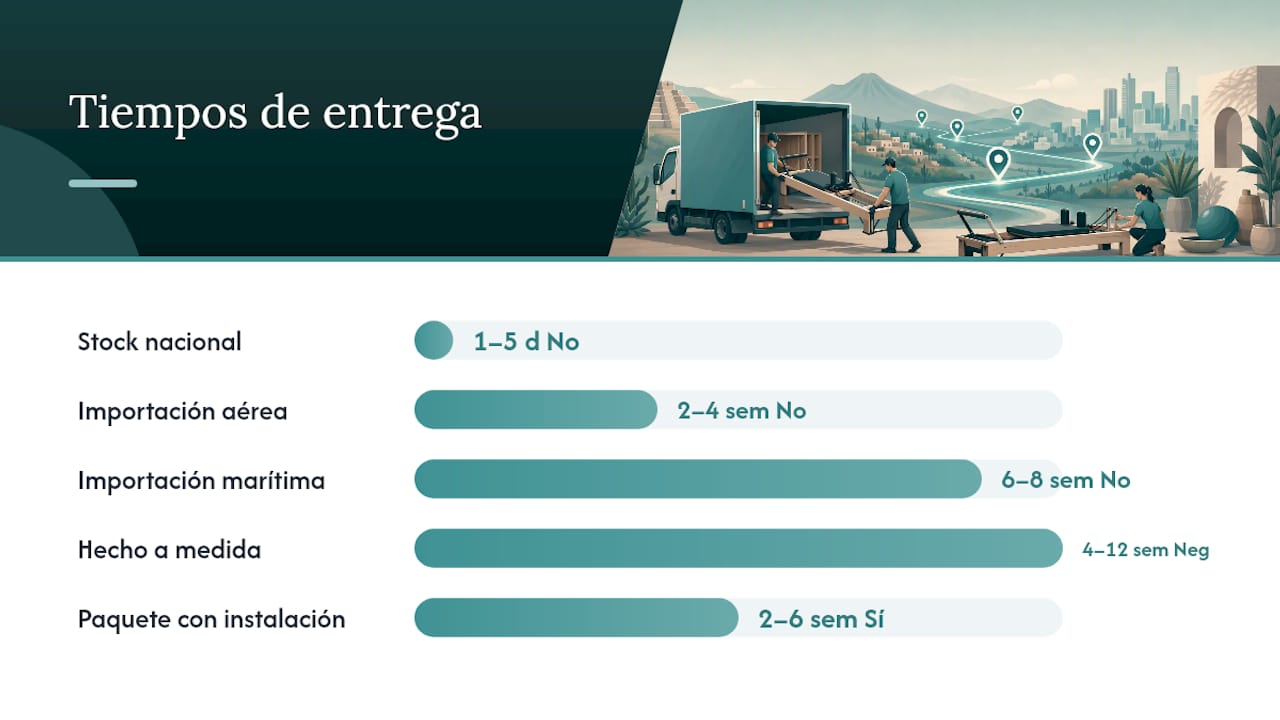
| Order Type | Estimated Time (Preparation + Transit) | Typical Shipping Method | Installation Included | Common Extra Costs | Coverage in Mexico |
|---|---|---|---|---|---|
| National Stock | 1–5 business days | Express parcel or ground freight | Not always | Maneuvers, upstairs delivery | 32 states (remote areas +2–3 days) |
| Air Import | 2–4 weeks | Air cargo + national parcel service | No | Customs, air freight, maneuvers | Major cities |
| Ocean Import | 6–8 weeks | Container + ground freight | No | Customs, ocean freight, storage | Ports + inland |
| Custom Made / OEM | 4–12 weeks | Ocean or air depending on urgency | Negotiable | Manufacturing, customs, assembly | Per agreement |
| Package with Installation | 2–6 weeks | Ground freight + onsite technician | Yes | Included in package | 32 states |
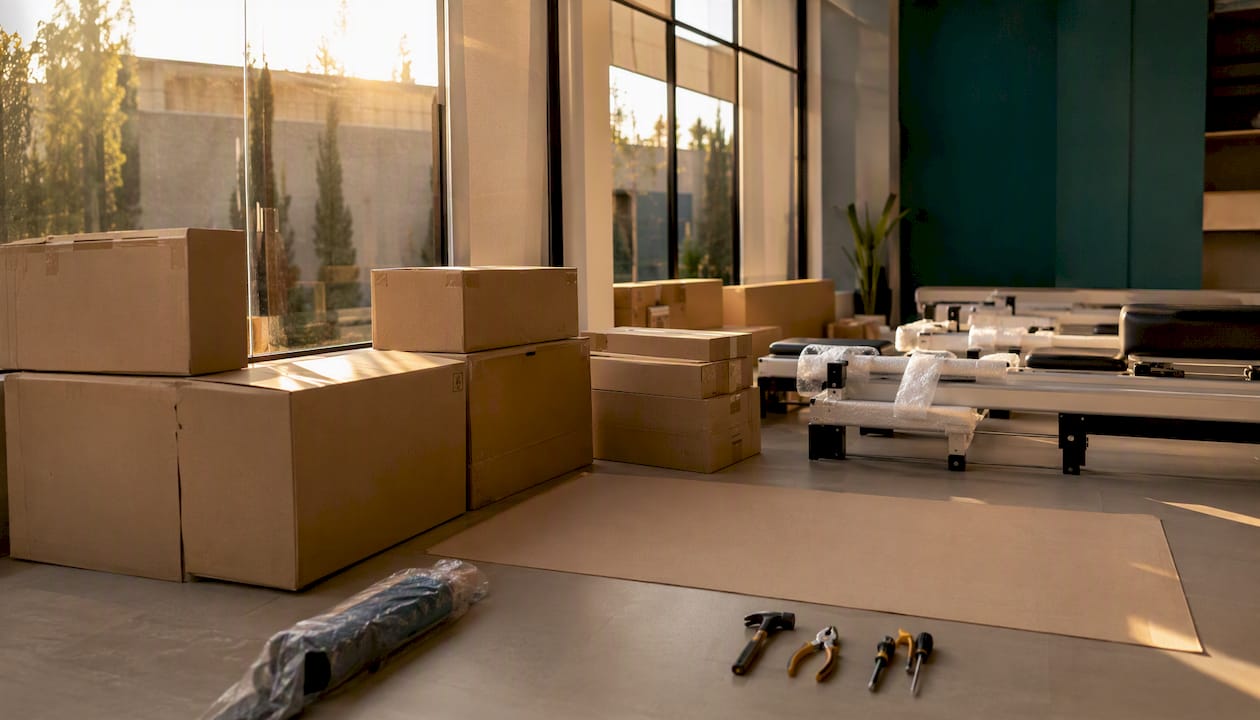
Some premium brands offer delivery with on-site installation in approximately 15 days, with prior appointment and additional charges for upstairs delivery. For multi-unit orders, ocean freight reduces the cost per unit but requires planning with at least an 8-week lead time.
High-demand seasons (January, September) and hard-to-reach locations can extend any of these ranges by an additional 3 to 7 business days.
Factors that lengthen or shorten reformer delivery times
The final deadline does not only depend on the shipping method. These are the factors that really move the dates:
- Stock availability: Equipment in local warehouse ships in hours. One that requires manufacturing can take weeks before the carrier even touches it.
- OEM/ODM customization: Changes in upholstery, color, dimensions, or hardware add production time. Each modification has its own approval cycle.
- Payment confirmation: According to Tienda Tecnología, payments verified before 6:00 p.m. ship the same day; those after the cutoff are processed the next business day. For imports, international bank transfers can take an additional 2–3 days.
- FOB/EXW terms: Under EXW conditions, logistics responsibility passes to the buyer from the moment the product leaves the factory. This implies coordinating customs agents, permits, and local transport, which can add 5–10 days if not prepared.
- Carrier capacity: During peak seasons, national parcel services operate at saturation. Freight that normally takes 2 days can extend to 5.
- Geographical location: Deliveries in metropolitan areas like Mexico City or Guadalajara are more predictable. Destinations in remote municipalities or without access to paved roads require additional coordination.
- Incomplete customs documentation: For imports, a missing document can hold equipment in customs for several days. The commercial invoice, packing list, and certificate of origin must be ready before shipment.
Professional tip: For imports, prepare all customs documentation with your agent before confirming the order. An incomplete process can cost more time than the entire sea transit.
Preparation vs. Transit: Where Delays Really Happen
Confusing these two stages is the most frequent cause of miscalculated opening dates. The total delivery time has two distinct parts, and each is under the control of different actors.
Preparation time (controlled by the seller or manufacturer):
- Payment confirmation received
- Order verification and stock assignment or manufacturing initiation
- Equipment packaging and labeling
- Delivery to carrier or freight forwarder
Transit time (controlled by the carrier):
- Receipt of equipment by parcel or freight company
- Ground, air, or sea transit according to route
- Customs clearance (for imports)
- Delivery to address or agreed-upon point
The gap between these two stages is where most days are lost. Amazon Mexico clarifies that the time shown to the customer begins when the package leaves the distribution center, not when the order is placed. This means that preparation time is outside the announced timeframe.
For reformers, preparation can range from a few hours (ready stock) to several weeks (custom manufacturing). Transit, on the other hand, is more predictable once the equipment is in the hands of the carrier.
Confirmation checklist you should receive from the supplier:
- Exact payment confirmation date
- Estimated shipping or carrier handover date
- Tracking number or reference
- Estimated final delivery with a date range
- Carrier or freight forwarder name and contact
Pro tip: Ask to be notified via WhatsApp or email the exact moment the equipment leaves the warehouse. This notification activates the actual transit countdown and allows you to coordinate reception in advance.
What shipping method is best for your reformer?
The size and weight of a reformer exclude it from standard parcel services. Here are the applicable methods and when each is suitable:
- National ground freight: The most common option for stock available in Mexico. Delivery times of 2–7 business days depending on the destination. According to Decathlon Mexico, large or heavy packages can take between 5 and 7 business days, and timelines are estimates subject to external variations. Moderate cost, wide coverage.
- Express parcel service with special freight: For smaller volume equipment or accessories. Faster (1–3 days), but with weight and dimension restrictions that full reformers usually exceed.
- International air freight: Reduces transit to 5–10 days from the factory, but the cost can double or triple that of sea freight. Justifiable when studio opening cannot be delayed.
- International sea freight: The standard for multi-unit orders from Asia or South America. Door-to-door times of 6–8 weeks, with the lowest per-unit cost for large orders.
Additional costs you should budget for regardless of the method:
- Transit insurance (recommended for high-value equipment)
- Forklift maneuvers at origin and destination
- Delivery to upper floors without an elevator
- Temporary storage if reception is not available
To reduce costs without sacrificing deadlines, order consolidation (several reformers in the same shipment) is the most effective strategy for imports. The difference between shipping one unit and five can significantly reduce the per-equipment cost.
How to plan your purchase to open or equip your studio
A poorly calculated timeline is the most expensive mistake a studio owner can make. Here is the recommended order of actions:
- 12 weeks before opening: Request quotes from suppliers, confirm stock availability or manufacturing times, and define the model and quantity of reformers.
- 10 weeks before: Compare shipping options and additional costs. If importing, contact your customs broker and prepare documentation.
- 8 weeks before: Confirm the order and make the payment. Check the supplier's cut-off time so the equipment enters the preparation cycle on the same day.
- 6–7 weeks before: Request shipment confirmation and tracking number. If the supplier does not send it within 48 hours, contact them directly.
- 4 weeks before: Monitor transit. For sea imports, confirm the arrival date at the port and coordinate with the customs broker.
- 1–2 weeks before: Coordinate final delivery: access to the premises, forklift availability, building loading permits, and schedule the assembly technician if applicable.
Operational checklist for the reception week:
- Confirm dimensions of doors and access points at the premises
- Verify availability of the installation technician
- Have a clear space for unloading maneuvers
- Have staff available for reception and signing for conformity
Pilates de México studio packages include opening consultancy that covers precisely this coordination, reducing the margin of error in time planning.
Pro tip: Always add a week of safety margin to any deadline the supplier gives you. Customs unforeseen events or carrier saturation are more frequent in January and September.
Questions you should ask the supplier before paying
Not all the answers you receive will be clear. Here are the questions you should get in writing before transferring any money:
- When does the delivery period start? From the order, from payment confirmation, or from when the carrier picks up the equipment?
- Does delivery include installation or just drop off at the door? The difference between "home delivery" and "delivery with assembly" can mean additional weeks of coordination.
- What are the expected additional charges? Customs, handling, insurance, delivery to upper floors.
- What policy applies if the equipment arrives late or damaged? Ask for the procedure in writing, not just a verbal promise.
- Do they send a tracking number and notification upon shipment? If the answer is "we'll let you know when it arrives," that's a red flag.
- Under what trade terms does international shipping operate? FOB, EXW, or CIF determine who assumes the costs and risks from what point. Under EXW or FOB terms, logistical responsibility passes to the buyer once the product leaves the factory.
Red flags: ambiguous answers about who pays customs, absence of a written estimated date, or inability to provide a tracking number after shipment.
Pro tip: Ask for photos of the packaging before dispatch and confirm that the transport insurance covers the full value of the equipment. A reformer damaged in transit without insurance can become a total loss.
Reported ranges in practice: what providers say
The ranges circulating in the Mexican market come from public policies of sellers and manufacturers. Here is a reference summary:
- 1–2 business days: Reported by national sellers with available stock and same-day processing. Tienda Tecnología indicates total delivery in that range when payment is verified before the cut-off time.
- 3–5 business days: Standard range for medium-sized packages with national ground freight, according to Decathlon Mexico.
- 7–15 business days: Typical timeframe for large products in Mexico from payment confirmation, with variations by geographical area and season, according to Martí.
- 30–45 days: Usual range for imports including cargo consolidation and customs procedures.
- 6–8 weeks: Standard timeframe for international sea shipping from the factory, reported by manufacturers with production under order.
These ranges serve as a reference to calibrate expectations. The actual delivery time for your order will depend on the specific provider, the chosen shipping method, and your location within Mexico.
PilatesdeMexico's perspective on delivery times
Reformer logistics in Mexico have a peculiarity that few providers openly mention: the most important deadline is not transit time, but decision time. Studios that open late almost always made the purchase decision too late, not chose the wrong carrier.
At PilatesdeMexico, we manage shipments to all 32 states of the country with lines such as the MetaLife Infinity Reformer with Tower and the Advanced Reformer, equipment that we keep with controlled availability to reduce waiting times. Studio packages include installation coordination, which eliminates the most unpredictable variable in the process: finding an available assembly technician in your city.
What I recommend to any owner planning their opening is simple: don't treat the delivery time as data the provider will give you at the end of the process. Ask for it first, get it in writing, and build your timeline backward from there. A reformer that arrives two weeks late is not a logistics problem; it's a planning problem that could have been avoided with a question at the beginning.
Stock management and notification coordination are tools that the best studios already use to anticipate deliveries and avoid unexpected closures due to lack of equipment.
PilatesdeMexico shortens times and eliminates uncertainty
Opening a studio with controlled timelines requires a provider who knows logistics from the inside, not just the catalog.
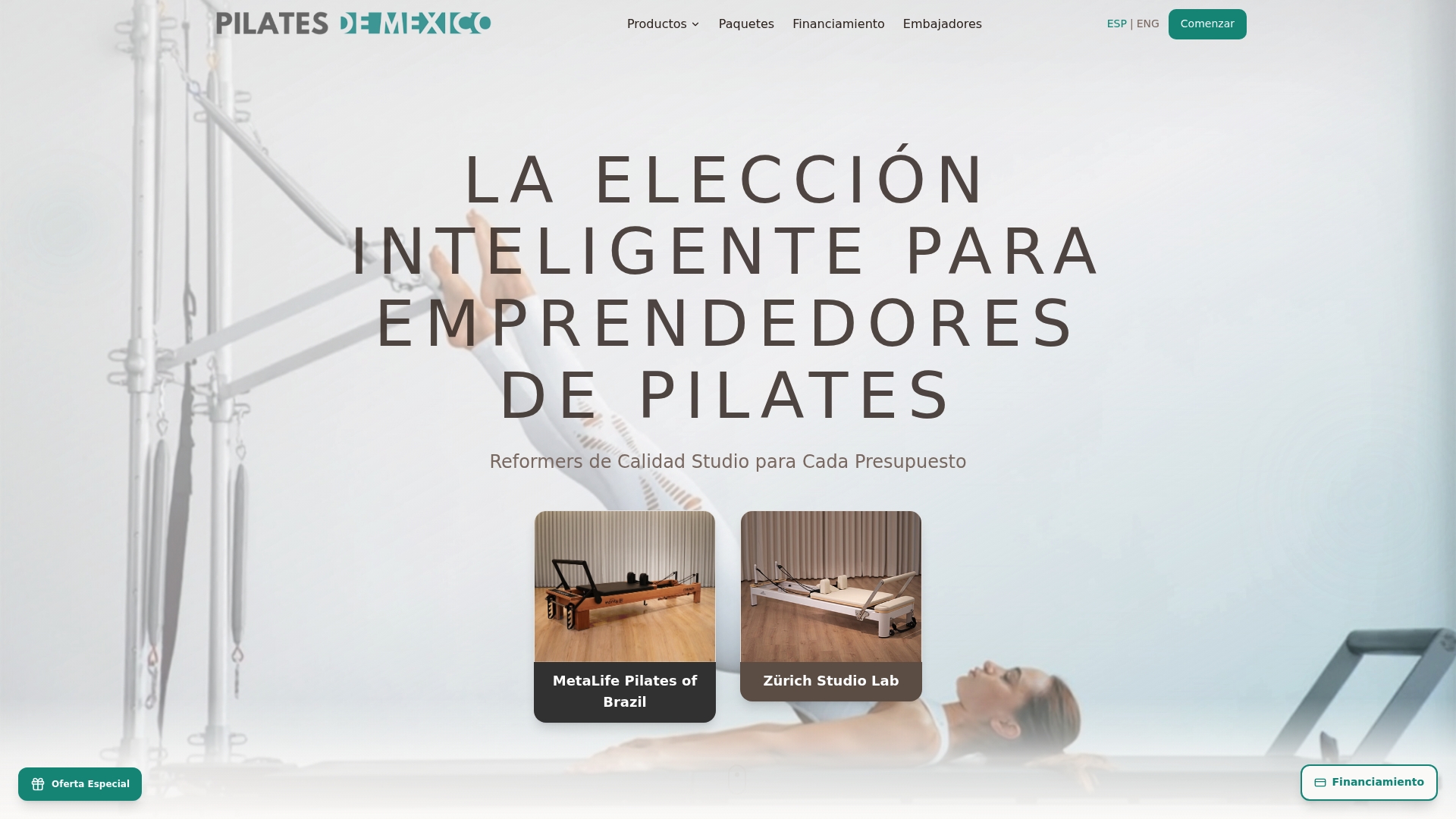
Pilates de México offers national stock of professional reformers, including the Zürich Labs Reformer, the MetaLife Infinity Reformer with Tower, and the Advanced Reformer, with delivery times confirmed in writing from the first contact. Studio packages include coordinated installation, direct financing, and opening consulting so your start date doesn't depend on assumptions. Prepare the number of equipment you need, your preferred model, and your target date, and contact us to receive a real delivery schedule before committing to any deadline.
Sources
These sources illustrate how vendors in Mexico count business days, apply cut-off times, and define shipping responsibilities:
- Delivery conditions | Martí
- Shipping to Mexico — Tienda Tecnología
- Delivery conditions and times | Decathlon México
- Shipping times to Mexico - Amazon Customer Service
- Delivery information - NordicTrack
Recommendation
Why studios across Mexico equip with Pilates de México
- MetaLife reformers — our flagship line: manufactured in Brazil from Brazilian hardwood and the number one selling Pilates Equipment brand in all of South America, featured in over 40,000 studios. Pilates de México is the exclusive distributor of MetaLife in Mexico: local stock, local technicians and a 3-year frame warranty.
- Advanced and Infinity Reformers by MetaLife — the two MetaLife lines most studios in Mexico choose, with towers, accessories and studio-grade upholstery.
- Zürich Labs — our accessible alternative when the budget is tighter.
- Studio packages — complete studio setups, with discounts on packages of 5+ reformers.
- Financing — equipment financing so your opening budget goes further.
- Certifications and workshops — instructor training and continuing education.
We own and operate studios throughout Mexico, so the advice comes from operators, not resellers. Request a quote.