Business Models for a Pilates Studio in Mexico

Business Models for a Pilates Studio in Mexico
A Pilates studio in Mexico rarely relies on just one revenue stream. The most common approach is combining memberships as a foundation, class packages for those who want flexibility without commitment, and single drop-in classes as a welcoming entry point. On top of that, studios often layer private sessions, workshops, and premium experiences. What varies from one studio to another is the format (mat, reformer, or hybrid), the physical space, and the available investment capital. Here we break down each model, how to choose yours, and what to include in your business plan.
At a Glance
- The strongest business model blends three pricing structures: recurring memberships, class packs, and single drop-in trial classes.
- There are four main operating formats: boutique studio, shared or multidisciplinary space, franchise, and hybrid (in-person plus digital).
- A benchmark initial investment for a reformer studio in Mexico ranges from several hundred thousand to over one million pesos, depending on the number of reformers and total square footage.
- Your plan should calculate studio capacity and break-even points before projecting revenue, while setting aside a three-month buffer for fixed expenses.
- Be sure to complete your tax registration (RFC) and COFEPRIS operating notice before opening your doors.
Table of Contents
- How a Studio Charges: Memberships, Packages, and Drop-In Classes
- Operating Formats: What Type of Studio Should You Open?
- Mat, Reformer, Private, or Group: How to Choose Your Offering
- Startup Costs by Studio Model
- Capacity, Break-Even Point, and Revenue
- What Your Business Plan Must Include
- Market Risks and How to Mitigate Them
- Essential Permits and Legal Requirements
- Equip Your Studio with Pilates de México
- Frequently Asked Questions
- Sources
How a Studio Charges: Memberships, Packages, and Drop-In Classes
First, you need to decide how your revenue will flow. A pricing guide for boutique studios in Latin America outlines three primary revenue models and recommends combining them:
| Model | Purpose | Ideal for |
|---|---|---|
| Recurring membership | Predictable monthly revenue | Students attending multiple times a week |
| Class pack | Flexibility and upfront payment | Those who don't want a monthly commitment |
| Drop-in or trial class | Entry point | First-time visitors discovering your studio |
Memberships serve as your financial backbone, providing the predictability needed to cover rent and instructor payroll. Class packs capture clients who travel frequently or have fluctuating schedules. Trial classes convert the curious into committed students—as long as you have a clear roadmap to guide them to the next step.
This hybrid approach is widely seen across the Mexican market. In April 2026, Mundo Startups described the Reformer model in Mexico as a dynamic blend of memberships, class packs, and premium experiences.
Per-Class Pricing Benchmarks
As a local reference point, AgendaPro México lists published rates in Mexico City around $240 MXN for a 60-minute individual session and $450 MXN for a 60-minute semi-private class. These figures reflect market samples rather than a fixed standard. Your actual pricing will depend on your neighborhood, your equipment quality, and class capacity.
Operating Formats: What Type of Studio Should You Open?
Virtuagym highlights four core studio formats. Here is how they translate into the Mexican market.
Boutique Studio
A standalone facility with a strong brand identity, small group classes, and premium rates. It requires a higher initial investment, but it builds loyal brand equity and community. This is the go-to format for operators planning to scale to multiple locations. Leading chains in Mexico demonstrate this potential: on June 10, 2025, Mercado Fitness reported that one brand was already operating 7 studios with 3 more in the pipeline, offering over 80 reformers every hour.
Shared or Multidisciplinary Space
If you already run a gym, a CrossFit box, a yoga, barre, or dance studio, or a physical therapy clinic, adding a reformer studio leverages your existing foot traffic, front desk staff, and lease. Virtuagym highlights this as an agile, cost-effective way to get started. For physical therapists and chiropractors, introducing reformers creates a high-margin service line through private or semi-private sessions.
Franchise
A franchise flattens the learning curve, but it comes with strict operational guidelines and recurring fees. To illustrate the scale, a prominent European brand lists a total investment of €300,000—including €135,000 in direct equity—offering both boutique and shop-in-shop gym models. Always evaluate royalty structures, territory exclusivity, and equipment mandates before signing.
Hybrid or Digital
This model blends in-person classes with live-streamed sessions and on-demand video libraries. Zenind includes it among today's standard operating models, noting that revenue streams can combine class packs, recurring memberships, private sessions, specialized workshops, and retail merchandise. According to bsport, hybrid boutique studios show greater financial resilience by diversifying their cash flow, outperforming models that rely solely on private sessions or high-volume group reformers.
Mat, Reformer, Privates, or Groups: How to Define Your Services
Crossfy outlines a practical framework:
- Mat: Attracts new students and validates local demand with minimal upfront investment.
- Reformer: Drives higher-ticket, recurring monthly memberships.
- Private Sessions: Addresses specific therapeutic or performance goals.
- Specialty Programs: Targets prenatal care, active aging, or joint mobility.
The same source cautions that launching too many formats at once complicates scheduling and requires broader instructor training, advising instead to start with three distinct offerings. A solid launch strategy: group reformer as your core service, private sessions for clients seeking tailored attention, and one signature specialty program that sets you apart from competitors.
Before locking in your lineup, clearly define your target demographic (beginners, advanced practitioners, athletes, rehab patients), what your local market is willing to pay, and the surrounding competitive landscape, as Zenind recommends.
Which Model Fits Each Profile
- Instructor opening their first studio: small boutique or shared space, with 4 to 6 reformers and financing.
- Established studio expanding: second location or room renovation, featuring equipment built for heavy daily use.
- Gym or fitness box adding reformers: multidisciplinary model with an add-on membership.
- Clinic: one-on-one or semi-private sessions with a therapeutic approach.
- Investor without a Pilates background: boutique studio with a management team and a lead instructor, supported by clear numbers from day one.
How Much It Costs to Open by Business Model
Figures vary widely. These are estimates published by industry guides in Mexico, not official pricing:
| Scenario | Estimated Investment | Source |
|---|---|---|
| 4 reformers, 50 m² | $469,000 MXN ($679,000 with a three-month operating cushion) | Pilaty |
| 12 reformers, 110 m² | $1,179,000 MXN ($1,590,000 with operating cushion) | Pilaty |
| Boutique with 5 to 6 reformers | $380,000 to $750,000 MXN | Syncro Fitness |
| Mat or yoga studio | $150,000 to $350,000 MXN | Amyra |
| Reformer studio | $500,000 to $1,500,000 MXN | Amyra |
According to Syncro Fitness's breakdown, six reformers with towers and boxes range between $210,000 and $420,000 MXN, buildout and renovations between $80,000 and $160,000, security deposits and upfront rent between $40,000 and $90,000, and a three-month reserve between $40,000 and $70,000.
Equipment is the line item you control the most. A durable line of reformers holds its resale value and prevents early replacements. To break down each expense, check out our guide on the costs of opening a Pilates studio in Mexico and our guide on how to choose the right location.

Capacity, Break-Even Point, and Revenue
Before banking on projected revenue, calculate your capacity ceiling. Ficha Fit summarizes it as available reformers multiplied by classes per day, days open, and price per class. They also recommend setting an exact class capacity, automating waitlists, and enforcing a consistent cancellation policy.
Your break-even point is calculated based on spots per class, classes per month, occupancy rate, and net revenue per spot. Pilaty illustrates this with six reformers, 30 weekly classes, $45,000 MXN in fixed overhead, and $350 MXN per class paid to the instructor: the studio breaks even at 49% occupancy. You can follow the formula step by step in our guide to the break-even point for a Pilates studio.
Revenue Benchmarks
Klasius reports gross monthly revenue of $95,000 to $165,000 MXN for medium-to-high demand studios in Mexico City, and $140,000 to $230,000 MXN in premium neighborhoods. For Guadalajara, they report $80,000 to $170,000 MXN, and for Monterrey, $110,000 to $210,000 MXN. These are editorial benchmarks, not official statistics: use them to sanity-check your calculations, not to replace them.
What to Include in Your Business Plan
According to Pilaty, a comprehensive business plan covers:
- Concept and target audience.
- Team training and hiring.
- Commercial space and zoning permits.
- Equipment.
- Licenses and permits.
- Initial investment and cash reserve.
- Pricing and class packages.
- Booking and payment systems.
- Marketing and presale strategy.
- Capacity and break-even point.
Factor in a conservative scenario for each point. For space planning, refer to our guides on how much space each reformer needs and fitting 6 to 8 reformers in 40 to 80 m². To fill your studio starting from presales, check out Pilates studio marketing. If you are looking for a comprehensive roadmap, we have a practical guide to opening a Pilates studio in Mexico.
Market Risks and How to Minimize Them
The market is vast. INEGI reported that in 2018, Mexico had 44,297 sports-related establishments, with an average annual growth rate of 5.4% between 2013 and 2018, along with 20,900 private fitness centers. While demand is strong, competition is too, so it pays to enter the market with a solid client acquisition plan.
Three ways to reduce risk:
- Validate before you invest. Pilaty suggests testing mat classes in a borrowed space or renting by the hour to gauge demand.
- Start with 4 to 6 reformers in a space that fits 8. That way, you can scale without relocating.
- Keep three months of fixed expenses as a cash cushion.
Another competitive advantage is professionalization. Mercado Fitness highlights that one Mexican chain doesn't just open locations—it trains instructors, boasting over 200 certified professionals through its academy. A well-trained team sustains quality as you grow.
Permits and Basic Legal Obligations
Review your tax situation with an accountant. The SAT indicates that your tax regime and obligations must first be determined according to your business activity, and that you must keep your RFC registration updated, including notices for opening new establishments and updating business activities.
Regarding health regulations, the COFEPRIS operating notice (aviso de funcionamiento) is submitted using your e.firma and official ID, and Ventanilla MiPyME lists it as free of charge. The DIGIPRiS manual specifies that each establishment can only file one notice for products and one for services, including address, activity, start of operations, and business hours. Be sure to also confirm local zoning (uso de suelo) requirements and municipal operating licenses.

Equip Your Studio with Pilates de México
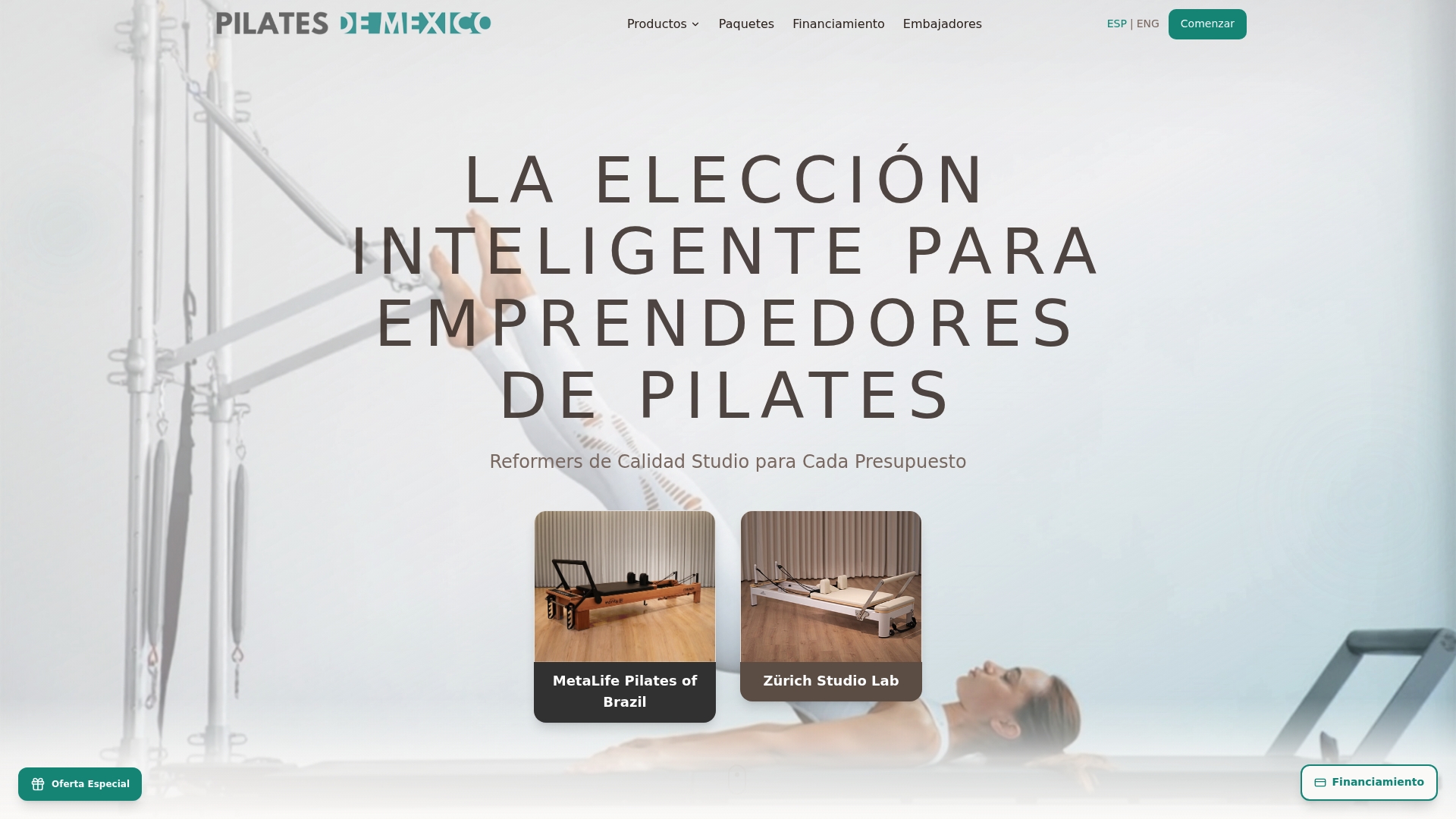
Whatever your business model, your equipment determines how long your investment lasts. At Pilates de México, we carry MetaLife, crafted with certified Lyptus® FAS wood and stainless steel hardware, as well as more accessible options so your first studio doesn't have to start at the highest price point. Every piece of equipment includes financing options, packages, and consulting from a team that understands the true cost of opening and filling a studio.
Explore the Infinity Line and Advanced Line, check out our financing options, or get started with our reformer for your first studio.
Frequently Asked Questions
What is the best business model for a Pilates studio?
There is no single one-size-fits-all answer, but the most solid model combines memberships, class packages, and trial classes. This structure provides predictable recurring revenue along with flexibility. Choose your format (boutique, shared, or hybrid) based on your capital and available space.
How much does it cost to open a Pilates studio with reformers?
Guides in Mexico publish broad ranges, from around $380,000 MXN for 5 or 6 reformers up to over $1,500,000 MXN for larger studios. It depends on the number of reformers, square footage, build-out costs, and your financial cushion. Calculate your own projection using real quotes.
Is it better to start with mat classes or with reformers?
Mat Pilates requires less upfront investment and is ideal for validating demand. Reformers, however, support higher-ticket memberships. Many studios launch with group reformer classes and add mat or private sessions later on.
Can I add reformers to my gym or clinic?
Yes. The multidisciplinary model leverages your existing space, current clients, and front desk. Calculate the required space per reformer and set up a dedicated membership or package specifically for the studio room.
Sources
- Pricing models for boutique studios (Jogo)
- The awakening of Pilates in Mexico (Mercado Fitness)
- Pilates reformer studios grow like fitness startups (Mundo Startups)
- Pilates in Mexico City (AgendaPro)
- How to open a Pilates studio (Virtuagym)
- Franchise (Pilat3s)
- How to start a Pilates business (Zenind)
- Profitable Pilates studio (bsport)
- Types of Pilates (Crossfy)
- How to open a Pilates studio in Mexico (Pilaty)
- Cost of opening a studio (Syncro Fitness)
- Guide to opening a studio (Amyra)
- How much revenue a studio generates (Klasius)
- How to open a studio (Ficha Fit)
- Sports statistics (INEGI)
- Tax obligations simulator (SAT)
- How to pay taxes (SAT)
- COFEPRIS operating notice (Ventanilla MiPyME)
- DIGIPRiS user manual