Pilates Reformer Trends in 2026 for Studios
Pilates Reformer Trends in 2026 for Studios
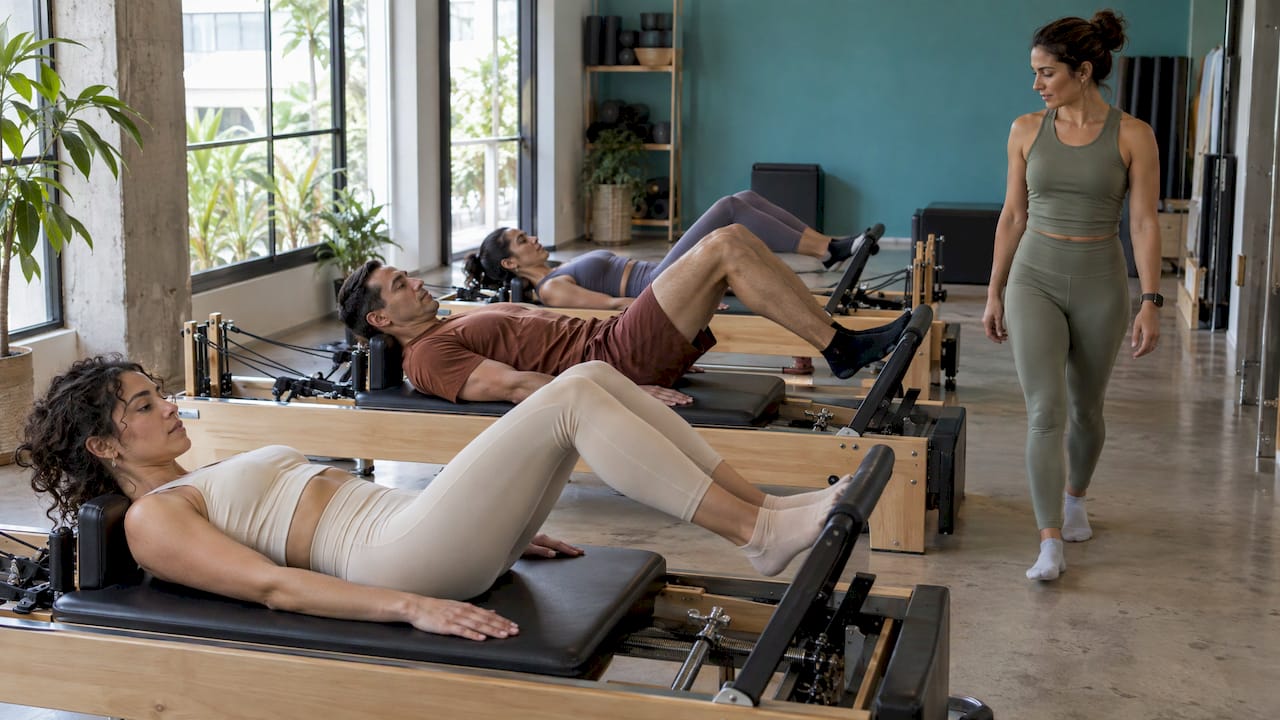
The clearest trend of 2026 is that the reformer has stopped being just an extra feature in the studio and has become the core of the business: more classes, more bookings, and higher demands on the equipment that supports them. For anyone opening or expanding a studio in Mexico, this translates into a concrete decision: choosing reformers that can handle back-to-back daily classes, adapt to new formats, and retain their value when it is time to scale. That is the philosophy behind how we equip studios at Pilates de México, and it is the guide we follow in this article.
In Brief
- The Mexican pilates and yoga studio market reached USD 2.4 billion in 2025 and is projected to hit USD 5.1 billion by 2034, according to IMARC Group.
- Top-performing studios are focusing on strength-focused classes, smaller group sizes, and hybrid formats—all of which demand durable, versatile reformers.
- Opening a reformer studio in Mexico requires an investment that Amyra estimates between $500,000 and $1,500,000 MXN, making financing and packages just as crucial as unit price.
- Durability, maintenance, and resale value must be evaluated before purchasing, not after: wood quality, hardware, and local support determine how long your equipment lasts.
Table of Contents
- Why Pilates Demand Is Growing in Mexico
- Class Formats Defining 2026
- How Reformer Studio Layouts Are Evolving
- Gyms, Multi-Discipline Studios, and Clinics
- Investment and Financing: Key Calculations
- Durability, Maintenance, and Resale Value
- Equip Your Studio with Pilates de México
- Frequently Asked Questions
- Sources
Why Pilates Demand Is Growing in Mexico
This growth is not just a social media trend. IMARC Group’s report on pilates and yoga studios in Mexico, updated in April 2026, estimates a market value of USD 2.4 billion in 2025 with a projection of USD 5.1 billion by 2034, reflecting a compound annual growth rate (CAGR) of 8.61% between 2026 and 2034. The report links this expansion to the rise in stress-related health conditions and the arrival of more than 45 million international tourists in 2024.
The broader fitness context also helps. Health & Fitness Business's HFA Global Report 2026 recorded a total of 20,642 facilities, 7.2 million consumers, and a 5.6% penetration rate for Mexico in 2024, placing Pilates among the modalities experiencing rising demand, alongside yoga, functional training, and recovery services. The same report cites INEGI's MOPRADEF 2025: 41.7% of the population aged 12 and older engages in physical activity during their leisure time.
Foreign investment confirms this trajectory. In October 2024, an international studio chain signed a master franchise agreement to open at least 65 studios in Mexico over the next decade, backed by $72 million in financing, according to IMARC Group. When operators of that caliber see an opportunity, the market for well-equipped independent studios expands as well.

What North American Data Reveals
Mexico still has limited publicly available data broken down by modality, so it is worth examining the Pilates 2026 report by Mariana Tek, a leading studio management platform. Based on December 2025 data across North America, 42% of its studios offer Pilates, boasting an average class occupancy of 65% compared to 49% across all fitness modalities. The average class price is 29% higher, and memberships cost 48% more than those of other modalities.
Another crucial data point for prospective studio owners: 17% of monthly Pilates studio visitors are first-timers, compared to 9% in other modalities, and retention remains strong after the first two visits. Furthermore, 43% of clients belong to Gen Z, and the average age is 32. While these statistics reflect a different market, they describe a young, higher-paying, and loyal demographic that is increasingly prominent in Mexico's major metropolitan areas as well.
Class Formats Defining 2026
Founders surveyed in the Mariana Tek report agree on a clear trend: clients want physical challenges without the wear and tear of high-impact workouts. Greg Galloway, founder of Peak45, notes that the strongest growth is driven by strength-focused classes: muscular endurance, control, and full-body efficiency. In the same report, Sydney Dumler, founder of Forza Pilates, highlights a strong appetite for in-person community experiences, with the reformer consistently ranking among the most popular classes due to its versatility, full-body strength, and balanced mobility work.
For anyone outfitting a studio, these trends carry direct practical implications:
- Strength-based classes: heavier spring resistance, higher repeated loads, and longer daily operating hours per unit. Structural frames and hardware deteriorate much faster if they aren't engineered for commercial use.
- Mid-sized groups and app-based bookings: studio rooms designed for 6 to 10 reformers, running packed schedules with virtually zero tolerance for equipment downtime.
- Hybrid formats: reformer workouts combined with functional training or specialized props. This makes a compatible ecosystem of accessories for your reformer fleet all the more valuable.
- Community and ambiance: a studio sells through the experience it delivers. A stable, whisper-quiet reformer with premium wood finishes is an integral part of that client experience.
With a commercial-grade reformer, the same room can easily host high-intensity strength classes in the morning and restorative mobility sessions in the afternoon without changing equipment. That level of versatility is essential when comparing models. If you are currently evaluating your options, our guide on how to choose a reformer for your studio or clinic breaks down every key criterion step by step.
How Reformer Studio Layouts Are Evolving
In 2026, studio spaces are designed around capacity and member flow rather than simply square footage. Three key decisions guide the planning process:
- How many reformers fit with actual working space. Each piece of equipment requires clearance around it for mounting, dismounting, and instructor hands-on corrections. Sizing it properly prevents a cramped, uncomfortable room. We break down the exact measurements in how much space each reformer needs.
- What equipment goes beyond the reformer. Cadillacs, chairs, and accessories expand your offerings for private sessions and rehabilitation without having to multiply the number of reformers. You can explore the options in studio accessories.
- Which equipment line supports the intended use. A studio running daily group classes does not place the same demands on equipment as a private-session room. The premium MetaLife line is built for heavy-duty use, while more accessible professional options allow you to launch on a controlled budget.
A common mistake is purchasing the exact number of reformers that fill up during the first month. If demand trends hold, your studio will need to grow. Choosing a line you can expand with the same style and matching quality makes the second purchase seamless.
Gyms, multi-discipline studios, and clinics
The reformer no longer belongs solely to the Pilates studio. Gyms, yoga, barre, dance, CrossFit, or HYROX studios, as well as physical therapy and chiropractic clinics, are incorporating it because it fills a gap their current offering doesn't: controlled, low-impact strength training with measurable progression.
The approach varies depending on the type of operator:
- Gyms and multi-discipline studios: it is best to start with a small room—4 to 6 units—and set schedules. The reformer attracts a new demographic and complements the training of existing members.
- Rehabilitation, physical therapy, and chiropractic clinics: stability, fine spring adjustment, and ease of use with patients take priority. Robust, properly installed equipment minimizes scheduling disruptions.
- Investors without a Pilates background: the equipment is the core asset. The smartest move is to rely on studio launch consulting and choose equipment backed by local support, because the business relies on classes running every single day.
In every scenario, professional installation and a local warranty matter more than they seem. A studio shut down for a week over a pending spare part costs classes and client trust.
Investment and financing: what to factor in
Amyra, a Mexican guide for opening studios, estimates that a reformer Pilates studio in Mexico requires between $500,000 and $1,500,000 MXN, with equipment ranging from $35,000 to $120,000 MXN per unit. It models an average ticket of $250 to $450 MXN per class, groups of 6 to 10 people, and an unlimited membership around $2,200 MXN per month. With 8 reformers, it estimates between 70 and 100 active clients to achieve a 25% to 30% profit margin. It also suggests equipment leasing to lower the initial capital investment.
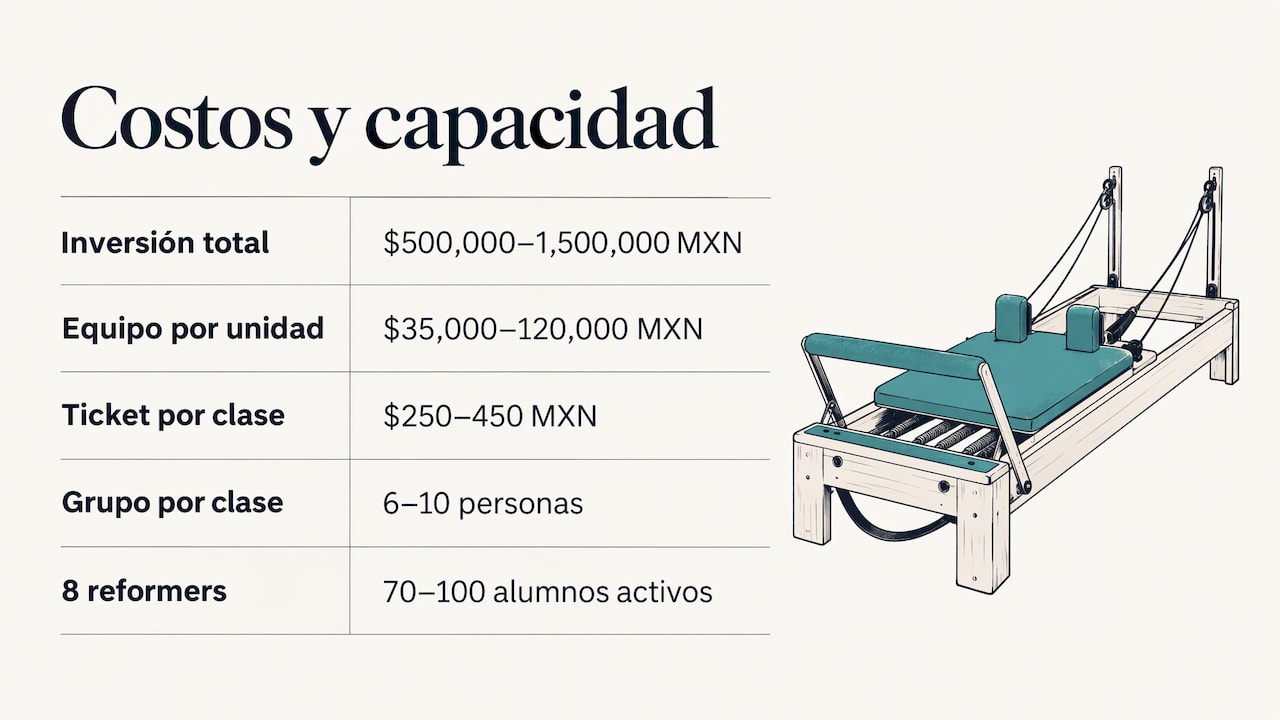
These are estimates from a guide published in September 2026, not guarantees. They serve as a baseline to build your own model: multiply reformers by classes per day, by capacity filled, by ticket price, and compare that against rent, payroll, and equipment payments. To dive deeper into each cost line, check out our guide on costs to open a Pilates studio in Mexico and our guide on studio profitability in 2026. For per-unit pricing, check out the professional reformer pricing guide.
How financing helps
Equipment is the single largest upfront expense, and it is precisely where financing makes all the difference: it allows you to launch with a fully equipped room instead of cutting back on units or postponing your grand opening. At Pilates de México, we offer direct financing and multi-unit packages, along with launch and expansion consulting. And because we carry both the premium MetaLife line and accessible options manufactured in China and other countries, your first studio doesn't have to start at the highest price point.
Once the studio opens, the challenge shifts: filling it and retaining your clients. Two valuable reads are our guide on marketing for a Pilates studio and our guide on client retention.
Durability, maintenance, and resale value
If high-intensity strength classes and fully booked studios are the trend, equipment wear and tear is the natural consequence. Before buying, be sure to assess four key factors:
- Frame material. The MetaLife line uses certified Lyptus® FAS wood, engineered for years of daily classes.
- Hardware. Stainless steel components withstand heavy use and sweat better, which is the silent enemy of any studio.
- Versatility. A frame that supports more than 200 exercises allows you to program diverse classes without changing equipment.
- Local backing. A warranty in Mexico, professional installation, and dedicated equipment support are what keep your studio running.
Resale value is decided at the time of purchase. A well-maintained reformer from a recognized brand retains its value when it's time to upgrade or expand. Our approach is to buy once and buy right, and we consider resale value an essential part of what our equipment offers. With regular maintenance of springs, ropes, pulleys, and upholstery, your studio looks great and your equipment stays in peak condition.
How to choose based on your situation
| Your situation | What to prioritize | Line to consider |
|---|---|---|
| Established studio upgrading or expanding | Durability, heavy use, and resale value | Infinity Line |
| Instructor opening their first studio | Entry-level price and financing | Advanced Line |
| Gym or multi-discipline studio | Small footprint, expandable, equipment bundles | Equipment packages |
| Rehabilitation clinic | Stability and ease of adjustment | Reformer and accessories |
| Investor | Local support and advisory | Package with consulting |
If your project falls between several options, we also have a guide with alternatives for outfitting your reformer studio.
Equip your studio with Pilates de México
Pilates de México is the equipment partner behind reformer studios across the country. We carry MetaLife, the leading reformer line in South America and now available in Mexico, as well as equipment from Zürich Studio Lab, with certifications and dedicated support in Mexico, local warranty, and professional installation. Every piece of equipment includes financing options, packages, and consulting from a team that knows what it takes to open and fill a studio.
If you already know how many reformers you need, request a quote for your Pilates equipment. If you are still planning your space, start by exploring our reformer lines, and let’s design your package together.
Frequently Asked Questions
Is Pilates reformer still growing in 2026?
Yes. IMARC Group projects that the Mexican Pilates and yoga studio market will grow from USD 2.4 billion in 2025 to USD 5.1 billion by 2034. In North America, Pilates studios report an average class occupancy rate of 65%, compared to 49% across all fitness modalities.
How much does it cost to open a reformer studio in Mexico?
Amyra estimates between $500,000 and $1,500,000 MXN for a full studio, with equipment ranging from $35,000 to $120,000 MXN per unit. The final investment depends on the number of reformers, studio space, and accessories. Financing options and equipment bundles can help spread out the initial investment.
Can a gym or clinic add reformers?
Yes, and it is an increasingly popular path. It is best to start with a few units, set dedicated schedules, and choose reformers that are stable and easy to adjust. You can always expand the studio as demand grows.
What makes a reformer retain its resale value?
Frame quality, durable hardware, and proper maintenance. MetaLife’s certified Lyptus® FAS wood and stainless steel hardware are engineered for years of daily use, while local backing makes servicing easy throughout the lifespan of the equipment.