Pilates Reformer Demand in Mexico: Data and How to Equip Your Studio

Reformer Demand in Mexico: Data and How to Equip Your Studio
Demand for Pilates Reformers in Mexico is growing steadily, and it is doing so in the segment that matters most to equipment buyers: small, high-ticket classes with clients who return multiple times a week. The Pilates and yoga studio market expanded from USD 2.4 billion in 2025 to a projected USD 5.1 billion by 2034. For you, the question is no longer whether there is demand, but how many reformers you need, of what quality, and with what financing options to fill them without falling short or overinvesting.
This article brings together the data that actually allows you to measure that demand, explains what it means for your specific case (expanding studio, first studio, gym, clinic, or investment), and concludes with a clear roadmap to guide your purchasing decision.
In Summary
- The Mexican Pilates and yoga studio market was valued at USD 2.4 billion in 2025, with a projected USD 5.1 billion by 2034 and a compound annual growth rate of 8.61% for 2026–2034.
- Demand is no longer just niche: it is driven by professionals aged 25 to 45, seniors, runners, office workers, and individuals recovering mobility.
- The median price for a group reformer class is $270 MXN, and equipment costs between $35,000 and $120,000 MXN according to an opening guide: the quality of the reformer determines how many years you can generate revenue from it.
- Public figures have limitations: use them to scale your studio in phases, rather than betting all your capacity at once.
- With Pilates de México, you can start with an affordable line or with MetaLife, supported by financing, packages, and consulting.
Table of Contents
- How Large Is the Demand Today
- Who Fills Reformer Classes
- Signs That Demand Supports a New Studio
- What a Class Charges and What It Costs to Equip
- The Limitations of the Data
- How to Translate Demand into Equipment Purchases
- Equip Your Studio with Pilates de México
- What to Watch Before Setting Your Capacity
- Frequently Asked Questions
- Sources
How Large Is the Demand Today
There is no official figure for “reformers sold per year” in Mexico. Demand is measured using proxy indicators. The most comprehensive is the overall market size of Pilates and yoga studios: IMARC Group estimates it at USD 2.4 billion in 2025 and projects USD 5.1 billion by 2034, representing a compound annual growth rate of 8.61% between 2026 and 2034.
A projection is an estimate, not a guarantee. Even so, the trajectory aligns with what is being observed across the industry. In September 2025, the boutique fitness market in Mexico grew by over 30%, driven by concepts like reformer Pilates. The model combines memberships, class packages, and premium experiences.
Two main drivers explain much of this growth, according to the same IMARC report:
- Stress and long work hours. Mexico has the highest percentage of people working long paid hours (27%), and stress-related health issues are driving more people toward studios offering personalized classes and wellness.
- Wellness tourism. The country welcomed more than 45 million international tourists in 2024. Studios in tourist destinations offer short-term packages and bilingual instructors, while some boutique hotels partner with local studios.
Who Fills Reformer Classes
Demand is better understood through specific profiles rather than aggregate numbers. Here is what the data shows.
High-Frequency Urban Professionals
According to industry association data cited by Metro Noticias in February 2026, the typical boutique Pilates client in Mexico City is between 25 and 45 years old, a professional or creative with an upper-middle income, who values personalized attention. Sixty-two percent pay monthly memberships ranging from $2,800 to $4,200 MXN, and more than 40% attend three or more times per week.
For studio owners purchasing equipment, frequency is the key metric. A client attending three times a week uses the reformer about 12 times a month. That continuous daily wear and tear demands commercial-grade equipment built for back-to-back sessions.
An Increasingly Diverse Audience
Excélsior (August 2026) describes classes shared by men, adults in their 50s and 60s, runners, office workers, and clients recovering mobility after an injury. It highlights a studio in Polanco-Anzures, Mexico City, that welcomes everyone from seniors over 60 to individuals with specific mobility needs.
For your studio floor, this means reformer Pilates is no longer limited to a single demographic. The same space can serve athletes cross-training, active seniors, and individuals restoring functional movement. As a result, you can keep your schedule booked across more hours of the day.
Clinics and Rehabilitation Spaces
If you manage a physical therapy or chiropractic clinic, the trend is identical: more and more patients turn to Pilates to restore mobility. A reformer provides variable resistance and zero-impact movement, allowing practices that integrate it to expand their services into ongoing recovery and maintenance sessions. While clinical protocols depend on your own professional judgment, what the equipment delivers is a stable, precision-adjustable bed built for heavy, continuous use throughout the day.
Signs That Market Demand Supports a New Studio Room
The indicators that matter aren't social media trends—they are the ones directly impacting your cash flow.
Studios expanding to multiple locations. The Fit Pilates operates 7 studios across Mexico and, according to its director Isaac Kably in Mercado Fitness, projects closing 2026 with at least 20 locations and over 80 reformers running every hour. That installed capacity proves operators are confident enough to invest at scale.
International capital. In October 2024, an international studio franchise announced—citing the IMARC report—a master franchise agreement to open at least 65 studios in Mexico over the next decade, backed by $72 million USD in funding. When well-funded competitors enter the market, your competitive edge lies in opening with superior equipment and seamless operations.
High occupancy and standardized sessions. According to Mundos Startups, high occupancy accelerates return on investment, while session standardization makes it easy to replicate the concept across multiple locations. That is what makes launching a second studio room far easier than the first.

Class Pricing vs. Equipment Costs
Demand translates into a viable business when two numbers balance out: what each client pays and what you invested per reformer.
A review of published rates across 39 studios in six cities, conducted on September 23, 2026, shows a median of $270 MXN per group reformer class, with half of the studios charging between $240 and $310. In CDMX, the median is $325, and outside CDMX it is $250. In 8-class packages, the median drops to $211 per class.
On the investment side, a guide to opening studios in Mexico estimates an initial investment between $500,000 and $1,500,000 MXN, largely driven by equipment, which costs between $35,000 and $120,000 MXN per unit. That same guide suggests an average ticket of $250 to $450 MXN per class and group sizes of 6 to 10 people. For a space of around 80 to 120 m² with 8 units, it calls for ceilings of at least 2.7 meters and good ventilation.

A Sample Calculation
Let’s consider an 8-reformer room and the national median of $270 MXN per class. This is a basic mathematical example, not a market projection:
- A full class of 8 people generates $2,160 MXN.
- With 4 full classes per day, 6 days a week, that amounts to 24 classes and $51,840 MXN weekly at 100% capacity.
- If your actual occupancy is 60%, that figure would be $31,104 MXN weekly.
With that range, you can compare the cost of each reformer against the revenue it can generate. For profitability and break-even analysis, this guide on whether a Pilates studio is profitable dives deeper into different scenarios, and costs to open a studio breaks down the rest of the investment.
The Limitations of the Data
Use these figures with discretion. Three key precautions will help you avoid oversizing your studio.
- The market is still small compared to the overall population. The Mercado Fitness Mexico 2024 Overview estimates 7.2 million people hold a membership at a club, gym, or studio—just 5.64% of the population. Furthermore, 73% of facilities serve fewer than 400 people. Isaac Kably sums it up by saying that the Pilates market is “still in its infancy,” which is precisely where the opportunity lies.
- Demand is highly localized. Median prices vary significantly between CDMX and the rest of the country, and the demographic willing to pay memberships between $2,800 and $4,200 is concentrated in specific neighborhoods. Assess your area before multiplying beds.
- The target audience is specific. The cited opening guide targets women aged 25 to 55 from middle-to-high and high socioeconomic backgrounds, with over 60% arriving by car. Parking and location matter just as much as equipment.
The practical approach is phased growth: launch with the number of beds your schedule can consistently fill, track occupancy, and add equipment once waitlists justify it.
How to Turn Demand into Equipment Purchases
Equipment is the workhorse of your investment: each reformer is used in classes every single day for years. Make your decision based on your specific situation.
If You Already Own a Studio and Are Expanding or Renovating
Your primary criteria should be durability and resale value. With daily classes, the quality of the wood, hardware, and structural build is critical. MetaLife, the line we carry at Pilates de México, is built with Lyptus® FAS certified hardwood, stainless steel hardware, and a frame engineered to support over 200 exercises and years of daily classes. The Infinity and Advanced lines are specifically designed for this intensive use. If you are looking for uniformity throughout your studio, our studio packages bundle multiple units into a single purchase.
If You Are an Instructor Opening Your First Studio
Your main considerations are price and financing. We also offer affordable options manufactured in China and other countries, so your first studio doesn't have to start at top-tier pricing. You can begin with a few beds, fill your time slots, and add more later. Explore our financing options before finalizing your budget, and consult our practical guide to opening a Pilates studio to plan your steps.
If You Operate a Gym or a Studio for Another Discipline
If you run a fitness, yoga, CrossFit, HYROX, barre, or dance facility, adding a reformer room means offering a higher-ticket class to your existing member base. Start with a small group of reformers and measure how many members book them. Exploring business models for a Pilates studio helps you decide whether to operate it as a membership tier, class pack, or premium add-on service.
If you run a physical therapy or rehab clinic
Your space requires just a few stable, highly ergonomic units, since you work by appointment rather than with large group classes. Complement them with props to adapt exercises to different patients: check them out in our accessories section.
If you are an investor without a Pilates background
Your main focus is ROI. What you can directly control is your startup cost, payment schedules, and the quality of equipment that will maintain strong resale value. A Pilates studio consulting session helps you organize your numbers before committing capital.
Equip your studio with Pilates de México
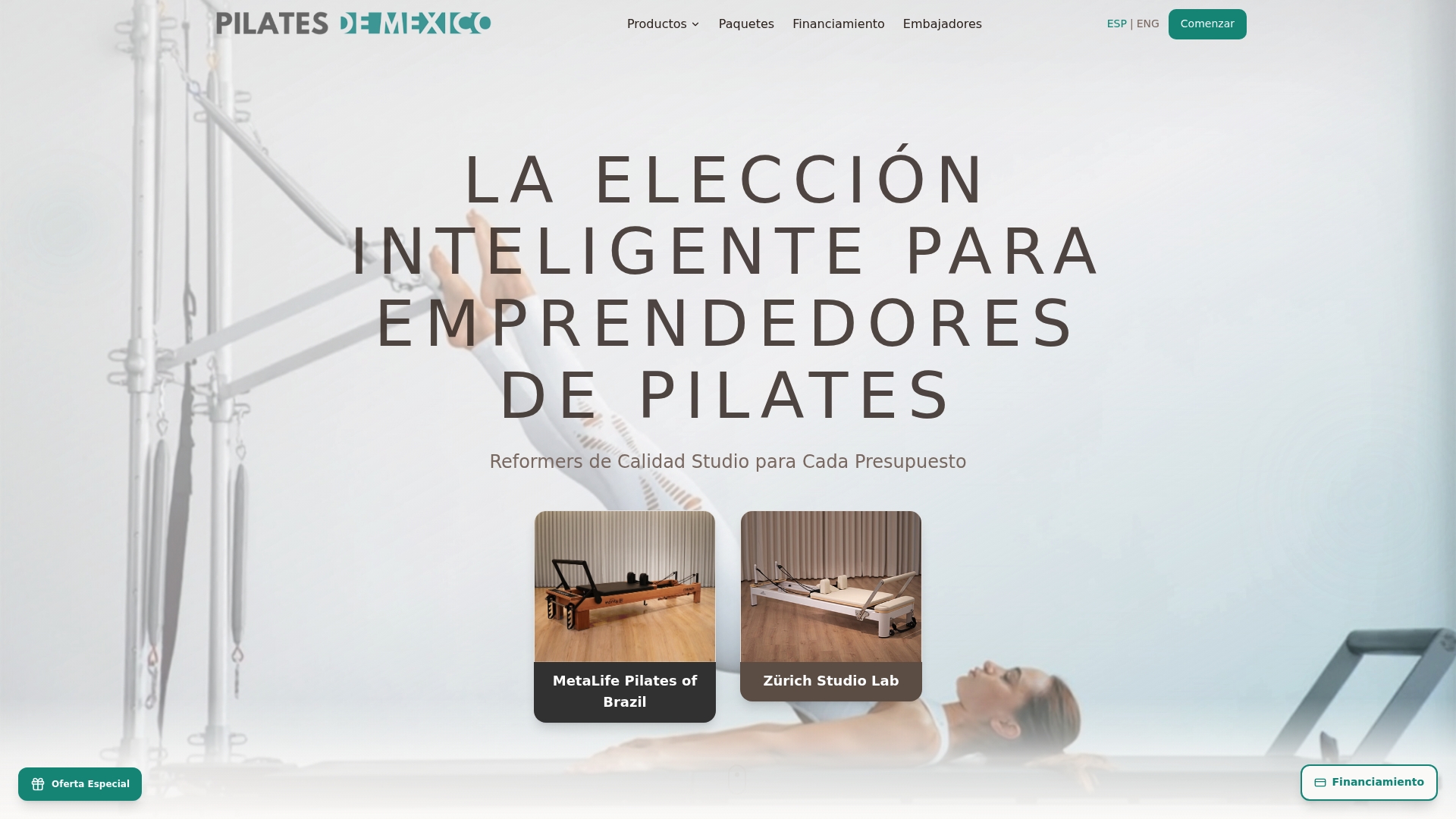
At Pilates de México, we are the equipment partner behind reformer studios across the country. Every equipment setup includes financing options, studio packages, and expert consulting from a team that understands what it takes to open and fill a studio. Our lineup features MetaLife and Zürich Studio Lab equipment backed by local warranties, professional installation, and end-to-end guidance—from layout design and permits to ongoing operations.
If you already know how many reformers you need, explore our reformer lines or request a quote for a studio package. If you are still mapping out your plan, start by reviewing our financing options.
What to watch before locking in your capacity
Before purchasing, track these five key indicators within your local market:
- Waitlists. If your classes consistently book up in advance, there is proven demand for another reformer.
- Peak vs. off-peak hours. Early mornings and evenings tend to fill up quickly. Decide whether new reformers will serve peak demand or help balance off-peak times.
- Client visit frequency. Clients attending three sessions a week justify higher-tier memberships and support intensive equipment use.
- Local pricing benchmarks. Compare your rates against the median in your specific city, not just the national average.
- Tourism and seasonality. In tourist-heavy areas, short-term class packs and bilingual instruction can unlock an additional revenue stream.
Once you have this data, calculate your ROI per reformer and determine your financing strategy. Securing studio insurance and the required permits wraps up your checklist ahead of opening day.
Frequently asked questions
Is there enough Pilates reformer demand in Mexico to open a studio?
Market data points to sustained growth: IMARC projects a compound annual growth rate (CAGR) of 8.61% from 2026 to 2034 for Pilates and yoga studios. However, demand is inherently local. Evaluate your neighborhood’s demographic profile, nearby class pricing, and your ability to fill schedules before determining how many reformers to purchase.
How much does a reformer class cost in Mexico?
The median price for a single group class is $270 MXN, according to a survey of 39 studios published in September 2026. In Mexico City (CDMX), the median is $325 MXN, compared to $250 MXN outside CDMX. With an 8-class pack, the median price drops to $211 MXN per class.
What client profile drives this demand?
The most prominent segment consists of professionals aged 25 to 45 in the mid-to-high income bracket who attend regularly. We are also seeing growing participation among active older adults, runners, men supplementing strength training, and clients working on mobility rehabilitation.
How many reformers does a new studio room need?
A typical studio opening guide recommends spaces between 80 and 120 m² (approx. 860 to 1,300 sq ft) with 8 units. Many businesses launch with fewer reformers and scale up as attendance grows. Project how many full classes you can realistically run per day, and expand your equipment footprint once your waitlists support it.
Is it better to start with a premium reformer or an entry-level model?
It depends on your expected utilization and budget. For back-to-back daily classes and high resale value, the MetaLife line is crafted from FAS-grade Lyptus® reforested wood and stainless steel hardware. For a first studio operating on a leaner budget, we also offer cost-effective, accessible alternatives. Our team can help you select the ideal option for your business plan.
Sources
- IMARC Group: Pilates and yoga studios market in Mexico
- Mundos Startups: Pilates reformer studios growing as fitness startups
- Metro Noticias: The boutique Pilates boom in CDMX
- Excélsior: Pilates breaks old stereotypes
- Mercado Fitness: The awakening of Pilates in Mexico
- Pilaty: How much does a Pilates reformer class cost
- Guide to opening a Pilates or Yoga studio in Mexico
- Mercado Fitness: Mexico 2024 Market Overview