Pilates Instructor Discounts: How Studios Save in Mexico

Pilates Instructor Discounts: How Studios Save Money in Mexico
The discounts that truly impact the cost of equipping a studio in Mexico come through three channels: wholesale packages, direct financing, and the ambassador program. Pilates de México combines these three with local warranty and CFDI invoices, which also allows for immediate deduction. If you're looking for real savings, start there, not with seasonal promotions.
In summary:
- Volume discounts, ambassador programs, and seasonal promotions do not guarantee warranty, delivery, or replacement conditions; it is necessary to review them in detail before committing.
- Real tax deduction depends on adding the negotiated price, additional CFDI costs, and financial cost if the purchase is financed, not just the discount on the invoice.
- The recommended initial purchase for a new studio is 4 to 6 reformers, and expansion should only occur when peak hour occupancy reaches close to 80%.
- It is essential to request written warranties and service conditions, with details of coverage, timelines, and responsibilities, to avoid additional costs in case of problems.
- Acquiring equipment through integrated packages that include financing, local warranty, and consulting reduces costs and risks, facilitating a more agile and profitable opening.
Table of Contents
- What types of discounts are available for purchasing Pilates equipment in Mexico?
- How does a discount translate into real tax savings?
- MetaLife vs. Accessible Options: What weighs more in the decision?
- Checklist before finalizing a discounted purchase
- How long does it take to buy discounted equipment in Mexico?
- What costs, besides the equipment price, should you budget for?
- When is the right time to buy more reformers?
- What questions should you ask the supplier before accepting a discount?
- Red flags when negotiating discounts or hiring instructors
- What warranty and local support should you demand when buying at a discount?
- What Pilates de México brings to the discount equation
- Request your discounted quote today
- Sources
- Frequently Asked Questions
What types of discounts are available for purchasing Pilates equipment in Mexico?
Discounts for studios and gyms in Mexico fall into four categories with distinct logics. Confusing them is the most common mistake when negotiating with a supplier.
Volume discounts reward the quantity of units in a single order. Most suppliers scale the benefit: an order of 4 reformers gets a better unit price than an order of 2, and from 6 or 8 units, an additional level often opens up, including preferential shipping or installation conditions. Always ask for the level table in writing before signing, because many suppliers negotiate it case by case and do not publish it.
The ambassador program works differently: certified instructors or industry influencers recommend equipment in exchange for a commission, and that commission can be converted into credit for the next purchase or a direct discount for the studio they refer. It's an underutilized avenue for studio owners who already have a relationship with local trainers.
Seasonal promotions (year-end, brand anniversary, launches) offer immediate savings but rarely include the fixed contractual conditions of a negotiated package: extended warranty, signed delivery times, replacement clauses. They are useful for buying accessories or an additional unit, not for setting up a complete room.
Importing inexpensive equipment directly from the factory seems attractive on paper, but it carries risks that are rarely calculated upfront:
- Transit times of 45 to 90 days that delay the studio's opening.
- Customs procedures that can generate unforeseen costs if the tariff classification is not declared correctly.
- Non-existent warranty or managed from another country, with response times of weeks.
- Without a local representative, any piece damaged in transit becomes a total loss.
How does a discount translate into real tax savings?
The nominal discount on the invoice is only half the equation. The other half is defined by the tax treatment of the investment and the real cost of financing if you buy in installments.
Article 31 of Mexican tax law establishes which concepts make up the "original amount of the investment": it is not just the price of the reformer, but also freight, installation, insurance, and commissions associated with the purchase. This means that your deductible base grows if the supplier invoices these concepts separately in the same CFDI, instead of absorbing them as a "courtesy."
If your studio or gym invoices less than 100 million pesos per year, you can opt for the immediate deduction of investments offered by the SAT for new fixed assets, under the conditions established by that program. Applying it along with competitive financing reduces the effective capital cost of the purchase, without implying a high operational burden from the first month.
To calculate the real net savings, follow this order:
- Take the list price and subtract the discount negotiated by volume or ambassadors.
- Add freight, installation, insurance, and commissions that appear itemized in the CFDI.
- If financing, calculate the total cost in installments (include opening fees and any interest).
- Compare that total against the applicable tax benefit in your regime before deciding the amount to finance.
Professional tip: before closing any purchase, confirm with your accountant if your tax regime and annual income qualify for the immediate deduction; limits and percentages vary depending on the type of asset and not all studios apply equally.
MetaLife vs. Accessible Options: What weighs more in the decision
The question is not which reformer is abstractly better, but which one suits your business phase.
The premium MetaLife equipment, the leading line of reformers in South America and now available in Mexico, is built with certified Lyptus® FAS wood and stainless steel hardware, designed to withstand more than 200 exercises and years of daily classes without losing structural rigidity. This durability translates into fewer maintenance visits and parts that are still available years later, something not all manufacturers guarantee.
Accessible options manufactured in China and other countries perform well when the goal is to validate demand before committing high capital. They make sense in three specific scenarios:
- Studios opening for the first time and not yet confirming how many classes they will fill per week.
- Gyms adding reformers to an already operating space, without certainty if the format will stick.
- Expansions where cash flow must also be allocated to instructor training and local marketing.
Resale is another factor almost never calculated when buying. A premium reformer with a certified structure maintains market value years later, while economical equipment quickly loses resale appeal because buyers are suspicious of the maintenance history. If your plan is to grow and eventually renew your machine park, premium equipment protects that exit strategy.
Checklist Before Finalizing a Discounted Purchase
An attractive discount on the unit price is worthless if the rest of the contract has loopholes. Before signing, review these five points:
- Require that the CFDI (tax invoice) describes each concept separately (equipment, freight, installation, insurance) so that the deductible base is clear for any tax review.
- Confirm the local warranty in writing: coverage period, who repairs, and how many business days the provider will respond.
- Clarify if installation, assembly, and functional testing are included in the agreed price or charged separately.
- If financing is involved, ask for the total annual rate, opening commissions, and what exactly happens if you are late on a payment.
- Document in writing who assumes responsibility if the equipment arrives damaged: the provider, the carrier, or the studio.
Skipping any of these points usually costs more than the discount you just negotiated.
How Long Does it Take to Buy Discounted Equipment in Mexico?
The complete process, from the first quote to the reformer being installed and operating, takes between two and six weeks when the provider has local inventory in Mexico. Times stretch significantly longer if the order depends on direct import.
The first week is usually dedicated to quoting and discount negotiation: this is where you define if you qualify for volume, for the ambassador program, or for an active promotion. The second stage, one to three weeks, covers the formalization of the contract, the issuance of the CFDI, and, if applicable, the approval of financing. Installation and functional testing add an additional three to seven days, depending on how many machines are received in the same delivery.
When equipment is imported from the factory without a local representative, the entire process can extend from two to three months due to customs procedures and international transit. This delay has a real cost: each week without operating reformers means rent and instructor salaries paid without generating income. That's why it's advisable to plan the studio's opening with a contingency calendar, not just an ideal date.
What Costs Beyond the Equipment Price Should You Budget For?
The discounted price of the reformer is just the starting point. The actual budget for the purchase includes at least four additional items that many managers underestimate when calculating their initial investment.
National shipping varies according to distance and order volume; deliveries to cities outside major distribution routes often have an additional cost that the provider should itemize before closing the deal. Professional installation, when not included in the package, is charged per unit and by the complexity of the assembly (some models like the Cadillac or the ladder barrel require more time than a standard reformer). Taxes are calculated on the invoiced amount, including items that add to the deductible base according to Article 31, so a well-itemized CFDI also affects how much you pay in total.
If you finance the purchase, add credit opening commissions and any interest generated during the agreed term; this financial cost can significantly reduce much of the savings achieved with the initial discount if not carefully compared. Finally, consider a margin for preventive maintenance during the first year, especially if you purchased accessible-range equipment that requires more frequent check-ups than the premium line.
When is the Right Time to Buy More Reformers?
The strongest operational recommendation for a new studio in Mexico is to start with 4 to 6 reformers and expand only when occupancy during peak demand hours reaches around 80%. Over-purchasing before validating demand is the most expensive capital mistake a new studio makes.
That 80% figure is not arbitrary: below that threshold, there is still room to absorb more clients during the same hours without investing in additional machines, so buying too early only increases fixed costs without proportionally increasing revenue. Furthermore, a studio's profitability improves with small group models, of between 2 and 8 people per class, which makes the use of each reformer more efficient than having large rooms with underutilized machines most of the day.
Phased purchasing also protects cash flow: acquiring 4 to 6 initial units, validating real demand for three to six months, and then expanding with concrete occupancy data reduces the risk of committing capital to idle equipment. This logic applies equally whether you buy premium or accessible equipment; the difference lies in how much you can scale without redoing the entire investment. Also review how many instructors you need to hire before deciding how many machines to add, because your staff's capacity is as limiting as physical space.

What questions should you ask the supplier before accepting a discount?
An aggressive price discount sometimes hides conditions that cost more later. Before accepting any offer, ask the supplier directly:
Does the discount apply to the published list price or to an inflated price that only exists for negotiation? What items does the package include besides the equipment (installation, training, accessories) and which are charged separately? What is the actual delivery time in your city, not the national average? Is the warranty managed by the same supplier in Mexico or does it depend on a foreign manufacturer without local representation?
It's also advisable to ask what happens if you need to expand the order in six months: does it maintain the same level of volume discount or do you have to renegotiate from scratch? And if the supplier offers financing, ask them to show you the total annual rate in writing, not just the monthly payment, because that's where commissions that reduce the actual savings from the initial discount are hidden.
Red flags when negotiating discounts or hiring instructors
Certain business practices should raise an immediate red flag, both when buying discounted equipment and when hiring instructors to operate your studio.
For equipment, be wary of suppliers who do not break down the CFDI by concept, who avoid putting the warranty in writing, or who pressure you to close the purchase "before the promotion ends" without giving you time to compare conditions. A real discount does not depend on you deciding in minutes. It's also a red flag if the supplier does not have local representation for repairs: without that, any fault turns into weeks of out-of-service equipment.
When hiring instructors, be careful with certifications you cannot verify, references the candidate cannot support with previous studies, or promises of total availability that later conflict with other work commitments. An instructor with good technique but no ability to manage groups reduces the occupancy of your reformers even if the equipment is impeccable, so personnel evaluation weighs as much as that of the equipment supplier.
What warranty and local support should you demand when buying with a discount?
The warranty is the part of the contract that is most often poorly negotiated, because the price discount usually distracts from the after-sales support conditions.
Always ask for the exact coverage period in writing, not a verbal promise. Confirm whether the warranty covers parts, labor, or both, and whether the technician's travel to your studio has an additional cost. Also ask about the promised response time: a warranty that responds in 48 hours is not the same as one that takes three weeks to send a spare part from another country.

The replacement policy is as important as the repair. If a machine arrives defective or fails in the first few months of use, you need to know if the supplier replaces the entire unit or only repairs the damaged part, and how long it will take. Suppliers with inventory and technical service in Mexico usually resolve this in days; those that depend on a foreign manufacturer, in weeks. Before buying, also verify how to protect your investment with adequate insurance to cover what the manufacturer's warranty does not, such as damage from misuse or incidents at the premises.
What Pilates de México brings to the discount equation
A supplier that handles a premium line and accessible options under the same roof allows for packages that combine equipment, financing, and consulting in a single negotiation. This structure reduces the initial outlay: instead of buying reformers, installation, and accessories separately from different suppliers, the integrated package usually comes with a better discount condition than negotiating each piece on its own.
Opening and expansion consulting covers everything from how many machines to buy according to your space to how to structure instructor training, a value rarely offered by a supplier who only sells equipment without accompanying support.
Request your discount quote today
It is possible to find alternatives to negotiating equipment piece by piece with different suppliers, to assemble a package, financing, and local warranty in a single conversation, with a CFDI invoice that supports tax deduction from day one.
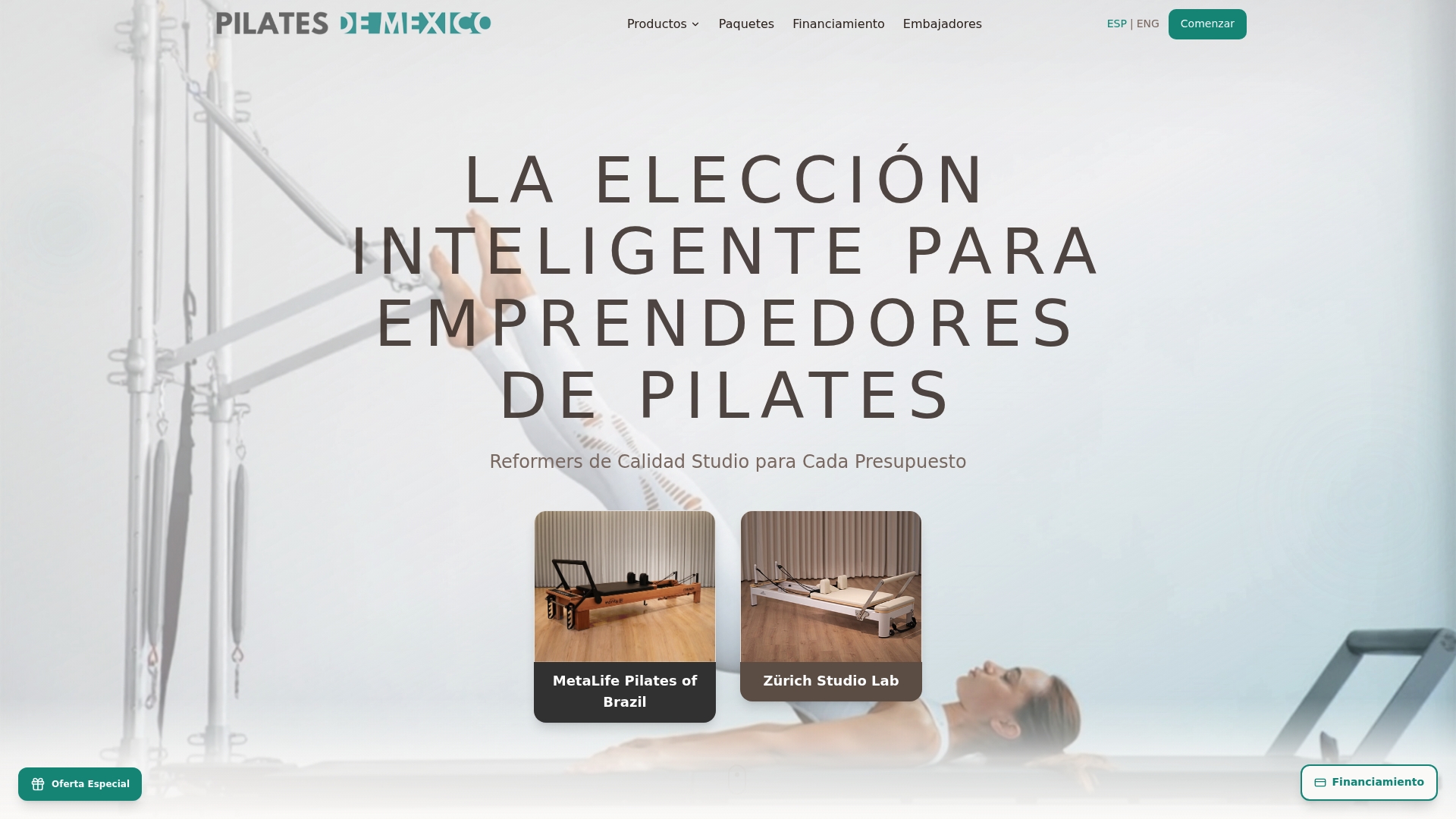
Before requesting your quote, have three pieces of information ready: how many machines you need (remember the starting point of 4 to 6 reformers), the intended use of your room (boutique studio, gym, or clinic), and your approximate budget, including whether you plan to finance part of the purchase. With this, the Pilates de México team can put together a proposal for studio packages tailored to your business phase, show you the available direct financing conditions, or take you directly to the Infinity and Advanced line catalog if you already know which model you are looking for. If you are also interested in earning commission by recommending equipment to other studios, the ambassador program is the way to turn those referrals into an additional discount. Request your quote this week and decide which supplier you're comparing against before demand in your area raises the price of waiting.
Sources
To verify tax conditions before signing, consult article 31 on deductible investments and the SAT page on immediate deduction of investments. To quote equipment, review the complete catalog of Pilates de México.
- Article 31 - Procedures and Services Portal - SAT
- Immediate deduction of investments - SAT
- Guide to opening a Pilates and Yoga studio (Amyra)
Frequently Asked Questions
What is the best way to get discounts on reformers in Mexico?
Wholesale packages combined with direct financing often yield the best net discount, because they integrate equipment, installation, and payment conditions into a single negotiation. The ambassador program is another useful route if you already have a relationship with certified instructors who can refer your purchase.
Does immediate deduction apply to any Pilates studio?
It only applies if your annual income is below the limit set by the SAT and the asset qualifies as a new fixed asset. Confirm your specific case with your accountant before assuming it automatically qualifies.
What should the CFDI include to maximize the tax benefit?
The CFDI must itemize the price of the equipment along with freight, installation, and insurance, because these concepts make up the original investment amount used as the deductible basis. A generic CFDI without this detail limits how much you can deduct.
How many reformers should I buy to start my studio?
The operational recommendation is to start with 4 to 6 reformers and expand when peak hour occupancy approaches 80%. Buying more from the start usually results in idle equipment during the first few months.
Does Pilates de México offer financing to buy at a discount?
Yes, Pilates de México offers direct financing in addition to packages and opening consultancy, which allows combining commercial discount with payment conditions adjusted to the studio's cash flow. Specific prices and conditions can be consulted directly on the website.