Pilates Franchises in Mexico: Costs, Royalties, and Alternatives

Pilates Franchises in Mexico: Costs, Royalties, and Alternatives
A Pilates franchise provides you with a brand, manuals, and training in exchange for an initial franchise fee and monthly royalties. An independent studio gives you full control over your brand, pricing, and equipment resale value, but requires careful budgeting. The decision comes down to the numbers: how much each path costs, how many classes you need to fill, and what equipment can withstand years of daily use. Here they are, based on published figures, along with the approach we take at Pilates de México: a studio under your own name, MetaLife equipment or an accessible professional line, financing, and opening consulting.
In Summary
- Pilates franchises in Mexico charge an initial fee and ongoing royalties on sales. One Mexican example lists a $150,000 fee and 10% monthly royalties.
- An independent studio with 4 reformers can be opened with an estimated investment of $469,000, and an 8-reformer studio for around $819,000, based on 2026 projections.
- With 6 reformers and $45,000 in monthly fixed costs, the break-even point is around 49% occupancy. That matters far more than the logo.
- With high-quality equipment, financing, and turnkey packages, you can open under your own brand with zero royalties. Request an equipment quote to explore your specific case.
Table of Contents
- What a Pilates Franchise in Mexico Offers
- How Much a Franchise Costs vs. an Independent Studio
- How Much It Costs to Open Your Own Pilates Studio
- The Deciding Number for Success: Occupancy Rate
- Operating Permits: The Same With or Without a Franchise
- Equipment: The Asset You Actually Own
- How to Open Under Your Own Brand with Lower Risk
- Which Path Is Right for You Based on Your Profile
- Frequently Asked Questions
- Sources
What a Pilates Franchise in Mexico Offers
The Mexican market features Pilates franchises of various sizes, and they all sell the same core value: a proven business model. According to what their own websites state, the package typically includes:
- Trademark licensing and business model usage rights.
- Initial training for the franchisee and their staff, along with ongoing education.
- Site selection support, including demographic and location studies.
- Operations manuals, architectural layouts, and grand opening assistance.
One Mexican studio and fitness franchise, for example, lists an initial fee of $150,000 and 10% monthly royalties, in addition to floor plans, manuals, and operational support. Another Pilates franchise indicates that its initial cost is quoted based on location and size, with opening taking between 3 and 6 months from signing.
Interest continues to grow. In 2024, one of the largest global brands, with over 1,000 studios, signed a master franchise agreement for Mexico committing to open at least 65 studios over 10 years, starting in Mexico City.
What a franchise cannot change is what ultimately determines whether a studio survives: class occupancy, rent, and equipment quality. Those three factors depend on you under any business model.
How Much a Franchise Costs vs. an Independent Studio
The initial franchise fee is only part of the equation. Royalties are an ongoing cost that lasts for as long as the studio operates. As a benchmark from a mature market, the 2026 franchise disclosure document of a major Pilates franchise in the United States reports a total investment of $413,289 to $1,029,811 per studio, with a $65,000 initial franchise fee, 8% weekly royalties, and 2% for the brand fund. These figures reflect that specific market and brand. They serve to illustrate the cost structure, not as a direct price quote for Mexico.
The most useful comparison is not just the initial investment, but the ongoing monthly outflow:
| Item | Franchise | Independent Studio |
|---|---|---|
| Initial fee | Yes, set by the brand | None |
| Royalties on sales | Yes (for example, 10% monthly in a typical Mexican franchise model) | None |
| Branding and pricing | Determined by the franchise | Entirely yours |
| Equipment | Dictated by the franchise contract | You choose the product line, quantity, and financing |
| Equipment resale | Subject to contract terms | It is yours and retains value if you buy wisely |
If your studio generates $200,000 MXN per month, a 10% royalty means $20,000 MXN monthly—or $240,000 MXN per year. In an independent studio, that capital could cover a significant portion of a financed reformer package. This is an illustrative calculation; your actual numbers will depend on your contracts and revenue.
How Much It Costs to Open Your Own Pilates Studio
Estimates published in 2026 vary depending on room size. Assuming a Mexican-made reformer priced at $52,000 MXN and rent at $400 MXN per square meter, one industry analysis calculates the following scenarios:
| Scenario | Floor Space | Opening Cost | With 3-Month Cash Cushion |
|---|---|---|---|
| 4 reformers | 50 m² | $469,000 MXN | $679,000 MXN |
| 8 reformers | 80 m² | $819,000 MXN | $1,128,000 MXN |
| 12 reformers | 110 m² | $1,179,000 MXN | $1,590,000 MXN |
The standard rule of thumb is to allocate about 6 m² per reformer, leaving 60 to 90 cm of clearance around each unit. Another industry guide breaks down an 8-reformer studio: equipment is the single largest expense, ranging from $280,000 to $960,000 MXN, build-out and renovations cost from $100,000 to $250,000 MXN, and 4 to 6 months of working capital requires $100,000 to $200,000 MXN.
That nearly fourfold range in equipment costs is the biggest lever you have. Selecting the right product line and securing smart financing will impact your startup investment more than any other decision. For deeper insights, explore our guides on the costs of opening a Pilates studio in Mexico and professional reformer pricing. If you plan to open in the capital, check out our breakdown of how much it costs to open a studio in Mexico City.
Expenses That Do Not Appear on Equipment Quotes
A realistic budget encompasses far more than reformers and monthly rent:
- Maintenance: Experts recommend budgeting between 4% and 6% of the equipment value in the first year for spare parts, rail alignments, and spring replacements.
- Permits and legal fees: Corporate incorporation ranges from $4,000 to $25,000 MXN, while land-use zoning and civil protection permits typically cost between $8,000 and $25,000 MXN, according to the same estimate.
- Working capital: The same source notes that most studios that fail in their first year do so due to a lack of operating cash flow, not a lack of clients.
That is why it makes sense to request equipment quotes with payment plans that protect your cash reserves during the initial months. Our guide on studio expansion financing outlines that path, and our article on Pilates equipment leasing explains how to significantly lower your upfront capital requirements.
The Metric That Makes or Breaks Your Studio: Occupancy Rate
Whether it's a franchise or an independent studio, revenue comes from the same formula: reformers × classes per day × days per month × price per class × occupancy rate. With 6 reformers, 6 classes per day, 26 days, and 70% occupancy, around 655 spots are booked per month.

The same analysis illustrates the break-even point: with 6 reformers, 30 classes per week, $45,000 in fixed expenses, and $350 per class paid to the instructor, you need a 49% occupancy rate just to break even. In another guide, the typical break-even point for a group class in Mexico City, Monterrey, and Guadalajara sits between 35% and 45% gross occupancy, with targets of 75% or higher during peak hours and 40% or higher during off-peak hours.
Three practical takeaways:
- Start with the reformers you can fill. It's easier to add a reformer when you have a waitlist than to pay for months of empty equipment. With pilot classes and pre-registration, you can validate demand before buying.
- Calculate using your actual expenses. An estimate for a mid-sized studio with 5 reformers places monthly fixed costs between $136,000 and $258,000, depending on the city and neighborhood.
- Choose your city based on numbers. Median commercial rent varies widely across Mexico City, Nuevo León, Jalisco, and Querétaro. If your market isn't a major capital, check out Pilates demand in Aguascalientes as an example of how to analyze a market before investing, along with our guide to studio location.
If you want to compare profitability scenarios, read whether a Pilates studio in Mexico is profitable in 2026.
Operating permits: the same with or without a franchise
A franchise can guide you, but the administrative procedures are your responsibility and must be completed with local authorities. For a studio in Mexico City, the standard checklist includes:
- SAT tax registration under the corresponding economic activity.
- Zoning certificate (uso de suelo), verified before signing a lease.
- Notice of operation via SIAPEM: a gym is considered a low-impact business and opens with a free online notice, not a commercial license.
- Civil Protection (Protección Civil) approval, depending on the venue's size and maximum capacity.
- Article 56 local regulations: changing rooms, instructor accreditation, equipment maintenance program, client registration, and posted pricing and occupancy limits.
The COFEPRIS notice does not apply to a studio that exclusively offers workout classes, but it does if you add a smoothie bar or a nutrition consulting room. If your studio will be located outside Mexico City, check the regulations in your municipality and state. While the law does not require certification to teach Pilates classes, clients, instructors, and insurance companies expect it, so working with certified instructors is strongly recommended.
We recommend confirming every requirement with your local municipal authority and your accountant before signing a lease. Our practical guide to opening a Pilates studio in Mexico lays out each step in the ideal sequence to execute them.
Equipment: the asset you actually own
With a franchise, you pay for a brand name. In your own studio, a reformer is an asset you use eight to ten hours a day and can resell as you expand. That's why equipment is the most profitable decision to carefully evaluate.
At Pilates de México, we carry MetaLife, the leading reformer brand in South America, now available in Mexico. It is built with FAS-certified Lyptus® wood, stainless steel hardware, and a structure engineered to support over 200 exercises and years of daily classes. We also offer accessible professional options so your first studio room doesn't have to start at the highest price point. Our focus is helping you launch with lower risk: local warranty, professional installation, and guidance from studio design and permits all the way to daily operations.
To make the right choice, compare these key factors in any quote:
- Durability: frame and hardware materials, and capacity for daily classes.
- Local service: warranty in Mexico and accessible replacement parts. Springs are regularly inspected and replaced, so it pays to know their cost from the start.
- Delivery times: domestic reformers can take between a month and a half and two months, and imported ones around three.
- Resale: quality equipment holds its value when you expand or upgrade your studio floor.
How to Open with Your Own Brand and Less Risk
Whether you're opening your first studio, adding reformers to a gym, clinic, or a yoga, barre, or CrossFit studio, or investing without prior Pilates experience, equipment and financing are at the core of your plan. Here is how we support that journey at Pilates de México:
- We offer the Infinity Line and Advanced Line, featuring MetaLife as our premium line alongside more accessible professional alternatives.
- We put together studio packages with multiple units, complemented by accessories.
- We offer direct financing so you don't have to pay for all your equipment upfront.
- We provide studio opening and expansion consulting from a team that knows what it takes to open and fill a studio floor.
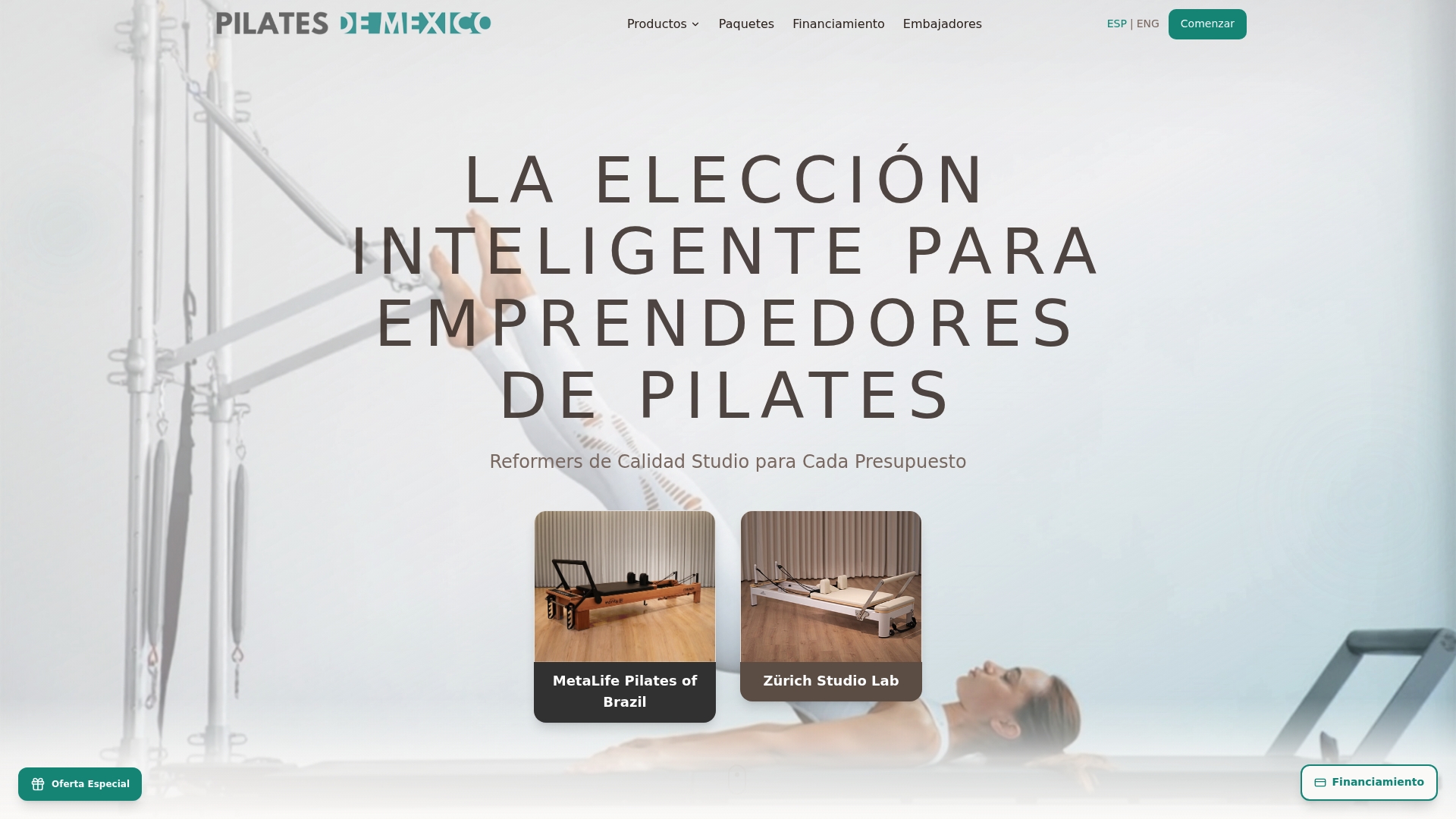
If you already know how many reformers you need, request a quote for your Pilates equipment and we’ll help you choose the right line, package, and payment plan. If you run an established studio and want to upgrade or expand with MetaLife, the same form is your starting point.
Which Path Is Right for You Based on Your Profile
Instructor opening their first studio. Entry cost and cash flow matter most. Start with 4 to 6 reformers, validate demand with pilot classes, and finance your equipment to preserve working capital. This lets you set your own pricing and build your brand from day one.
Established studio expanding or upgrading. You already have a brand and a client base. Durability and resale value are the deciding factors, so standardizing your studio floor with a robust line like MetaLife and planning phased upgrades is the way to go.
Gym or studio from another discipline. If you already have a physical space and clients, adding a reformer room is primarily a decision about equipment and layout. Estimate around 6 m² per reformer and start with a small package you can scale up as occupancy demands.
Physical therapy or rehabilitation clinic. You're integrating reformers into an existing practice. The setup needs to be sturdy, stable, easy to maintain, and professionally installed.
Investor without a background in Pilates. Your business hinges on smooth operations and reliable equipment. A franchise gives you a turnkey model, while opening your own studio with professional consulting allows you to build a proprietary branded asset. In either case, the key metric to monitor is occupancy.
To compare more operational formats, check out our Pilates studio business models.
Frequently Asked Questions
How much does a Pilates franchise cost in Mexico?
It depends on the brand. One Mexican franchise lists an initial fee of $150,000 MXN and a 10% monthly royalty, while other franchises quote based on location and size. Always request a full breakdown of the initial fee, royalties, marketing fees, and equipment costs before comparing.
How much does it cost to open a Pilates studio on your own?
Estimates for 2026 range from around $469,000 MXN for 4 reformers in a 50 m² space to roughly $1,179,000 MXN for 12 reformers in 110 m², excluding a working capital cushion. The range varies depending on the city, rent, and the equipment line you choose.
Do I need Pilates experience to open a studio?
The law does not require certification to teach classes, but clients and insurers expect certified instructors. If you're investing without being an instructor yourself, hire a certified team and rely on studio opening consulting.
How many reformers do I need to get started?
Start with the number you can fill. With 4 reformers you need about 50 m², with 6 about 65 m², and with 8 about 80 m². Validate demand with pilot classes and add more reformers once you have a waitlist.
Sources
- Eunoia: models and franchise fee
- Pilates franchises: process and opening
- Master franchise agreement for Mexico (Business Wire, 2024)
- Franchise Disclosure Document 2026, United States
- How to open a Pilates studio in Mexico (2026), Pilaty
- Permits to open a Pilates studio (2026), Pilaty
- Guide to opening a Pilates or yoga studio, Amyra
- Detailed budget for opening a studio, Klasius
- Class schedules and occupancy, Klasius
- COFEPRIS and gym regulations, Mr. Gimnasios
- How to open a Pilates studio in Mexico, Fitune