Standards for Pilates Equipment in Mexico: What Applies

Standards for Pilates Equipment in Mexico: What Actually Applies
If you're looking for a single official standard with the name “Pilates,” the short answer is that purchasing and operating a reformer in Mexico is governed by a framework of general regulations: commercial product labeling, workplace safety, and health regulations only when the equipment is marketed for medical use. Mexican standards (NMX) and international references like ISO are, for the most part, voluntary. This guide explains which is which, what your responsibilities are as a buyer and studio operator, and how to verify everything before making a purchase.
At a Glance
- NOM-050-SCFI-2004 requires accurate product information, including manufacturer or importer details when applicable.
- Healthcare NOMs for medical devices (NOM-241 and NOM-137) only apply if the equipment is sold as a medical device, which you should clarify with your supplier.
- As a studio, gym, or clinic, your safety obligations stem from STPS (Ministry of Labor): safe facilities, regular inspections, and maintenance logs.
- NMX standards and ISO guidelines serve as voluntary quality benchmarks, not legal mandates.
- Before buying, request the technical specification sheet, importer tax details (RFC), local warranty coverage, and an official tax invoice.
Table of Contents
- Which standards apply to a reformer and which do not
- Commercial information: NOM-050-SCFI-2004
- Health regulations: when COFEPRIS comes in
- Your responsibilities: safety in your studio, gym, or clinic
- ISO and NMX standards: voluntary benchmarks
- How to verify validity, scope, and compliance
- What to ask your supplier for before buying
- Insurance, signage, and other studio requirements
- Equipment ready for your studio
- Frequently asked questions
- Sources
Which Standards Apply to a Reformer and Which Do Not
In Mexico, three types of standards coexist, and confusing them is the most common mistake made when purchasing equipment:
- Official Mexican Standards (NOM): mandatory within the specific areas they regulate.
- Mexican Standards (NMX): developed by standards bodies, technical committees, or the Ministry of Economy, and their compliance is voluntary.
- International standards (ISO and similar): serve as technical benchmarks. They are not legally mandatory on their own, though they can become enforceable through contracts, insurance policies, or warranty terms.
In commercial terms, a reformer is physical conditioning equipment. This means that commercial information standards apply to it first, rather than medical device standards. Second, workplace safety regulations apply to your studio and where you install it, not to the manufacturer.
Commercial Information: NOM-050-SCFI-2004
This is the standard that most commonly applies when purchasing imported or domestic equipment. NOM-050-SCFI-2004, published in the Official Gazette of the Federation on June 1, 2004, establishes that product information must be truthful and presented in a way that does not mislead consumers regarding its nature and characteristics.
Where applicable, the information must include:
- The generic product name.
- The quantity, in compliance with NOM-030-SCFI.
- The identification and tax address of the manufacturer or importer.
For you as a buyer, this translates into something very practical: the equipment, its packaging, or its commercial documentation must state what it is, who manufactures or imports it, and where to locate them. If you don't know who is responsible for the product in Mexico, you have no recourse if an issue arises.
What to Look for in a Spec Sheet
A reliable spec sheet outlines materials, dimensions, weight capacity, components, and composition. In fact, import guidelines state that gym equipment requires a technical spec sheet detailing physical, usage, and material composition specifications. That same guide classifies gym equipment under tariff code 9506.91.03, notes it as exempt from general import tax (IGI), and mentions compliance with NOM-050-SCFI-2004. Tariffs and tariff codes are subject to updates, so your customs broker should confirm them for your specific transaction.
In the case of our collections, the Infinity Line and Advanced Line come with clear specifications: certified Lyptus® FAS wood, stainless steel hardware, and a frame engineered for more than 200 exercises and years of daily classes. These are core brand design specifications, and they should be visible on the spec sheet of any equipment you compare.

Health Standards: When COFEPRIS Comes into Play
This is where confusion often begins. Mexico's General Health Law, under Article 3, Section XXV, considers the sanitary control of medical equipment, prosthetics, orthotics, functional aids, and other products to be a matter of public health, from processing through importation and final disposal. A reformer, on its own, is fitness training equipment. Health regulations only become relevant if the manufacturer or importer markets it as a medical device—for example, with stated therapeutic purposes.
If you are a physical therapist, chiropractor, or clinic owner, it is worth asking your supplier how they classify the equipment and what their documentation states. For specific regulatory decisions, consult a regulatory consultant or attorney specialized in COFEPRIS.
NOM-241-SSA1-2025: Medical Device Manufacturing
NOM-241-SSA1-2025 establishes the minimum requirements for the design, development, manufacturing, storage, and distribution of medical devices for human use, based on their risk level, that are marketed within Mexican territory. An interpretative criterion published in the DOF on November 11, 2025 recognizes the MDSAP program as equivalent to the quality management system required by this standard.
NOM-137-SSA1-2025: Health Labeling
According to an analysis by Santamarina + Steta, this standard sets sanitary labeling information requirements for medical devices, covering proper use and traceability, and is mandatory for those who manufacture, distribute, or import medical devices for sale in Mexico. It requires legible information in Spanish, as well as details such as the COFEPRIS sanitary registration, manufacturing or expiration date, batch or serial number, and full identification of the manufacturer, importer, or distributor.
Registration, Low-Risk Classification, and Import Permits
COFEPRIS updated its list of low-risk and deregulated medical devices. Annex 1 includes low-risk devices that do require sanitary registration. Annex 2 includes low-risk devices subject to good manufacturing practices and technovigilance, exempt from sanitary registration but requiring an import permit. In addition, Article 376 of the General Health Law governs registration validity and renewals, according to a guide on COFEPRIS registration.
The takeaway for buyers: if a supplier tells you their equipment has "sanitary certification," ask for the registration number or supporting documentation. If they state it is fitness equipment, the applicable path is commercial labeling and compliance.

Your responsibility: safety in the studio, gym, or clinic
Once equipment is installed, responsibility shifts to the operator. Here, standards come from the Ministry of Labor and Social Welfare (STPS) and apply to workplaces—meaning any studio with instructors or staff.
NOM-001-STPS-2008: buildings, premises, and facilities
NOM-001-STPS-2008 establishes safety conditions for buildings, premises, facilities, and areas in workplaces, applying nationwide across Mexico. According to its text, the employer must:
- Maintain facilities in safe condition.
- Conduct visual inspections every twelve months.
- Repair any identified damage.
- Record the results and keep records on file for one year.
Structural elements must also support the static and dynamic loads of the activities being carried out. This is critical if you plan to install a studio with ten reformers on a second floor or in a repurposed space: check the floor load capacity before installation, and consult a structural engineer or licensed inspector if you have any doubts.
Machinery and equipment: the draft NOM-004-STPS
PROY-NOM-004-STPS-2020, published on January 8, 2021, is a draft standard proposing safety conditions and protective devices for machinery and equipment in workplaces. It applies to equipment operated in fixed locations with moving parts. Because it is a draft project, check the Official Gazette of the Federation (DOF) to verify whether a final version has been enacted before considering it mandatory. Even so, it provides an excellent framework for your internal routine: springs, pulleys, ropes, and hardware should be inspected on a set schedule.
A simple inspection routine
| Component | What to check | Suggested frequency |
|---|---|---|
| Springs and hooks | Wear, deformation, abnormal noises | Weekly |
| Ropes and pulleys | Fraying, smooth rotation | Weekly |
| Carriage and rails | Cleanliness, smooth glide, bumpers | Daily |
| Upholstery and footbar | Tears, secure attachment | Weekly |
| Frame and hardware | Tightness, play or loosening | Monthly |
This frequency is a suggested best practice, not a statutory requirement. Keeping written inspection logs helps demonstrate due diligence to insurance providers or inspectors. For cleaning and routine care, check out our reformer maintenance guide.
ISO and NMX standards: voluntary references
In the Mexican standardization system, Mexican Standards (NMX) are voluntary. The same applies to most international standards: they serve as benchmarks to compare quality, safety, and performance. A manufacturer claiming compliance with a voluntary standard should be able to specify which standard, which edition, and provide supporting documentation.
For you, this means two things:
- Do not demand a "mandatory Pilates standard" that does not exist in the way people assume. Demand verifiable data instead.
- Assess durability through materials and construction: wood type, hardware, finish, and capacity for heavy commercial use. At MetaLife, for example, we use certified FAS Lyptus® wood and stainless steel hardware.
How to verify validity, scope, and compliance
A standard can be superseded, amended, or repealed. The references in this article include standards from 2004 and 2025, along with a 2021 draft: they do not share the same legal status. Follow this process:
- Identify the complete standard code. A NOM includes the year (for example, NOM-050-SCFI-2004). If the supplier doesn't provide the year, you don't know which version it complies with.
- Consult the official text. Search the Official Gazette of the Federation (Diario Oficial de la Federación - DOF), the Ministry of Economy's standardization portal, or the STPS website.
- Review the scope. Read the field of application: does it address products, processes, or workplaces? That determines whether compliance falls on you or the manufacturer.
- Confirm whether it is a NOM, NMX, or ISO standard. This distinguishes mandatory requirements from voluntary guidelines.
- Request the documentation. Ask for the technical spec sheet, tax details of the importer or manufacturer, and, if applicable, the sanitary registration or certificate.
- Keep everything on file. Your invoice, spec sheet, and warranty form your official equipment file.
If your studio operates as a clinic or declares therapeutic use, consult with a sanitary regulation specialist as well.
What to Ask Your Supplier Before Buying
A professional supplier will answer these questions straightforwardly:
- Who is the importer or distributor, and what is their registered tax address?
- Is there a technical spec sheet detailing materials, dimensions, and weight capacity?
- Is the warranty local, and what does it cover? We break this down in our guide to Pilates equipment warranties in Mexico.
- Does it include professional installation and training?
- Are replacement parts readily available domestically?
- Do they offer financing options to spread out the investment?
At Pilates de México, we provide local warranties, professional installation, and comprehensive consulting—from studio design through day-to-day operations. And if you're just starting to plan your launch, check out our guide on permits needed to open a Pilates studio, because equipment is only one part of total compliance.
Insurance, Signage, and Other Studio Essentials
Compliance doesn't end with your equipment. A studio also needs general liability coverage and clear safety signage. We recommend reading our guides on how to insure your Pilates studio and what signage a studio needs. Both topics tie directly into routine inspections: keeping documented records of your facilities makes any regulatory audit or procedure much smoother.
Equipment Ready for Your Studio
Whether you're outfitting a new space or expanding an existing one, we help you choose between the Infinity Line—built for studios prioritizing long-term durability and resale value—and the Advanced Line, a more accessible professional option. We also carry accessories and multi-unit equipment packages. Every purchase can include financing along with opening and expansion consulting.
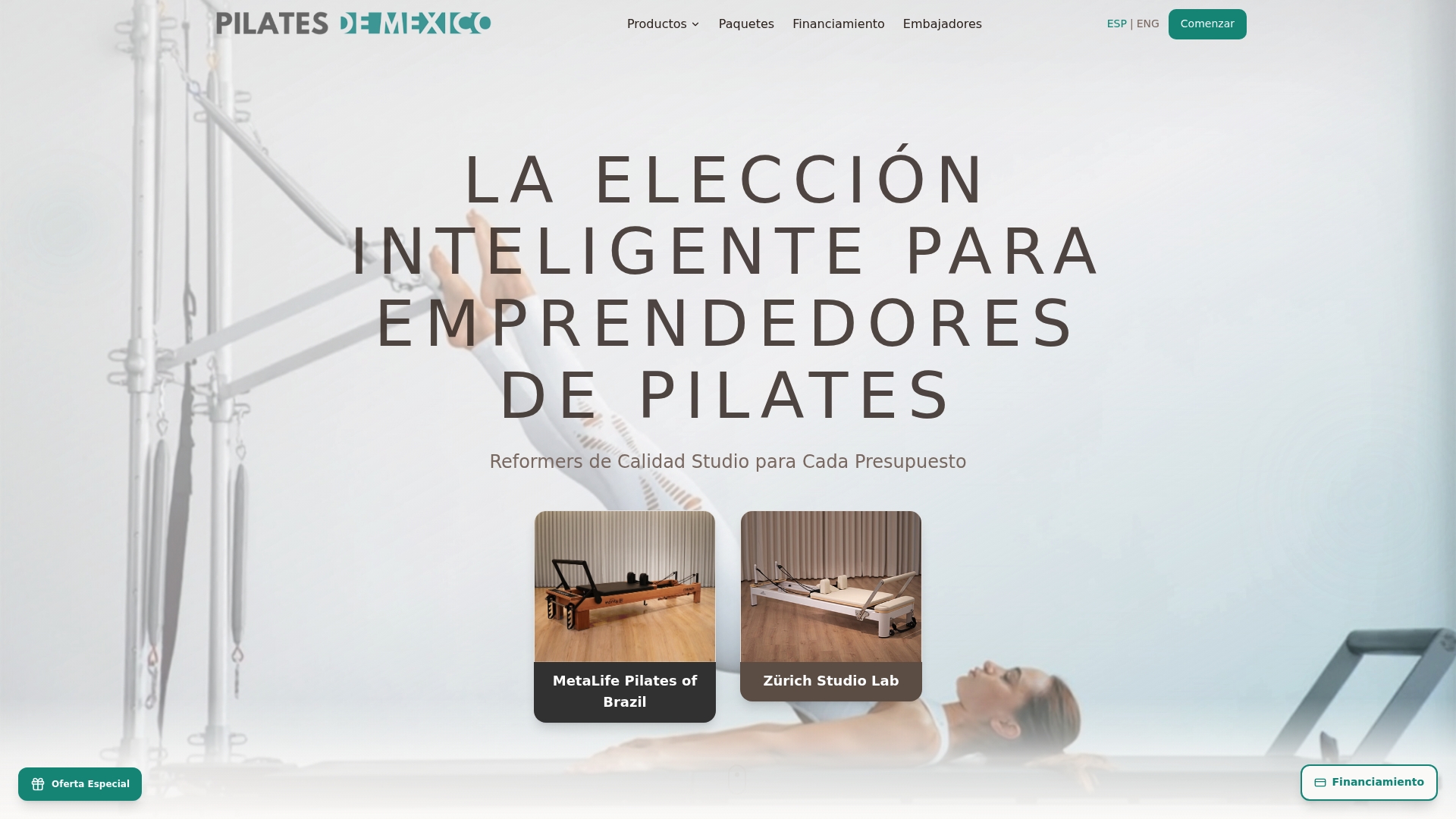
Explore our reformer lines, check out the Reformer Advanced, or explore our financing options to take the next step for your studio.
Frequently Asked Questions
Is there a specific NOM for Pilates equipment?
The standards identified for this guide are general: commercial information, workplace safety, and sanitary standards for medical devices. None apply solely because a product carries the name "Pilates"; rather, they depend on the type of product or facility. If you have specific questions, confirm them in the DOF or consult a regulatory compliance advisor.
Does a reformer require a COFEPRIS sanitary registration?
It depends on how the product is classified and marketed. Sanitary regulations apply to medical devices, where certain low-risk items require registration while others only need an import permit. Ask your supplier how they classify their equipment and what official documentation they hold.
Are ISO standards mandatory in Mexico?
On their own, no. Mexican NMX standards are voluntary, and international standards serve as technical benchmarks. However, they can become legally binding if required by a contract, warranty, or insurance policy.
What standards must my studio comply with as an employer?
If you employ staff, NOM-001-STPS-2008 applies regarding safety conditions in buildings and facilities, including visual inspections every twelve months and documented logs of the results. You should also monitor the status of the proposed NOM-004-STPS concerning machinery and equipment. An occupational safety specialist can help you apply these requirements to your space.
What documents should I keep for my equipment?
Keep the purchase invoice, technical spec sheet, warranty, importer or manufacturer details, and any applicable sanitary permits. Add your routine inspection and maintenance logs to the file. This ensures everything is in order in the event of a warranty claim, insurance review, or official audit.
Sources
- NOM-050-SCFI-2004, Ministry of Economy
- Mexican Standards, Ministry of Economy
- General Health Law
- NOM-241-SSA1-2025, DOF
- Interpretation Criteria for NOM-241-SSA1-2025, DOF November 11, 2025
- NOM-137-SSA1-2025, Santamarina + Steta
- List of Low-Risk Devices, Emergo by UL
- Medical Device Registration with COFEPRIS, MedDeviceGuide
- Importing Gym Equipment, Aduaeasy
- NOM-001-STPS-2008
- PROY-NOM-004-STPS-2020