Owners: Start with 3 Machines and Combine Reformer and Barre
Owners: Start with 3 Machines and Combine Reformer and Barre
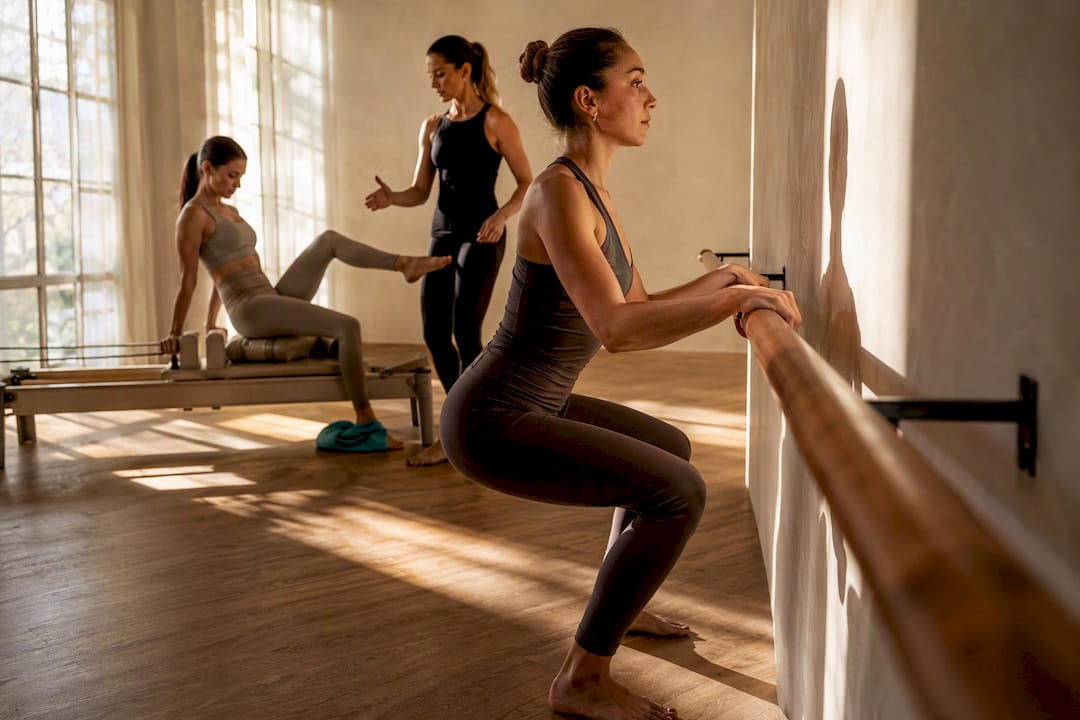
The format that works best for most studios is a hybrid model: quality professional reformers for apparatus classes and a well-defined barre area for barre sessions.
In summary:
- It's advisable to start by purchasing reformers to guarantee income from opening day, then complete the studio with supports or barres as a secondary step.
- A reformer approximately 240 cm long and 10 to 12 m² of space per machine allows for safe and efficient circulation.
- Effective programming combines reformer and barre sessions in mixed or consecutive blocks, with online booking to avoid gaps and overbooking.
- Accessory compatibility between brands is key to maintaining operation and reducing cancellations due to incompatible parts.
- Investing between 35,000 and 50,000 euros in equipment, with specialized financing, reduces risks and helps validate demand before expanding facilities.
Table of Contents
- What to Buy First to Combine Reformer with Barre
- How Many Square Meters Do You Need Per Reformer and How to Lay Out the Studio
- How to Schedule Classes that Combine Reformer and Barre
- Accessories and Compatibility Between Brands
- How Much Does it Cost to Equip the Studio and How to Finance It
- Checklist for Opening or Adapting Your Combined Studio
- What Your Studio Gains by Combining Reformer and Barre
- Safety When Integrating Reformer and Barre in the Same Session
- What Type of Studio and Client This Combination Works For
- Examples of Sequences Combining Reformer and Barre
- Results of Combining Disciplines Versus Practicing Them Separately
- Why a Package with Consulting Reduces the Risk of a Bad Opening
- Start Your Combined Studio with a Specialized Supplier
- Sources
What to Buy First to Combine Reformer with Barre
The order of purchase determines whether your studio opens on time or is delayed due to missing parts. The logical sequence is: reformer, then the support or barreformer, then the tower or ladder barrel, and finally everyday accessories.
- Reformers first: These are the equipment that generates income from the first week; without them, there are no apparatus classes to offer.
- Barres and supports: These can be wall-mounted or portable, depending on whether your studio is also used for other activities.
- Tower or ladder barrel: These expand the exercise catalog but are not essential for opening.
- Essential accessories: Straps, bands, and rollers complete each station, although they arrive after the main equipment.
For studios that combine formats in the same space, foldable reformers reduce volume by 70 to 80% when not in use, freeing up the room for barre without moving heavy furniture. An option when looking for reformers built with certified wood and hardware designed to withstand daily classes for years is the Infinity Reformer with Tower. A well-assembled professional package includes warranty, spare parts availability, and on-site installation—three points that prevent dead weeks without being able to bill.
How Many Square Meters Do You Need Per Reformer and How to Lay Out the Studio
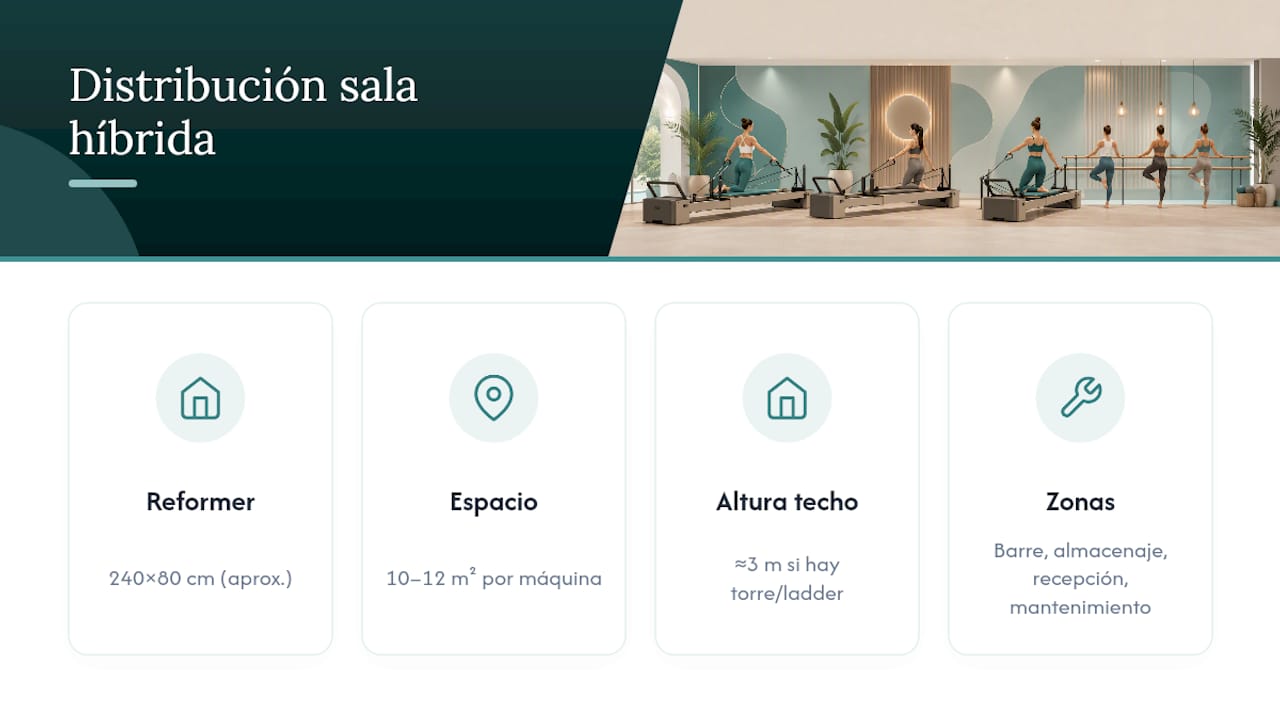
Each reformer measures approximately 240 centimeters long by 80 centimeters wide, and the recommended space is between 10 and 12 square meters per machine to allow the instructor to move around and assist without bumping into anyone. If you work with a tower or ladder barrel, the ceiling height should be around 3 meters to allow room for vertical exercises.
In addition to the equipment stations, reserve a separate barre area, a storage area for mats and accessories, a reception, and a technical space for maintenance. If your space is multifunctional, foldable reformers allow you to convert the same room into a barre area in minutes, without duplicating square footage, which in most cities costs more than a new studio can absorb.
How to schedule classes that combine reformer and barre
There are three formats that work in practice. The first is the mixed block, where reformer and barre are worked within the same 45- to 60-minute session. The second is consecutive sessions: a reformer class followed by a barre class, designed for clients who want a double stimulus on the same day. The third is completely separate blocks on the calendar, useful when each discipline has its own client base.
- Define standard duration: between 45 and 60 minutes per class, with 2 or 3 weekly sessions recommended per client to notice measurable changes in a few weeks.
- Organize morning and evening shifts: in a small studio, alternate reformer in the morning and barre at midday; in a medium one, offer both formats in parallel with different instructors.
- Calculate rotation time: allow 5 to 8 minutes between classes to clean springs, adjust resistance, and set up barre equipment.
- Automate bookings: an online booking system prevents empty slots and overbooking during peak demand times.
Pro tip: Always allow a 10-minute buffer between a reformer class and a barre class in the same room. This time is not a luxury: it's what prevents the incoming instructor from finding misplaced springs or poorly stored mats.
Programs that consistently combine both formats show measurable results in just a few weeks, which gives your sales team a concrete argument to sell multi-class packages per week instead of single sessions.
Accessories and brand compatibility
Before buying individual accessories, check that they fit the reformer you already own or plan to buy. Anchors, strap lengths, and spring systems vary between manufacturers, and an incompatible part can put a station out of service just before a full class.
- Replacement straps and footbar pads for each station.
- Rings (magic circles), resistance bands, and rollers for integrated barre sequences.
- At least one extra set of springs per reformer, as they are the part that breaks most often.
Checking accessory compatibility between brands before purchasing prevents last-minute cancellations. Keeping a simple inventory with replacement dates per part reduces the risk of running out of a spare in the middle of a consecutive reformer and barre class.
How much does it cost to equip the room and how to finance it
The budget depends on the size of the room and whether you buy accessible range equipment or premium lines like MetaLife. As a market reference, a boutique studio with capacity for several stations may require an equipment investment of between 35,000 and 50,000 euros if it opts for eight reformers, although many operators prefer to start with fewer machines and scale according to demand.
Starting with 3 or 4 reformers instead of 8 is not a limitation: it's the safest way to validate demand before committing more capital than necessary.
- Accessible range: equipment manufactured in China or other countries, suitable for the first room without starting at the highest price point.
- Mid-range and premium: lines like MetaLife, with certified wood and durable hardware, designed for studios that are already planning years of daily classes.
- Direct supplier financing: allows you to open without decapitalizing the business, especially useful when construction and the barre area also need to be covered.
The financing offered by Pilates de México is precisely designed to separate equipment payments from the cash flow needed to operate during the first few months. Compared to renting or leasing, direct purchase with financing is usually more convenient when you plan to keep the studio for more than two or three years, as you retain the resale value of the equipment.
Checklist for opening or adapting your combined room
Moving from decision to the first mixed class requires following a sequence, not improvising on the fly.
- Confirm permits and insurance before signing any construction or lease contract.
- Prepare the premises: check flooring, ventilation, and ceiling height, especially if you plan to install towers.
- Define the timeline: between 4 and 8 weeks for construction, followed by equipment delivery, installation, and a one-week pre-launch.
- Coordinate installation with the supplier so the equipment arrives calibrated and ready for use from day one.
- Measure from the first month: occupancy by time slot, 30-day retention, and conversion rate from trial class to paid package.
These four initial indicators tell you, before the first quarter passes, if the hybrid format is working or if you need to adjust schedules between reformer and barre.
What your studio gains by combining reformer and barre
Combining both disciplines expands the type of client you can serve without duplicating the size of your studio space. The reformer provides variable resistance through springs, while barre primarily works with isometric stimuli and body weight. This mechanical difference is why many studios report improvements in body composition and posture when alternating both formats in the same week, instead of offering just one.
From a business perspective, the benefit is equally clear. The hybrid format allows you to attract different segments: more affordable group barre classes in the morning and higher-ticket private reformer sessions at midday. This increases the total occupancy of the room without needing more square footage, because the same space rotates between two types of classes throughout the day.
For the end client, the advantage lies in the variety of stimulation. Alternating reformer and barre reduces the monotony that leads many students to abandon a program after a few months, and gives your teaching team a natural argument to sell combined packages instead of single classes of one discipline.
Safety when integrating reformer and barre in the same session
Mixing two techniques in the same class requires more instructor attention, not less. The reformer's springs and barre's balance work activate different muscle groups, and transitioning from one to the other without adequate preparation increases the risk of cramps or improper alignment in the first few sessions.
Instructors certified in both disciplines must supervise the transition, especially in a new client's first classes, when they are not yet aware of their body's limits on each apparatus.
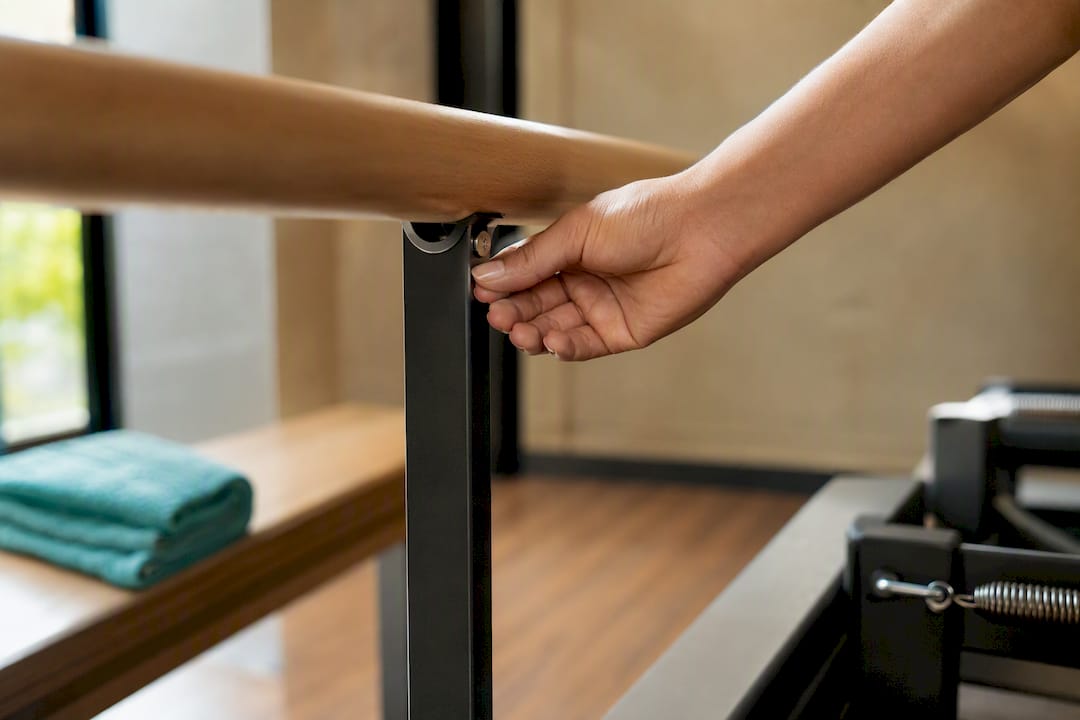
Equipment maintenance is also a matter of safety, not just operation. A worn spring on the reformer or a loose barre can cause a serious injury in seconds. Checking the condition of anchors and springs before each shift, especially in consecutive sessions where several classes use the same machine within a few hours, should be a fixed studio protocol and not an occasional task.
For what type of studio and client does this combination work?
The hybrid format performs best in studios that already have or are seeking a varied client base: from those starting Pilates who need the assisted resistance of the reformer, to those looking for low-impact toning in barre without added weight. It also works well in gyms that add reformers to an existing space, because the barre area can reuse part of the existing group class area.
It is not the ideal combination for all business profiles. A very small studio with only one instructor and space for just two machines can become overwhelmed if it tries to offer both formats at once; in that case, it is advisable to start with reformer only and add barre when demand justifies it. Clients with severe joint injuries or high-risk pregnancies require specific adaptation in both disciplines, and the instructor must be clear about which exercises to avoid on each apparatus before designing a mixed sequence.
It is also not advisable to force the combination in clinical rehabilitation sessions without direct medical supervision.
Examples of sequences that combine reformer and barre
A 50-minute sequence can open with 15 minutes of reformer focused on legs and glutes using medium resistance springs, followed by 20 minutes of barre with isometric small pulse work in the same areas to prolong muscle fatigue without loading joints. The last 15 minutes are usually dedicated to core and stretching, utilizing the reformer tower for spinal work.
Another common structure separates the focus by blocks: reformer for lower body and hip stability during the first half, and barre for upper body and balance in the second. This order works well in consecutive 45-minute sessions, where the client moves from one station to another with just a shoe change.
To conclude any mixed sequence, a short block of breathing and mobility helps the body lower its heart rate before leaving the room. Brief routines like those described by IKY Yoga in its abdominal breathing sessions serve as a reference for designing that final stretch without the need for additional equipment.
Results of Combining Disciplines Versus Practicing Them Separately
The main difference between combining and practicing each discipline separately lies in the variety of stimulation, not in one technique being superior to the other. The reformer works with progressive resistance through springs, while barre emphasizes isometric holds and small repetitions; alternating both prevents the body from adapting too quickly to a single type of effort, which delays the plateau of results that often appears after several weeks of repetitive routine.
In commercial protocols that consistently alternate both techniques, visible changes in body composition and posture have been reported in about 45 days when frequency is maintained at 2 or 3 sessions per week. Practicing only reformer or only barre also generates results, but it usually takes longer to show notable changes in strength and posture simultaneously, because each technique on its own covers fewer types of muscle stimulation.
For your studio, this difference translates into retention. A client who sees progress in less time renews their package more frequently, and that is, ultimately, the most solid commercial argument to justify the investment in mixed equipment from day one.
Why a Package with Consulting Reduces the Risk of a Poor Opening
The most expensive part of making a mistake is not the equipment; it's the lost time reconfiguring a poorly planned space. Technical consulting helps define the correct reformer model, the room layout, and the flow between classes before any concrete is poured. Professional installation prevents early mechanical failures and speeds up the opening, because the equipment arrives calibrated and ready for the first class, not for weeks of adjustments.
Start Your Combined Studio with a Specialized Provider
Having a package designed for your studio size, accompanied by financing that prevents decapitalizing the business before opening, is an alternative that offers greater security than improvising equipment purchases on your own.
There are also volume package programs for those opening more than one studio, and after-sales support to resolve failures or order spare parts without depending on third parties. If you already know how many reformers you need, check out the Zürich Labs Reformer for specifications and pricing, or directly request a technical visit and financing quote for your reformer and barre project.
Sources
- Reformer Machine for Pilates Studios: A Complete Guide to Equipping Your Professional Studio in 2026
- How to Open a Pilates Studio in 2026: Complete Guide | Virtuagym ES
- Fuego Program: The Winning Combination of Three Disciplines That Transforms Your Body in 45 Days