Outfitting a Pilates Studio: What Equipment and Signage You Need
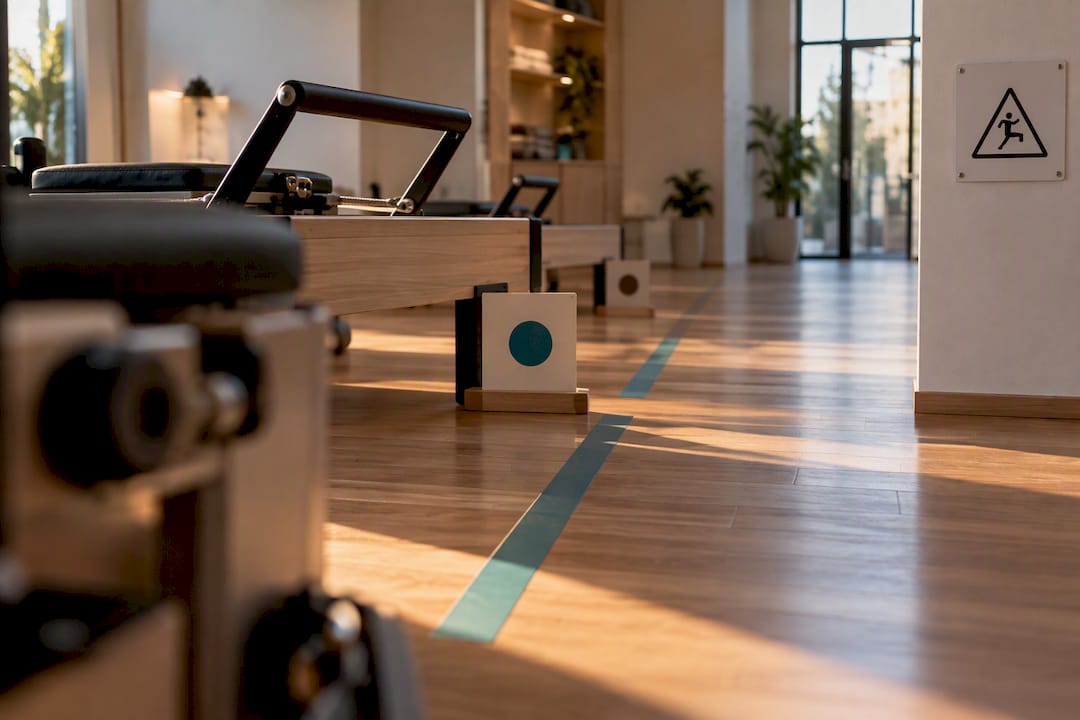
Signage in a Pilates Studio: What Equipment and Signs Do You Need?
Here, "Pilates studio signage" refers to the professional equipment that defines how your studio operates day-to-day: reformers, chairs, and accessories, along with the necessary financing and consulting to install them correctly. The central recommendation is simple: prioritize commercial-grade reformers with a stable structure, available spare parts, and local installation support. This provider works with different lines of reformers and offers packages with financing, designed to meet that initial criterion.
In summary:
- It is essential to choose reformers with a stable structure, preferably made of certified wood or aluminum, that can withstand intensive use and are easy to inspect.
- For a small studio, it is recommended to acquire between 4 and 8 identical reformers, depending on the type of classes, prioritizing uniformity and rotation capacity.
- A space of 40 to 50 square feet per reformer is needed, including safety margins for the instructor to move around without obstacles.
- Safety and circulation signage should be placed at eye level and in strategic points to improve safety and class flow.
- The acquisition and installation of equipment require compliance with labor and civil protection regulations, in addition to managing the opening notice procedure with the SAT (Mexican tax authority).
Table of Contents
- What to Check in a Commercial Reformer: Materials, Rails, and Springs
- How Many Reformers to Buy Based on Your Business Model
- Space, Clearance, and Installation Checklist
- Workplace Safety and Applicable Regulations
- How to Prepare Specifications and Compare Quotes
- Designing Signage Within a Pilates Studio
- Where to Place Each Sign So It's Truly Visible
- Regulations Applicable to Signage in Sports and Health Facilities
- What Impact Does Signage Have on the Customer Experience?
- Practical Examples of Signage That Works Well
- Recommended Materials Based on Internal or External Use
- Author's Perspective and Final Practical Recommendations
- How Pilates de México Can Help You Equip Your Studio
- Sources
- Frequently Asked Questions
What to Check in a Commercial Reformer: Materials, Rails, and Springs
The frame material determines how long your investment lasts. Certified wood, such as Lyptus® FAS, withstands torsion under repeated use better than many inexpensive aluminum options, though it requires periodic varnish and assembly checks. Aluminum weighs less and makes it easier to move between rooms, but lower-quality models tend to generate carriage vibration after months of daily classes.
The real test happens under load, not in the catalog. Before signing any quote, ask to move the carriage with maximum resistance and listen for noise in the rails: rail alignment is the first thing to get out of whack in low-end equipment. Selection guides for commercial environments emphasize that structural integrity and ease of inspection outweigh aesthetic finish when purchasing for intensive use.
Before deciding, check these points on any unit you evaluate:
- Consistent tension among springs and clear labeling to identify them without guessing.
- Actual ease of replacing a spring without disassembling half the machine.
- Quick adjustment system for the footbar and headrest, designed for changing clients in seconds.
- Upholstery resistant to sweat and frequent disinfectants, with seams that won't split open in months.
- Confirmed compatibility with accessories such as towers, jump boxes, or additional bands.
A structured checklist for evaluating reformers before buying reduces surprises: it covers carriage movement, spring system, adjustment mechanisms, and availability of after-sales service, which is precisely what a salesperson rarely mentions unless asked.
How Many Reformers to Buy Based on Your Business Model
You don't buy the same way for a boutique studio as for a rehabilitation clinic, and confusing these priorities is the most expensive mistake I see repeated.
- Boutique studio with semi-private classes. Prioritizes resistance customization and quiet carriage; 4 to 6 reformers are usually sufficient for smooth rotation.
- High-turnover group classes. Adjustment speed between clients matters more than luxury finish; it's advisable to buy in phases here, starting with 6 to 8 identical units.
- Rehabilitation clinic. The criterion leans towards extreme stability and fine adjustments of low resistance, even if it means fewer units but with higher technical specifications.
Buying in phases makes sense when cash flow is tight: start with half the projected equipment and add units of the same model as demand grows.
Professional tip: Never mix different brands or models in the same room if you can avoid it. Uniformity among units accelerates staff training and prevents an instructor from having to learn two different adjustment logics in the middle of a class.
Space, Clearance, and Installation Checklist
The most common layout error is underestimating the space per reformer. Planning guides recommend between 40 and 50 square feet per reformer, about 3.7 to 4.6 m², including clearance for the instructor to move without bumping into the moving carriage. For a room with six reformers, the same reference places the total recommended area, including functional zones, within an adequate range to ensure comfort and functionality.
If you plan to incorporate a Cadillac or a combo, ceiling height becomes critical: you need sufficient clearance for overhead bars and suspended exercises without compromising safety.
Before the delivery truck arrives, confirm:
- Actual access for the equipment to the room: doors, elevator, and hallways with the exact dimensions of the packaging.
- Condition of the floor and whether it requires additional protection during assembly.
- Installation schedule coordinated with the supplier, not improvised on the same day.
- Clear space for the installation team to work without moving furniture at the last minute.
Workplace Safety and Applicable Regulations
Equipment safety is not an optional or decorative matter. NOM-004-STPS-1999 requires protective conditions for machinery and work equipment, including accessible stop devices and integrated guards where mechanical risk exists.
In practice, this translates into specific points you must check before operating:
- Verify that the carriage stop or lock mechanism is accessible without tools.
- Confirm that springs and pulleys have guards to prevent accidental entrapment.
- Document preventive maintenance as evidence of compliance in case of an inspection.
In addition to the equipment, there is an administrative procedure that you cannot skip when opening. The notice of opening establishments with the SAT must be submitted within one month of opening, is done online, and generates a digital acknowledgment of fiscal situation update. Our practical guide to opening a studio in Mexico details the rest of the administrative steps that usually accompany this process.
How to prepare specifications and compare quotes
A poorly requested quote gives you a price that you cannot compare with anything. Before writing to any supplier, define your specification with precision.
- Detail the exact quantity of reformers, type of accessories (towers, boxes, bands), and if you need starting spare parts included.
- Request delivery and installation times in writing, not verbal estimates.
- Request warranty conditions and availability of local spare parts, not just the equipment price.
- Ask directly about financing: rate, term, and if the package includes opening consulting.
The final price is rarely just the equipment: the type of wood or aluminum, whether you add a Cadillac or tower, the origin of the springs, and the packaging for transport change the total cost and delivery times according to buying guides for studios and gyms. When receiving the equipment, set aside time to test each unit, record serial numbers and included parts, and train staff before the first actual class. Reviewing our guide to costs for opening a studio helps put these figures in context before negotiating.
Signage design within a Pilates studio
The internal signage of a Pilates studio serves a different function than that of a generic gym: it guides students between reformer, tower, and mat areas, and marks safety limits around each moving machine. The design must be legible from several feet away, with simple typography and high contrast, because many students arrive without their glasses on or directly in the middle of class.
Visual identity signs (logo, brand colors, studio name) fulfill a commercial role. Functional signs (circulation direction, warm-up zone, stretching area) fulfill an operational role. Mixing them on the same sign often confuses more than it helps.
For a studio with several reformers aligned, it is advisable to number each station with a simple and visible identifier from the entrance. This speeds up logistics when the instructor assigns places at the beginning of class and prevents students from stopping to ask where to sit.
Warning signs next to each reformer (maximum weight, supervised use, moving carriage area) should be specific to the equipment, not generic gym signs. A sign that simply says "caution" without explaining the concrete risk of the sliding carriage does not fulfill its function.
Where to place each sign so that it is actually seen
Placement decides whether a sign works or becomes invisible. The practical rule is to place safety signage at eye level for a person seated on the reformer, not at the height of someone walking standing up, because it is in that position that the student spends most of the class.
Direction and flow signs (entrance, exit, changing rooms, reception) work best at decision points: hallway intersections, doors, and the start of each functional zone. Placing a single large sign near the entrance is rarely enough if the studio has more than one zone.
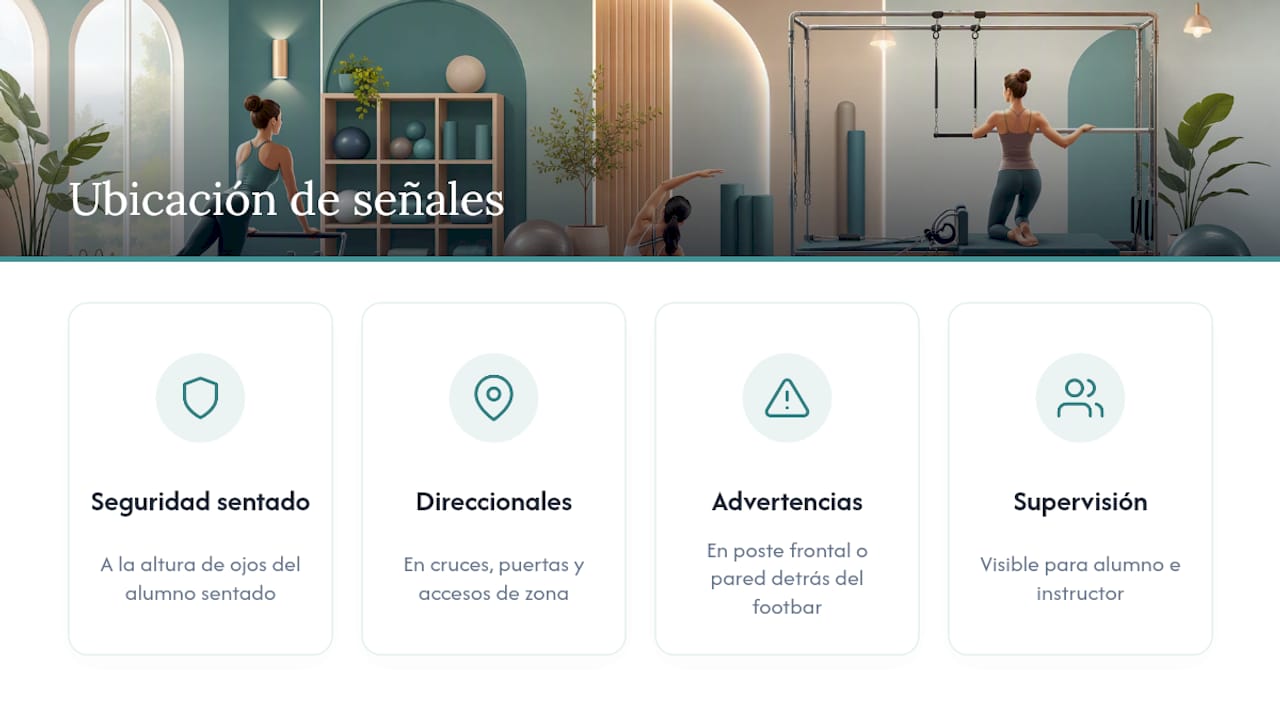
Near each reformer, warning signage should be at the point where the student looks before lying down, usually on the front pole or on the immediate wall behind the footbar. Placing it on the ceiling or on a side that the moving carriage partially covers is a common mistake that reduces its actual effectiveness.
In areas with Cadillac machines or towers, the supervised use sign must be visible to both the student and the instructor circulating between stations, so that both share the same safety reference without relying on memory.
Regulations applicable to signage in sports and health spaces
Mexico does not have a specific standard exclusively dedicated to Pilates studio signage, but there are obligations that apply because it is a workplace with machinery. NOM-004-STPS-1999 requires that machinery and equipment have visible and accessible safety devices, which practically obliges clear marking of mechanical risk points next to each reformer.
This does not replace general civil protection signage (emergency exits, evacuation routes, fire extinguishers), which follows municipal and state regulations applicable to any commercial premises, regardless of whether it sells Pilates classes or coffee. A well-prepared studio combines both layers: machinery safety signage required by labor standards and emergency signage required by local civil protection.
It's worth clarifying that these obligations fall on the studio operator, not on the equipment manufacturer. Buying a certified reformer does not release the owner from installing and maintaining visible stop devices, nor from correctly signaling the risks of the space where they operate.
How Signage Impacts Customer Experience
Clear signage reduces friction on the first visit, which is when most students decide whether or not to return. When someone new walks in and finds obvious directions on where to leave their belongings, which reformer is theirs, and how to adjust the footbar, the class begins with less anxiety and fewer interruptions for the instructor.
The impact on safety is equally direct. Visible warnings next to each machine (moving carriage area, maximum weight, supervision required) serve as a constant reminder, especially for students who have been at the studio for months and tend to relax their attention with routine. Visual repetition, more than memory, is what prevents minor accidents like pinched fingers or bumping into the moving carriage.
There's also an effect on the perception of professionalism. A studio with disorganized signage, with makeshift paper or tape signs, conveys the same sense of neglect as a reformer with rusty springs: students notice it, even if they don't verbalize it. Visual consistency between the signage and the rest of the space builds trust before the instructor says a single word.
Practical Examples of Effective Signage
Studios with high turnover often number each reformer with a discrete metallic disc or plate at the base, visible from the entrance without competing with the decor. This speeds up the assignment of spots in group classes with more than six students.
Another widespread practice is to place a colored strip on the floor around each reformer, marking the carriage's range of motion. This works better than a wall sign because the student sees it constantly during the exercise, not just when entering.
For warning signs, studios with the best safety records use simple iconography (a hand, an arrow, an exclamation mark) combined with a short phrase, instead of explanatory paragraphs that no one reads in the middle of a class. Extensive text works in a welcome manual, not on a sign next to the carriage.
Changing rooms and waiting areas usually benefit from warmer, less technical signage: here it makes sense to use the studio's full visual identity, brand colors, and decorative typography, because there's no safety risk to protect in that space.
Recommended Materials Based on Internal or External Use
Internal signage, near the floor or machines, needs to withstand moisture, sweat, and frequent cleaning with disinfectant. Acrylic and composite aluminum are common choices because they do not deform with repeated contact from cleaning products, which does happen with laminated cardboard or low-quality vinyl after a few months.
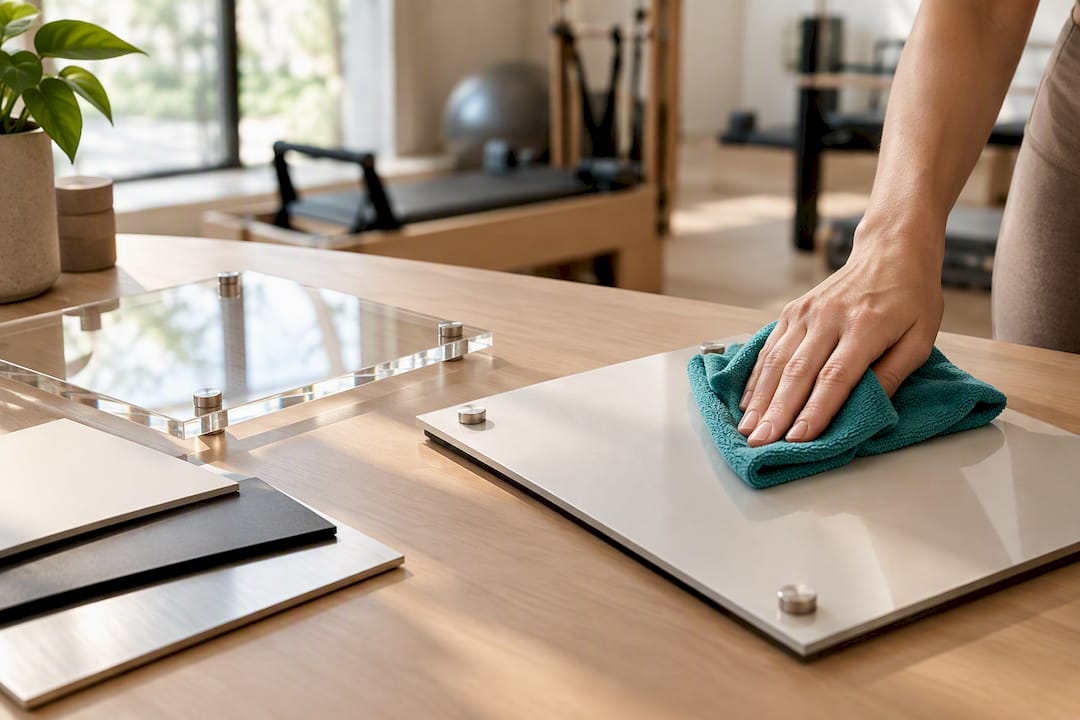
For outdoor signage, such as facade signs or entrance indicators, the material must withstand weathering without losing color or legibility. Anodized aluminum and UV-protected acrylics maintain their appearance under direct sunlight much longer than digital prints without lamination.
On surfaces near the floor, where there is a risk of rubbing with equipment or footwear, it's advisable to avoid materials that scratch easily, such as glossy vinyl without protection. A matte or textured finish better conceals daily wear and tear.
As a general reference, any signage installed near high-traffic equipment areas (such as the area around a reformer) should be considered for periodic replacement, just like any other studio consumable: checking it every six to twelve months prevents a faded sign from failing to perform its warning function.
Author's Perspective and Final Practical Recommendations
The most expensive decision I see repeated is buying for aesthetics or the lowest initial price, ignoring service and spare parts. Buy once, buy well: prioritize a stable structure, availability of parts, and local support. Use financing when it facilitates that decision, not when it replaces it.
How Pilates de México Can Help You Equip Your Studio
Pilates de México is the direct alternative to buying equipment blindly: instead of improvising with suppliers without local support, you work with MetaLife, Infinity, and Advanced lines backed by financing and opening consultancy.
If you are opening or expanding a studio, the concrete advantage lies in not separating decisions: equipment, accessories, and financing are coordinated from the same place, along with advice for layout and the procedures we already covered in previous sections. Studio packages are designed for those who purchase in phases without losing uniformity between units, and our practical studio consulting accompanies this process from studio design to daily operation. If your specification is already ready, the next step is simple: request a quote by reviewing the available lines and tell us how many reformers and what layout you have in mind.
Sources
- Submit your notice of establishment opening — SAT
- NOM-004-STPS-1999 — Secretary of Labor and Social Welfare
- Commercial Pilates Reformers: Selection, spacing and long-term use considerations — Gym Gear
- How much space do you need for a Pilates studio — Studio Growth
Frequently asked questions
What does "Pilates studio signage" mean in this context?
It refers to professional equipment (reformers, chairs, accessories) and associated services such as financing and consulting, not decorative signs. It is the basis upon which all daily studio operations are organized.
How many reformers do I need to open a small studio?
It depends on the class format: a semi-private boutique usually starts with 4 to 6 reformers, while a high-rotation group format should ideally begin with 6 to 8 identical units. Purchasing in phases with the same model facilitates staff training.
How much space do I need per reformer?
Planning guides recommend between 40 and 50 square feet per reformer, approximately 3.7 to 4.6 m², including clearance for the instructor to move safely.
What procedure must I follow when opening the studio with tax authorities?
You must submit the notice of establishment opening to the SAT within one month of opening; the procedure is online and generates a digital acknowledgment.
Does Pilates de México offer financing to equip my studio?
Yes, Pilates de México offers financing options along with equipment packages and opening consulting. The specific price of each plan is available directly on the website.