Opening a Pilates Studio in Mexico: A Practical Guide
Opening a Pilates Studio in Mexico: A Practical Guide
To open a Pilates studio in Mexico, you need three things before anything else: verify the zoning of the premises, register with the SAT (Tax Administration Service), and obtain approval from Civil Protection. The initial investment varies according to the model: a mat studio can start with a low investment (less than $200,000 MXN), a small to medium boutique reformer studio requires between $200,000 and $500,000 MXN according to a sectoral report, and a reformer room with 8 machines generally requires between $500,000 and $1,500,000 MXN, considering equipment, renovation, deposits, and working capital.
Your first three concrete actions:
- Verify land use at the urban development window before signing any lease agreement.
- Secure the premises with a contract that allows enough time to recover the investment (minimum 3 years).
- Start pre-sales at least 4–6 weeks before the official opening, with a waiting list and trial classes.
Table of Contents
- How much does it cost to open a Pilates studio according to the model?
- What business model is right for your Pilates studio?
- What equipment do you need to open your Pilates room?
- What permits do you need to operate legally in Mexico?
- How to set up the premises and how much do operating expenses cost?
- Who to hire and what certifications do you require?
- How to fill classes even before opening?
- When do you reach the break-even point with your studio?
- Key points
- What no one tells you before opening
- Pilates de México: equipment, packages, and consulting for your studio
- Useful sources and official resources to open your studio in Mexico
How much does it cost to open a Pilates studio according to the model?
The difference between a mat studio and a reformer studio is not just about price: it's about a complete business model. Here's the breakdown by item and scenario.
Estimated Investment Table by Scenario
| Item | Basic Mat | Reformer 4–6 machines | Reformer 8 machines |
|---|---|---|---|
| Equipment | less than $200,000 MXN | $200,000–$500,000 MXN | $500,000–$1,500,000 MXN |
| Premises Renovation | $100,000–$250,000 MXN | $100,000–$250,000 MXN | $100,000–$250,000 MXN |
| Rent Deposit | $60,000–$150,000 MXN | $60,000–$150,000 MXN | $60,000–$150,000 MXN |
| Furniture and Signage | low expense | moderate expense | moderate expense |
| Opening Marketing | controlled expense | variable expense | variable expense |
| Software and Technology | basic expense | moderate expense | moderate expense |
| Working Capital (3–6 months) | $100,000–$200,000 MXN | $100,000–$200,000 MXN | $100,000–$200,000 MXN |
| Estimated Total | low to moderate initial investment | $200,000–$500,000 MXN | $500,000–$1,500,000 MXN |
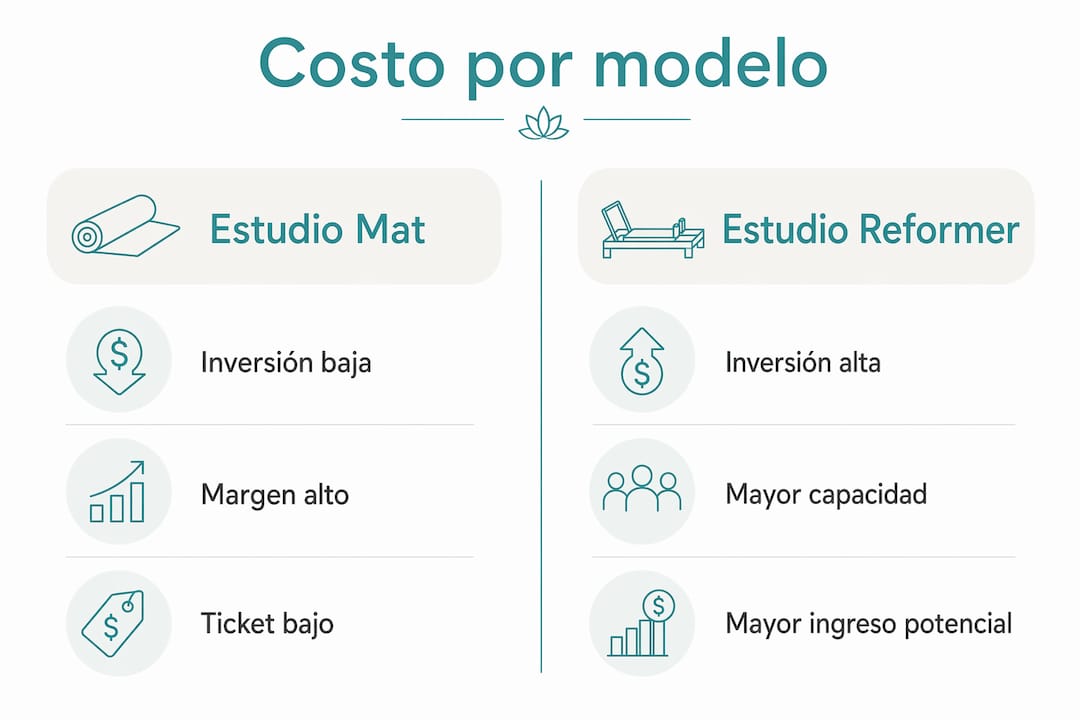
The ranges for the reformer scenario align with what sector operators report for boutique studios in Mexico: between $200,000 and $500,000 MXN for boutique concepts, and over a million for larger formats or franchises.
Some considerations that change the total:
- Rent varies enormously by neighborhood and city; in premium areas of CDMX, it can double the estimated deposit.
- Renovation costs increase if the premises require three-phase electrical installation or floor reinforcement.
- Class management software (reservations, payments, CRM) is usually charged as a monthly subscription; budget at least 12 months in advance.
Professional advice: Prioritize warranty and technical service over the nominal price of the reformer. Equipment that is out of service for two weeks due to a lack of local spare parts can cost you more in canceled classes than the initial savings on the purchase.
Which business model is best for your Pilates studio?
The model defines your average ticket, your margin, and the time it will take you to reach the break-even point. There isn't one universally better model; there's one that fits your capital, your market, and your goals.
Mat studio: Low average ticket, high margin per class, minimal investment. Ideal for instructors who want to validate local demand before committing capital to reformers. The limitation is the income ceiling: without specialized equipment, the class price has little room to grow.
Boutique reformer studio (4–6 pieces of equipment): The model with the best balance between investment and income potential for those just starting out. It allows for small group classes with a high ticket, privates, and semi-privates. The break-even point is reached sooner than in a larger format because fixed costs are manageable.
Medium reformer studio (8–12 pieces of equipment): Greater capacity, greater potential income, but also greater pressure on occupancy. You need to fill more classes to cover rent and payroll. Works well in areas with proven demand or when you already have an existing community.
Mixed model (mat + reformer): Reduces downtime risk because you can schedule mat classes during off-peak reformer hours. Diversification among privates, packages, workshops, and memberships increases occupancy and reduces the risk of empty spaces.
Private and semi-private only: Higher ticket per session, less installed capacity needed, but more volatile income dependent on individual retention. Works better as a complement than as a sole model.
Criteria for deciding:
- Available capital: With less than $400,000 MXN, the mat model or a small boutique reformer studio is the most solid starting point.
- Space: A reformer needs approximately 4.5 m² of maneuvering area; add changing rooms, reception, and circulation.
- Local demographics: Neighborhoods with a middle-to-high socioeconomic profile better sustain reformer pricing; in mixed areas, the hybrid model expands the market.
- Owner's objective: Do you want a manageable lifestyle business or to scale to multiple locations? The boutique reformer model scales; the mat model has a natural ceiling.
What equipment do you need to open your Pilates studio?
The equipment list depends on the model, but there's a core that applies to almost any professional studio.
Essential equipment and accessories
- Commercial Reformers: The central piece. For a boutique, 4 to 8 reformers is the practical starting range; a studio with 8 reformers and average occupancy achieves better margins although it requires a higher initial investment.
- Wunda Chair or Step Chair: Complements the reformer for strength and balance exercises; it's recommended to have at least 1–2 from the start.
- Barrel: Useful for spinal work and flexibility; 1–2 units are sufficient for most boutique studios.
- Quality Mats: Necessary even in reformer studios for warm-ups, floor work, and complementary mat classes.
- Resistance bands, balls, and minor accessories: Low cost, high use. Budget between $5,000 and $15,000 MXN for a complete set of specialized accessories.
Options available in Mexico
The lines available in the Mexican market cover different price ranges and usage profiles:
MetaLife (available through Pilatesdemexico): A leading line in South America, built with certified Lyptus® FAS wood and stainless steel hardware. Supports over 200 exercises and years of daily classes. The MetaLife Infinity reformer is the premium option for studios looking for durability and resale value.
Zürich Labs (available through Pilatesdemexico): An internationally recognized professional line, with Zürich Labs reformers available in Mexico with local support.
Affordable range options: Reformers manufactured in China and other countries, available in ranges of $40,000–$60,000 MXN per unit, suitable for studios starting with a tight budget. Imported lines from the USA can reach $80,000–$120,000 MXN per unit.
The total cost of ownership of a cheap reformer without local spare parts often outweighs the initial saving. Before deciding on price, ask the supplier: Do they have a technician in Mexico? How long does a spare part take? What does the warranty cover? These answers are worth more than any opening discount.
Pro Tip: Start with 4 reformers if capital is limited and scale as demand grows. This reduces pressure on liquidity and leaves room to invest in opening marketing, which has a greater impact on early occupancy than the number of machines.
What Permits Do You Need to Operate Legally in Mexico?
Operating without the correct permits is not just a legal risk: it's a concrete reason for your business to be shut down. The process varies by municipality, but the core is the same across the country.
Essential Procedures Checklist
- RFC and Registration with SAT: The first step before any other procedure. Define your tax regime (individual with business activity or legal entity) based on projected income volume.
- Land Use Consultation: Request it at your municipality's urban development window before signing a lease agreement. Without this step, you could commit capital to a location where the activity is not permitted.
- Operating License or Opening Notice: According to your municipality's Law on Commercial Establishments. In CDMX, establishments with a capacity of less than 49 people and less than 249 m² have different requirements than larger facilities; check with the urban development window before assuming which category applies to you.
- Civil Protection Approval: Requires valid fire extinguishers, marked evacuation routes, and a first-aid kit. Depending on capacity and square meters, an internal civil protection program or only an exemption letter may be required.
- Privacy Notice: Mandatory under the Federal Law on Protection of Personal Data Held by Private Parties. You must have a visible notice and obtain consent from your clients for the handling of their data.
- Liability Insurance: Not a governmental procedure, but practically mandatory. The recommended minimum coverage is $2,000,000 MXN, with an annual cost ranging from $8,000 to $20,000 MXN depending on the size of the studio and the services offered.
Recurring tax obligations to consider from the outset:
- Monthly VAT and ISR declarations before the SAT.
- Issuance of electronic invoices (CFDI) for all services.
- Electronic payroll if you hire staff in a formal employment relationship.
- Annual renewal of operating license in most municipalities.
How to Prepare the Premises and What Are the Operating Costs?
The premises not only have to look good: they have to function for movement, safety, and client comfort.
Minimum Physical Requirements
- Square Meters: A reformer needs approximately 4.5 m² of operational area. For 8 reformers plus circulation, changing rooms, and reception, calculate at least 120–150 m² total.
- Ceiling Height: Minimum 2.8 meters for standing exercises on the reformer; 3 meters or more is ideal.
- Floors: Non-slip surface, preferably wood or high-resistance vinyl. Avoid untreated tile or concrete.
- Ventilation: Efficient climate control is indispensable; accumulated heat in a reformer class affects customer experience and retention.
- Changing Rooms: At least one per gender with lockers and a shower; this is a real differentiator in the boutique market.
- Accessibility: Verify that access complies with basic regulations for people with reduced mobility.
Indicative Renovation Costs
- Specialized flooring: $20,000–$60,000 MXN depending on surface area and material.
- Lighting and mirrors: $15,000–$35,000 MXN.
- Electrical installation and climate control: $20,000–$80,000 MXN depending on the condition of the premises.
- Changing rooms and restrooms: $15,000–$50,000 MXN.
The most relevant monthly operating costs are rent, payroll, utilities (electricity, water, internet), cleaning, equipment maintenance, and insurance. The practical recommendation is to maintain working capital for 3–6 months of fixed costs before opening, not counting projected income.
Who to Hire and What Certifications to Require?
The human team defines the perceived quality of the studio as much as the equipment.
Key Roles Based on Studio Size
- Lead Instructor: The most critical profile. For a small boutique, this can be the owner if certified. For 8 reformers with multiple schedules, you need at least 2–3 instructors.
- Reception and Customer Service: From the first month, someone must manage bookings, payments, and client communication. In small studios, this role can be part-time or shared.
- Cleaning and Operations: Fundamental for perceived quality. This can be an external service or a part-time person.
Certifications recognized by the market
The Mexican market recognizes certifications from international organizations such as STOTT Pilates, Balanced Body, and BASI Pilates, as well as accredited national programs. Instructor certification increases the perceived value of the studio and supports higher class prices. The owner is not legally required to have certification, but having it or hiring certified instructors is a real differentiator from unaccredited studios.
Indicative salary ranges
- Instructor per class: $200–$500 MXN per session, depending on the city and experience.
- Salaried instructor: $8,000–$18,000 MXN per month in markets like CDMX or Guadalajara.
- Part-time reception: $4,000–$7,000 MXN per month.
- Commissions for package sales: between 5% and 15% of the value of the package sold, as an additional incentive.
How to fill classes before opening?
Client acquisition doesn't start on opening day. It begins 4–6 weeks prior, and that window is what separates a launch with a waiting list from one with empty classes.
Pre-opening timeline (weeks 1–6)
- Weeks 1–2: Create your Google Business profile and Instagram and Facebook accounts for the studio. Post “behind-the-scenes” content showing the premises being prepared and equipment being installed.
- Weeks 2–3: Launch a waiting list with a clear incentive: founder's price, free trial classes, or a discount on the first month. Collect emails and WhatsApp numbers.
- Weeks 3–4: Establish partnerships with nutritionists, doctors, beauty salons, and spas in the area. Offer a referral commission or complimentary classes for them to experience the space.
- Weeks 4–5: Organize a trial class or pre-opening event for those on the waiting list. A well-executed event can generate 40–80 sign-ups in the first week.
- Weeks 5–6: Convert trial attendees into memberships with a limited-time offer. The post-trial conversion rate is typically between 30% and 45%.
Low-cost channels and tactics
- Local Instagram: Post 4–5 times a week with valuable content (exercises, benefits, instructor introductions). Use geolocation and hashtags for your neighborhood or city.
- Google Business: Request reviews from the first day of operation. A profile with active reviews appears higher in local searches.
- Referral Program: Offer a free class to anyone who brings a friend who purchases a package. The customer acquisition cost through this channel is the lowest in the market.
- WhatsApp Business: Maintain a broadcast list with active clients to communicate schedules, promotions, and news without relying on the organic reach of social media.
Pro tip: Don't spend your entire marketing budget on paid advertising in the first month. Invest first in building the local community with partnerships and referrals; the return is more lasting, and the cost per acquired client is significantly lower.
When will your studio reach break-even?
Financial projection doesn't need to be complex to be useful. With three variables, you can estimate when the studio will pay for itself.
Basic formula: Monthly Income = price per class × capacity per class × classes per week × 4 weeks × occupancy rate.
Example for an 8-equipment reformer studio
| Scenario | Occupancy | Classes/week | Price/class | Estimated Monthly Income |
|---|---|---|---|---|
| Conservative | 40 % | 30 | — | $120,000 MXN |
| Moderate | 60 % | 30 | — | — |
| Optimistic | 80 % | 35 | — | — |
Assume monthly fixed costs of $80,000–$120,000 MXN (rent, 2 instructors' payroll, utilities, insurance, and maintenance). In the conservative scenario, the studio operates near or slightly below break-even. In the moderate one, it generates a surplus that allows for the amortization of the initial investment. In the optimistic scenario, the recovery of an $800,000 MXN investment can be achieved in 18–24 months.
Steps to build your own projection:
- Define your class pricing based on your local market and target client profile.
- Estimate the actual class capacity (not the theoretical maximum).
- Calculate how many classes per week you can schedule with your initial staff.
- Apply a conservative occupancy rate (40%) for the first quarter and adjust as you go.
- Sum all monthly fixed costs and compare them with the projected income for each scenario.
Maintain working capital to cover at least 3–6 months of fixed costs without relying on studio revenue. This buffer is what distinguishes studios that survive the first year from those that close before reaching cruising altitude.
Key Takeaways
Opening a Pilates studio in Mexico requires verifying land use before signing any contract, having working capital for 3–6 months of fixed costs, and starting client acquisition at least 4–6 weeks before the official opening.
| Point | Details |
|---|---|
| Initial Investment by Model | Mat model: less than $200,000 MXN; reformer boutique: $200,000–$500,000 MXN; 8-reformer studio: $500,000–$1,500,000 MXN |
| First Mandatory Step | Verify land use before signing a lease; without this step, you could lose your deposit and time. |
| Minimum Working Capital | Reserve for 3–6 months of fixed costs before opening, regardless of projected income. |
| Pre-opening Client Acquisition | Start a waiting list 4–6 weeks prior; post-trial conversion is usually between 30% and 45%. |
| Equipment with Pilatesdemexico | Pilates de México offers MetaLife and Balanced Body reformers with financing, packages, and opening consulting in Mexico. |
What No One Tells You Before Opening
There's a recurring pattern in studios that open with enthusiasm and close before reaching two years: they overinvest in equipment and underestimate marketing for the first 90 days. It's not a budget error; it's a priority error.
The most expensive reformer on the market doesn't fill a class on its own. What fills classes is the community you built before opening, alliances with local health professionals, and the consistency with which you appear in local Google searches. A studio with mid-range reformers and a solid acquisition strategy consistently outperforms one with premium equipment and improvised marketing.
Another point few mention: land use is the most underestimated bottleneck in the process. I've seen entrepreneurs sign 12-month lease agreements for premises where fitness activity is simply not allowed by zoning. Recovering that deposit is difficult; losing three months of rent while searching for another location is devastating for liquidity. A land use consultation takes days and costs little. Doing it before any financial commitment to the premises is not bureaucracy: it is the most cost-effective decision in the process.
Finally, regarding equipment: total cost of ownership matters more than the purchase price. A reformer without local technical service can leave you out of operation for weeks. Choose suppliers that have a real presence in Mexico, available spare parts, and a clear warranty. That's worth more than any opening discount.
Pilates de México: Equipment, Packages, and Consulting for Your Studio
Equipping a reformer studio in Mexico has a specific problem: most suppliers sell the equipment and disappear. Pilates de México works differently. In addition to handling the MetaLife line, built with certified Lyptus® FAS wood and stainless steel hardware, and professional Balanced Body reformers, it offers direct financing, complete studio packages, and opening consulting from a team that knows what it really takes to open and fill a studio in Mexico.
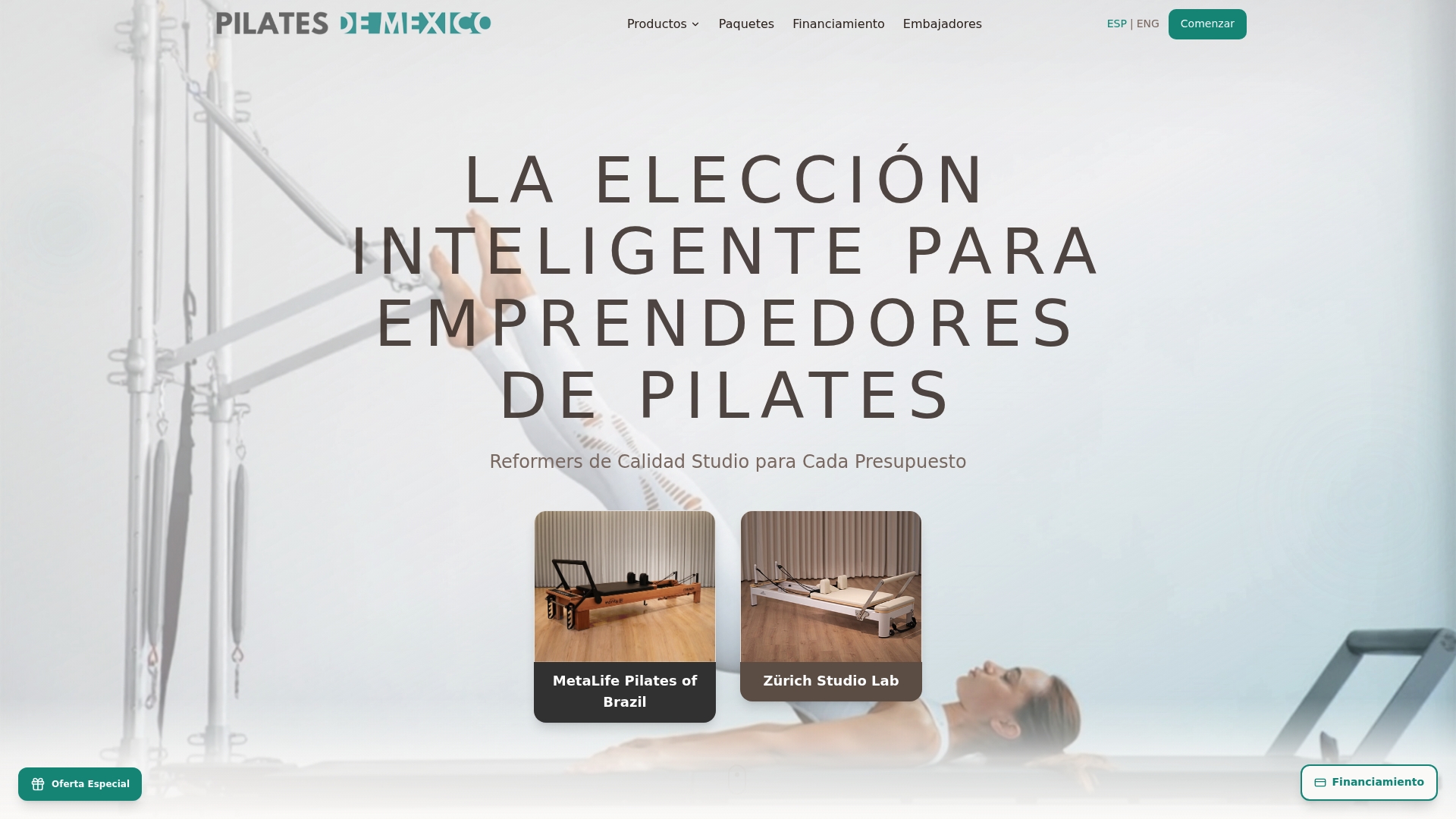
If you are in the quotation stage, the studio packages group reformers, accessories, and financing conditions designed for different investment sizes, from a 4-equipment studio to larger formats. To request a quote, have on hand the square footage of the premises, the number of reformers you plan to install, and your approximate budget. With these details, the team can put together a concrete proposal in a short time.
Useful Sources and Official Resources to Open Your Studio in Mexico
Before starting any procedure, consult official sources directly. Here are the most relevant resources:
- SAT (sat.gob.mx): RFC registration, fiscal regime selection, CFDI issuance, and periodic declarations. Search for "Mi portal SAT" for online procedures.
- SEDUVI (Mexico City): Zoning and land use certificate for establishments in Mexico City. In-person procedure at the urban development counter or online at seduvi.cdmx.gob.mx.
- Municipal Civil Protection: Each municipality has its own dependency. Search for "Protección Civil + name of your municipality" to find specific capacity and square footage requirements.
- Single Business Window (SIEM): Some municipalities consolidate opening procedures into a single window; check if your municipality operates under this scheme.
- Condusef (condusef.gob.mx): To compare civil liability insurance options and understand recommended minimum coverages.
- Studio equipment and packages: Pilates de México centralizes MetaLife and Balanced Body reformer options, accessories, financing, and opening consultancy for studios in Mexico.
- Instructor certification programs: Consult the available training programs to certify your team before opening.
Recommendation
- Pilates Certification in Mexico — Instructor Training Programs
- Pilates de México — Professional Pilates Equipment
- Pilates de México — Professional Pilates Equipment
- Zürich Labs Reformers — Pilates de México
Why studios across Mexico equip with Pilates de México
- MetaLife reformers — our flagship line: manufactured in Brazil from Brazilian hardwood and the number one selling Pilates Equipment brand in all of South America, featured in over 40,000 studios. Pilates de México is the exclusive distributor of MetaLife in Mexico: local stock, local technicians and a 3-year frame warranty.
- Advanced and Infinity Reformers by MetaLife — the two MetaLife lines most studios in Mexico choose, with towers, accessories and studio-grade upholstery.
- Zürich Labs — our accessible alternative when the budget is tighter.
- Studio packages — complete studio setups, with discounts on packages of 5+ reformers.
- Financing — equipment financing so your opening budget goes further.
- Certifications and workshops — instructor training and continuing education.
We own and operate studios throughout Mexico, so the advice comes from operators, not resellers. Request a quote.