Lifespan of a Professional Reformer: How Long It Lasts and When to Upgrade
Lifespan of a Professional Reformer: How Long It Lasts and When to Replace It
A well-built, well-maintained professional reformer lasts between 10 and 15 years in a studio running daily classes. But that number can be misleading if you don't separate two key elements: the frame and the carriage last a decade or more, while springs, ropes, wheels, and upholstery are wear-and-tear components that will be replaced multiple times during that period. What ultimately determines whether your reformer reaches the 15-year mark isn’t the purchase date, but the structural quality you start with and the maintenance routine you follow. At Pilates de México, we outfit studios with the MetaLife line—engineered to withstand years of back-to-back classes. This guide breaks down replacement timelines, maintenance costs, and the warning signs to help you decide when to repair and when to replace your equipment.
Key Takeaways
- With proper maintenance, a commercial reformer lasts 10 to 15 years; the frame and carriage can easily exceed 15.
- Springs are the most frequently replaced component: every 6 to 8 months in studios running 8 to 10 classes a day, and every 12 to 18 months under moderate use.
- Budget between $150 and $250 USD per reformer annually for replacement wear parts.
- Wiping down upholstery after every session and keeping it out of direct sunlight can double or triple its lifespan.
- Replace the entire unit only when the structural frame fails or when annual repair costs rival the price of a new machine; otherwise, simply swap out parts.
Table of Contents
- How Long a Professional Reformer Really Lasts in Practice
- What Factors Impact Durability the Most
- The Annual Cost of Maintaining a Reformer
- Signs You Need to Replace Parts Immediately
- A Maintenance Routine That Extends Equipment Life
- Repair or Replace: How to Decide
- How Lifespan Varies by Studio Operation Type
- What to Look for in Equipment Built to Last
- Equip Your Studio with a Reformer Built to Endure
- Frequently Asked Questions
- Sources
How Long a Professional Reformer Really Lasts in Practice
The industry benchmark is 10 to 15 years for a commercial reformer with proper care. According to a cost analysis comparing new and used equipment, springs are typically swapped out every 12 to 18 months in commercial environments, while the frame and carriage can hold up for 15 years or longer.
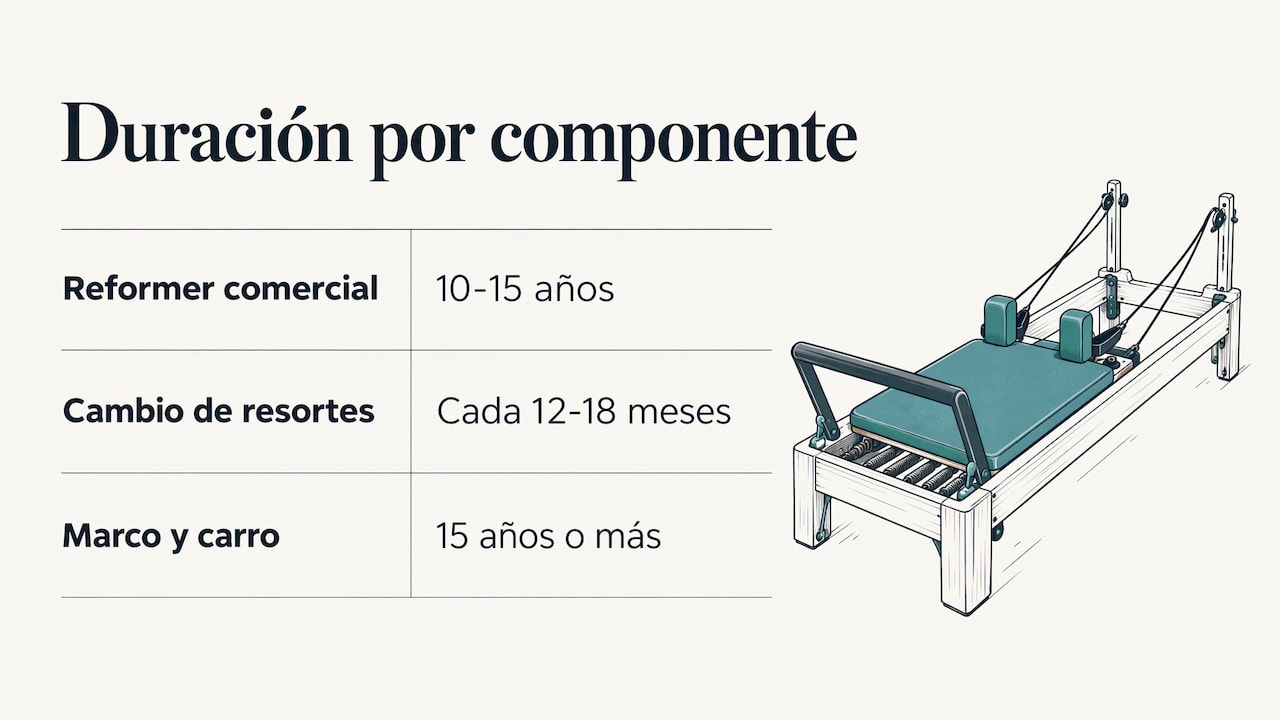
That difference is key to understanding the concept of lifespan. A reformer doesn't simply give out all at once. It consists of a structure (frame, rails, carriage) and consumable components. The structure defines the equipment's lifespan; the consumables define your annual operating expenses.
Usage also changes the timeline. A studio running eight to ten classes a day puts far more hours on each reformer than a physical therapy clinic that uses it with two or three patients daily. That’s why it’s best to measure lifespan in hours of use rather than just years: a reformer in a clinic can remain in pristine condition after 12 years, while one in a fully booked studio will require replacement parts much more frequently.
Which Parts Wear Out and How Often
The following timelines come from a maintenance guide for studio operators. Costs are listed in US dollars; in Mexico, the final price depends on the exchange rate and import fees.
| Part | Typical Studio Lifespan | Approximate Replacement Cost |
|---|---|---|
| Springs (set) | 6 to 8 months with 8 to 10 classes/day; 12 to 18 months with 4 to 5 classes/day; 2 to 3 years in low-volume private use | $150 to $250 USD |
| Ropes and straps | 1 to 2 years | $40 to $80 USD |
| Wheels | 3 to 5 years | $60 to $120 USD |
| Upholstery | 3 to 5 years with regular cleaning | $200 to $400+ USD per reformer |
| Frame and carriage | 15+ years | Not applicable |
Notice the last row. When the frame is solid, replacement parts cost a small fraction of the equipment's total value. When the frame is weak, every new part is mounted on a structure that can no longer hold up, turning maintenance into a recurring financial drain.
What Factors Influence Durability the Most
Three main factors account for almost the entire difference between a reformer that reaches the 15-year mark and one that needs to be replaced after six.
1. Materials and construction
The wood, hardware, and rail geometry determine how much load and how many cycles the equipment can withstand without loosening over time. In our MetaLife line, reformers are built with certified Lyptus® FAS hardwood and stainless steel hardware, with a structure designed to support over 200 exercises and years of daily classes. For a studio prioritizing long-term durability, this is the one part of the equipment you cannot change after making your purchase.
2. Intensity of use
Class hours, daily user count, and user weight all add up. A fitness studio adding a reformer room to its operation must calculate wear and tear just like a traditional Pilates studio: by daily classes, not by the age of the machine. If you plan to run at full capacity, plan your spring replacement schedule right from month one.
3. Daily care
This is the factor you control directly. According to the same maintenance guide, upholstery that is wiped down after each session and kept out of direct sunlight lasts 3 to 5 years in a studio setting, whereas without cleaning or with UV exposure, it can crack within a single year. That is up to a fivefold difference for a single component, achieved with a simple two-minute routine.
Cleaning solutions also matter. Avoid harsh alcohols, bleach, and aggressive degreasers on vinyl—they break it down faster than actual physical use. For specific details, check out our practical guide to reformer upholstery care and our guide on how to clean a reformer.
The Annual Cost of Maintaining a Reformer
For a studio owner or an investor without a background in Pilates, the most practical question isn’t just how many years it lasts, but how much it costs to maintain. The cited maintenance guide recommends budgeting between $150 and $250 USD per reformer per year. That budget primarily covers springs, ropes, and wheels.
For example, a room with six reformers under moderate use requires around $900 to $1,500 USD annually for routine wear-and-tear replacements—whether spent on a full set of springs every year or distributed across ropes, wheels, and other components. If your studio operates at high volume, the spring budget will be higher, as springs lose 15% to 20% of their tension after approximately 500 hours of use.
Two tips to ensure these expenses don't catch you off guard:
- Include replacement parts in your financial plan from day one as a fixed monthly line item.
- If you import or buy outside of Mexico, keep in mind that imported goods end up costing more than their list price due to freight, customs brokers, and VAT; that is why working with a supplier that maintains local inventory of replacement parts in the country is an advantage.
If you want to delve deeper into avoiding expensive repairs, check out our article on reformer maintenance to avoid costly repairs.
Signs You Need to Replace Parts Immediately
The maintenance calendar is a guideline, not a strict rule. A studio maintenance checklist indicates that certain warning signs call for immediate spring replacement, regardless of purchase date:
- Coils that do not close back up after stretching.
- Visible rust on the spring.
- Deformed or bent hooks.
- A spring that feels noticeably weaker than another of the same color.
- Unusual noises during exercise.
The same checklist recommends logging every inspection per machine. It is a simple habit that gives you a real-world track record: you will know which reformer goes through more parts and which one is approaching the end of its life cycle.
When it comes to springs, the rule of thumb is to replace them as a complete set rather than one by one, ensuring consistent resistance for each color across your entire studio. We have a step-by-step guide to replacing reformer springs and another to help you understand reformer spring resistance and color coding.
Carriage and Rails: The Weekly Inspection
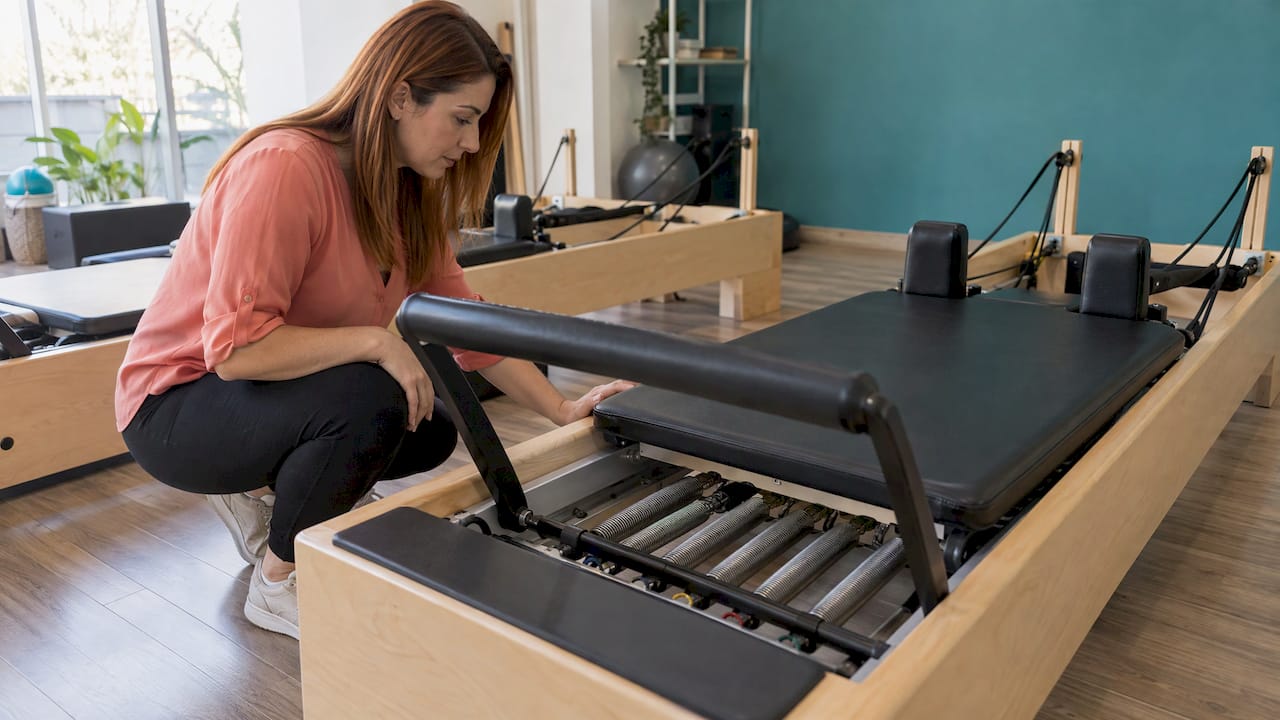
The carriage is the component clients interact with the most, and its issues typically center around two areas: the upholstery and the wheel-and-rail assembly. Make sure the carriage glides smoothly without noise or catching, the rails are clean and free of dust buildup, and the gear blocks are secure. If the glide feel changes, it is usually a sign of wheel wear or debris on the rail—and it can often be fixed with a quick cleaning or wheel replacement, not an entirely new machine. Here is more on reformer rails and what to inspect.
A Care Routine That Extends Equipment Lifespan
A short, consistent routine yields far better results than a major overhaul once a year.
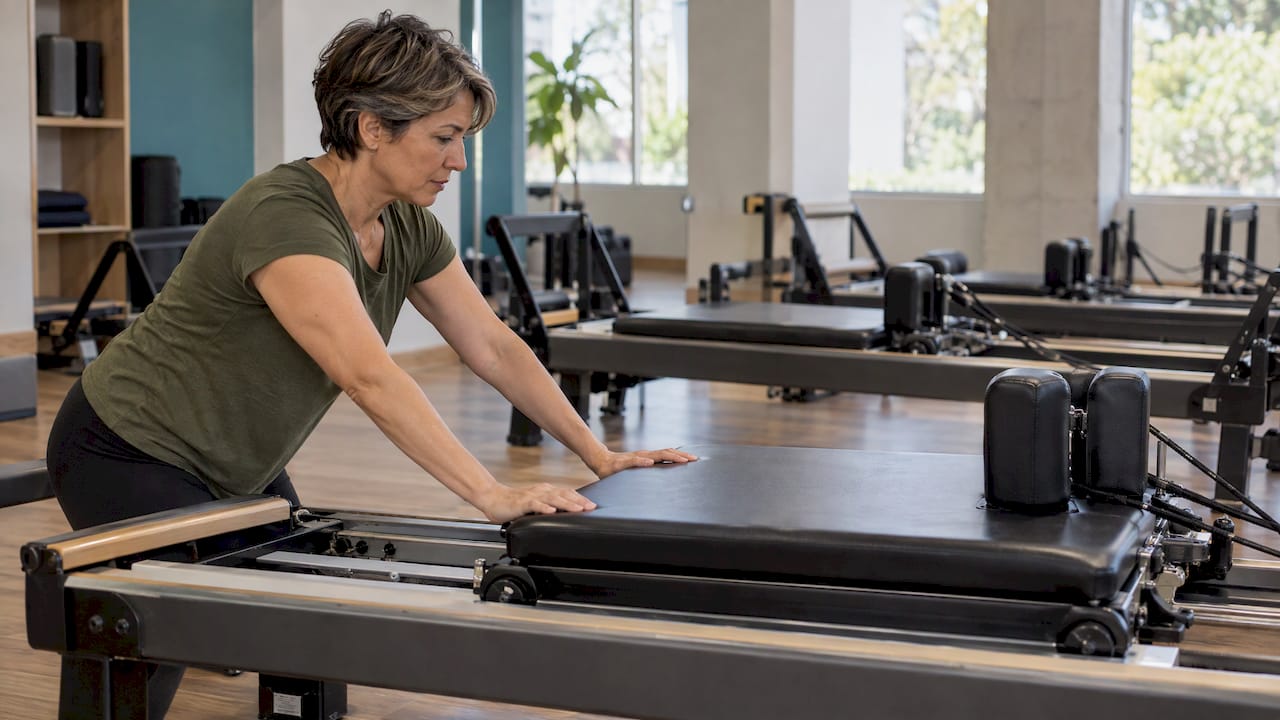
- After every session: wipe down upholstery and grips with a vinyl-safe cleaner, free of harsh alcohols or bleach. Sweat leaves behind salts and oils that degrade the material.
- Every week: inspect rails, wheels, ropes, and hooks. Look for wear, noise, or loose hardware.
- Every month: check springs one by one and log the findings for each machine.
- Based on usage: replace springs according to your class volume schedule, and ropes every one to two years.
- Always: protect equipment from direct sunlight and excessive humidity.
As for lubrication, avoid doing it routinely on sealed bearings: oil mixes with dust and can form an abrasive paste that accelerates wear. Only lubricate where explicitly indicated by the manufacturer.
In a clinic or gym setting, this routine becomes much easier if assigned to a specific person using a simple log template. Equipment with an assigned maintenance owner lasts far longer than gear that only gets attention when someone remembers.
Repair or Replace: How to Decide
The decision depends on which part of the reformer is failing.
Replace parts when the issue is with consumable components: springs, ropes, wheels, upholstery. These are expected expenses, and the frame remains the core asset. A reformer with a solid frame and stable carriage is well worth reupholstering every four years.
Consider replacing the equipment when:
- The frame or rails show cracks, warping, or play that cannot be fixed by tightening hardware.
- The annual repair cost per unit consistently approaches the cost of replacement.
- Compatible replacement parts are no longer available for that model.
- You are revamping your studio’s aesthetic or expanding the floor plan and need visual uniformity across all units.
For established studios, phased replacement is an effective strategy: replace high-mileage machines first and repurpose lighter-wear units for lower-volume use. If you already own MetaLife equipment, resale value plays a big role in this decision: a well-maintained machine with documented service records is much easier to sell when it is time to upgrade.
If you are about to open and comparing initial investment options, learning about common mistakes new studio owners make will help you avoid paying twice. And for studio floor planning, check out how much space each reformer requires.
How Lifespan Varies by Operation Type
Not everyone uses a reformer the same way, and maintenance timelines change accordingly.
Established Pilates studio. This scenario experiences the highest wear and tear. With multiple classes a day, springs are replaced every few months and upholstery becomes a key focus. Here, the frame carries the most weight in the purchase decision because it pays for itself over years of a fully booked schedule.
Instructor opening their first studio. Your priority is getting started with a manageable investment. Plan your annual replacement budget right from the start and choose equipment with spare parts available in Mexico. That is what prevents a cheap reformer from ending up costing more.
Gym or yoga, CrossFit, HYROX, barre, or dance studio. If you're adding a reformer room, your biggest risk is irregular use: many users, few checkups. Define who inspects the equipment and how often, just as you do with the rest of your fitness machinery.
Rehabilitation or physical therapy clinic. Class volume is lower, so springs last longer, but the equipment is used with patients and safety is paramount: check hooks, ropes, and gear stops before each workday and replace any visibly worn part without waiting for the maintenance schedule.
Investor without a Pilates background. Think of the reformer as an asset with predictable costs: an annual maintenance allowance, a parts replacement schedule, and a resale value that depends on the equipment's condition. Request the maintenance plan along with your quote.
What to Look for in Equipment to Make It Last
Before purchasing, evaluate these key factors that have the greatest impact on lifespan:
- Construction: solid wood and corrosion-resistant hardware that withstand daily commercial use.
- Spare parts: springs, ropes, and wheels available locally in Mexico without waiting months for imports.
- Local warranty and installation: equipment properly assembled from day one wears evenly.
- Post-purchase support: reliable after-sales support for reformers makes all the difference when you need a replacement part or have a technical question.
At Pilates de México, we provide these essentials alongside our equipment: local warranty, professional installation, and consulting for studios. If you want to see how much longer a well-designed frame can last, read our article on professional reformer durability.
Equip Your Studio with a Reformer Built to Last
Our MetaLife line combines certified Lyptus® FAS hardwood, stainless steel hardware, and a frame engineered for over 200 exercises and years of daily classes. It is available in two lines: Infinity and Advanced, in addition to specialized accessories. We also offer accessible options so opening your first studio doesn't require starting at the highest price point.
Every piece of equipment includes financing, packages, and consulting from a team that knows what it takes to open and fill a studio. Explore our financing options or request an equipment quote to plan your studio with a proactive maintenance schedule from day one.
Frequently Asked Questions
How many years does a professional reformer last?
With proper maintenance, a commercial reformer lasts between 10 and 15 years, and its frame and carriage can easily exceed 15. Springs, ropes, wheels, and upholstery are replaced several times over that lifespan. Heavy daily use shortens the wear cycle of individual parts, not necessarily the life of the frame.
How often should springs be replaced?
It depends on class volume. In studios running 8 to 10 classes a day, they are replaced every 6 to 8 months; with 4 to 5 classes, every 12 to 18 months; in low-volume private use, every 2 to 3 years. Replace them sooner if you notice gaps between coils, rust, or deformed hooks.
How much should I budget per year to maintain a reformer?
The industry benchmark is $150 to $250 USD per reformer per year, which primarily covers springs, ropes, and wheels. Upholstery is added every 3 to 5 years. Convert this amount to local currency using the current exchange rate and factor in shipping or import costs if applicable.
When is it better to replace the entire reformer instead of repairing it?
When the frame shows cracks, warping, or looseness that cannot be corrected, when spare parts are no longer available for the model, or when the annual cost of repairs approaches the price of new equipment. As long as the issue is limited to wear-and-tear components, replacing individual parts is the standard approach.
Sources
- Used vs. New Pilates Reformers: True Cost Analysis 2026
- Reformer Maintenance Guide for Pilates Studio Operators
- Pilates Equipment Maintenance: Checklist