How Many Reformers to Put in Your Pilates Studio
How Many Reformers to Put in Your Pilates Studio
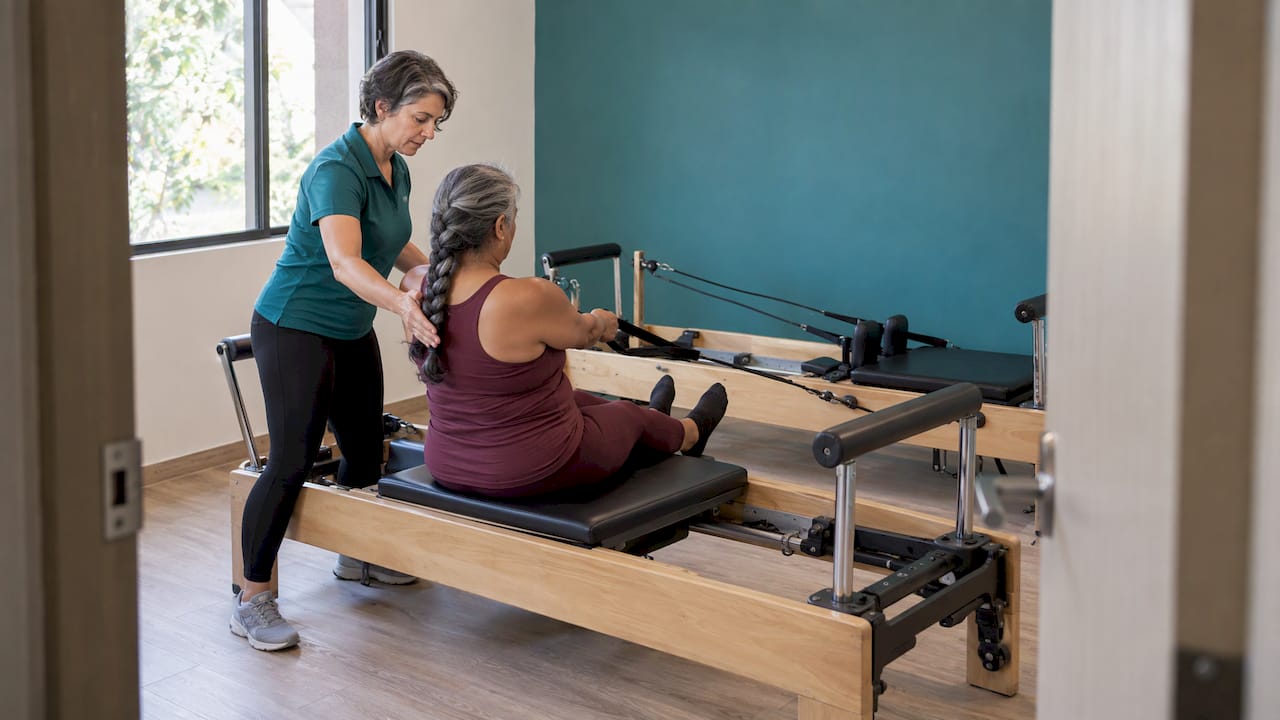
For most studios in Mexico, the practical answer is this: start with 4 to 6 reformers and design the room to fit 8. The final number isn't determined by floor space alone. It comes down to three factors: your studio's usable square footage, how many students an instructor can effectively guide, and how many reformers you can consistently fill. An extra reformer that sits empty is tied-up capital. A room with no room to grow forces you to relocate just a few months in.
At Pilates de México, we equip reformer studios nationwide, and this guide provides the full breakdown so you can make data-driven decisions: space per unit, class size, break-even point, and how to scale without reinvesting from scratch.
In Summary
- Starting point: 4 to 6 reformers, with a room designed for 8. This is the most recommended range across studio opening guides in Mexico.
- Space: plan for about 6 m² of studio floor space per reformer, plus reception, changing area, and storage. For 8 units, a space of around 80 m² is a reasonable minimum.
- Class size: each reformer is a bookable spot, but one instructor can properly manage 4 to 6 students on reformers, depending on the group's experience level.
- Profitability: with 6 reformers, the break-even benchmark requires nearly 3 beds filled per class just to cover operating expenses.
- Scaling smoothly: invest in durable equipment with strong resale value, and pace your purchases with financing and bundled packages.
Table of Contents
- The number depends on your studio, not a fixed rule
- How much space each reformer takes up
- How to calculate how many fit in your space
- Students per instructor: the studio's real limit
- The business math: how many beds you need to fill
- How to decide based on your business model
- How we help you configure your studio
- Frequently asked questions
- Sources
The number depends on your studio, not a fixed rule
There is no one-size-fits-all number. What does exist is a consistent range. A studio opening guide published in Mexico suggests leasing a commercial space that fits 8 reformers and starting with 4 to 6, leaving room to add units as demand grows. Another guide recommends 8 to 12 reformers for a group class studio, with a minimum of 6, because with fewer beds, the business model only works with premium pricing or personalized sessions.
The difference between the two recommendations comes down to your model. If you offer private or semi-private sessions, 2 to 4 reformers may be plenty. If you offer accessible group classes, you need more reformers per time slot so that each class leaves a healthy profit margin.
A practical tip: instructors are part of the equation. Ricardo González, founder of The Original Pilates in Mexico City with 26 years of experience, notes that one reformer is more than enough with great instructors and that it doesn't pay to buy equipment you don't have anyone to teach on. He also advises planning your space with your future number of reformers in mind, so you don't have to move after just one year.
How Much Space Each Reformer Takes Up
A professional reformer measures around 2.4 m long by 0.8 m wide. A benchmark model like the Balanced Body Allegro 2 is right around these dimensions, and you should leave 60 to 90 cm of clearance around it. That breathing room isn't a luxury: it's the space the instructor walks through to make corrections, and where clients get on and off the bed.
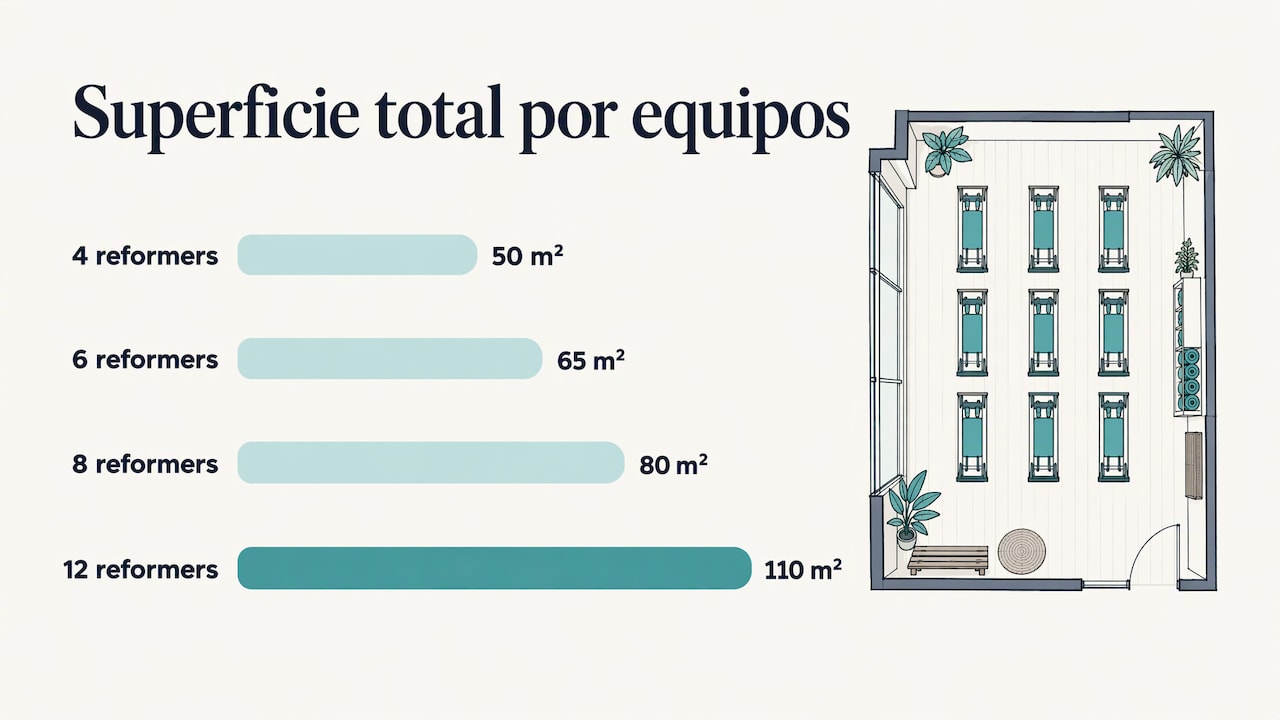
Sharing aisles between units results in roughly 6 m² of studio floor space per reformer. On top of that, you need to factor in common areas: reception, bathroom with shower, changing room, and storage.
The detailed breakdown for Mexico, according to the cost breakdown in the same guide, looks like this:
| Reformers | Studio Floor | Common Areas | Approximate Total Space |
|---|---|---|---|
| 4 | 24 m² | 26 m² | 50 m² |
| 6 | 36 m² | 29 m² | 65 m² |
| 8 | 48 m² | 32 m² | 80 m² |
| 12 | 72 m² | 38 m² | 110 m² |
Other Mexican guides arrive at similar figures through different approaches. One notes that a studio with 8 units needs between 80 and 120 m², including reception and changing rooms, with ceiling heights of at least 2.7 meters. Another describes the standard layout of 6 reformers with towers within 60 to 80 m² of usable studio room, plus reception and changing areas.
For those who prefer to think in spatial ranges, a studio floor plan guide outlines three comfort levels: compact at 3.7 to 4.6 m² per reformer, comfortable at 5.5 to 7.4 m² (the most common in boutique studios), and spacious at 7.4 to 9.3 m² or more. If your classes are aimed at beginners or rehabilitation clients, opt for the comfortable or spacious range.
A Real-World Studio Example
A fully equipped studio in Mérida, Yucatán, spans 54.28 m² (4.60 m wide by 11.80 m deep) with 8 reformer beds and capacity for 8 students per session. It's a long, narrow room with wall-to-wall mirrors: a lot fits into a small footprint, but that density requires a very thoughtful layout. If your commercial space has an irregular shape, the floor plan matters just as much as the square footage.
If you want to tailor these calculations to your specific location, our guide on how much space each reformer needs in your studio walks you through it step by step, and our guide on fitting 6 to 8 reformers in 40 to 80 m² is tailored for tight spaces.
How to Calculate How Many Fit in Your Space
Use this five-step method before signing a lease:
- Measure the usable length and width of the workout room, excluding columns, stairs, and storage. Also note ceiling clearance: industry guides recommend a minimum of 2.7 m, and 2.8 m or more if you have a tower or Cadillac.
- Set aside common areas first. The reception desk, changing room, bathroom, and storage consume between 26 and 38 m² depending on the size of the studio, as shown in the table above.
- Divide the workout room area by 6. This is the standard calculation for comfort. If the result falls between two numbers, round down.
- Draw the floor plan to scale, using 2.4 by 0.8 m for each reformer and 60 to 90 cm of clearance. Verify that the instructor can easily access the head and foot of every bed.
- Leave a clear exit path and one open wall to store accessories and, down the road, add one or two more beds.
Most mistakes happen in step 4: buying first and measuring later. That's why, before ordering equipment, it's wise to review the floor plan with someone who has actually set up studio rooms. This is part of our studio opening and expansion consulting, and our guide on how to set up a reformer studio room without layout or assembly mistakes outlines the critical points.
How Many Students per Instructor: The Room's Real Limit
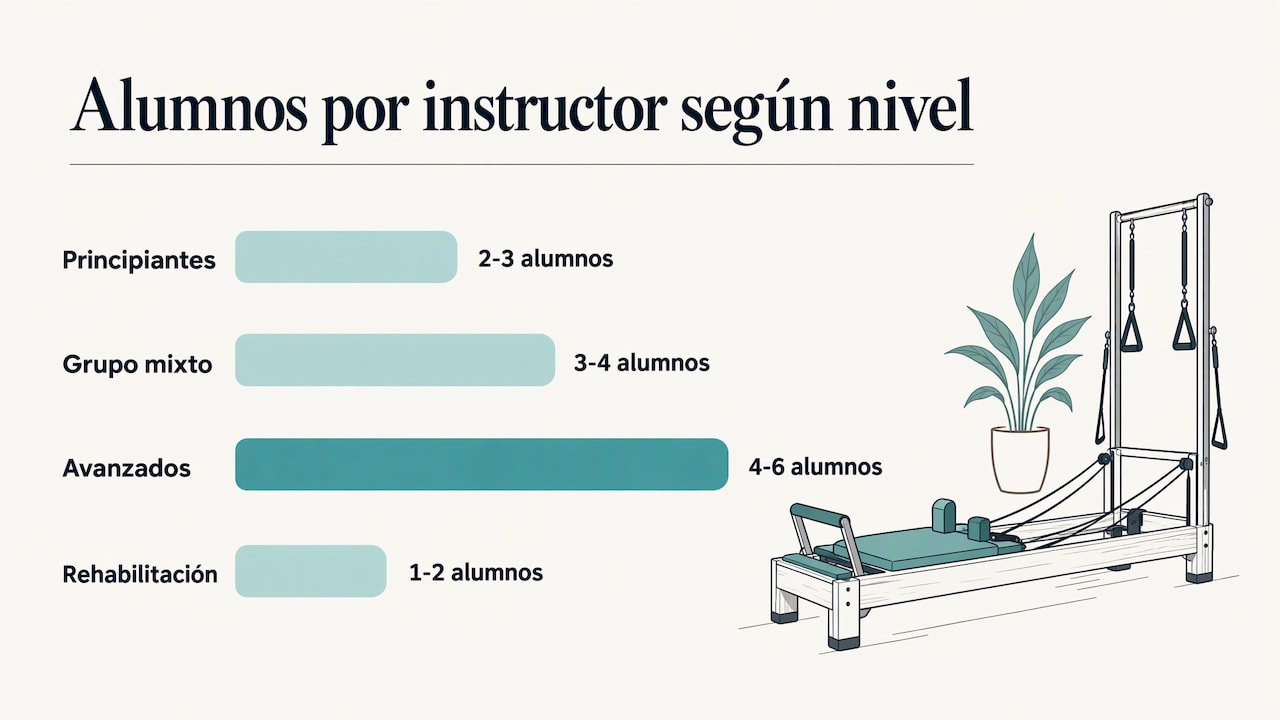
Having 8 reformers doesn't mean a single instructor should handle 8 students. A guide on group size indicates that an equipment-based class usually has 2 to 4 students per instructor, detailing limits by level: beginners on equipment 2 to 3, mixed regular group 3 to 4, advanced on reformer 4 to 6, rehabilitation 1 to 2. The same source recommends reviewing your liability insurance, as some insurance providers ask about the student-to-instructor ratio.
In Mexico City, some studios display their class caps upfront. One of them, located in San Jerónimo Lídice, caps its classes at a maximum of 6 people to provide real-time corrections. In Spain, another guide places the optimal range between 2 and 6 reformers per class, warning that more than 6 can compromise safety and effectiveness.
That is why many Mexican studios run classes of 6 to 10 people with an average rate of $250 to $450 MXN per class. If your studio will have 8 or more reformers and a single instructor per time slot, define right from the start who uses each machine, what level joins each class, and what class maximum you are going to advertise.
If you are a physical therapist, chiropractor, or manage a clinic, the ratio drops: rehabilitation requires 1 to 2 patients per professional, so 2 to 4 reformers are usually enough to start, eliminating the need for an 8-reformer room. For operational safety tips, check out our reformer studio safety guide.
When drafting your group guidelines, it is a good idea to put a written class size policy in place: how many students can attend, how the waitlist is managed, and what happens if an instructor is absent.
The Business Math: How Many Reformers You Need to Fill
The number of reformers is a financial decision. Each machine is a spot you sell in every time slot, and it only generates revenue when occupied.
A break-even example published in Mexico illustrates this well: with 6 reformers, 30 classes a week, $45,000 MXN in fixed expenses, and $350 MXN per class paid to the instructor, you need 49% occupancy—almost 3 reformers per class—just to break even. This is an illustrative calculation, not a guarantee: your rent, rates, and payroll will affect your specific outcome.
From this, two useful rules emerge:
- If your 6- or 8-student classes already have a waitlist, expanding makes sense. A studio layout guide frames it this way: if your average is 5 per class, two more machines won't solve an occupancy issue, but if classes are consistently full, each new reformer sells immediately.
- If you are just opening, don't buy 12 reformers just in case. Purchase 4 to 6 and leave the space ready for 2 to 4 more.
To give you a sense of scale, the total investment for a standard 6-reformer studio in Mexico is estimated between $400,000 and $795,000 MXN, with 50% to 55% allocated to equipment. Equipment represents the largest expense—and the one you most need to get right. That's why deciding how many reformers to buy and choosing their quality level go hand in hand.
What Type of Reformer Changes the Math
Unit prices in Mexico vary widely. A guide that interviewed 7 studio owners reports reformers ranging from over $40,000 MXN to around $200,000 MXN for high-end brands, with lead times of one and a half to two months for domestic suppliers, or close to three months if imported from China. When planning an opening, that lead time must be factored into your timeline alongside your lease start date.
Beyond the purchase price, consider how many classes per day each reformer will handle. Equipment in a shared studio with a packed schedule sees far more hours of use than one used only occasionally. Ricardo González points out that his machines have lasted 20 years, but routine maintenance is an expense he never cuts. Well-built equipment turns that maintenance into a predictable cost.
How to Decide Based on Your Profile
Certified instructor opening their first studio. Start with 4 to 6 reformers. Your main constraints are capital and your own time in each class. It is far better to have a few full machines than many empty ones. A financing plan allows you to fully equip a studio without paying everything upfront.
Established studio expanding or renovating. Look at your data: average occupancy per time slot and waiting lists. If your 8-person classes are consistently full, add 2 to 4 beds. If you are renovating, choose equipment built to withstand years of daily classes while maintaining resale value, because that decision will repeat itself every time you grow.
Gym, yoga, CrossFit, HYROX, barre, or dance studio adding a dedicated room. Your facility already exists, so the calculation starts with the square footage you can allocate. With 40 to 80 m² (430 to 860 sq ft), you can comfortably fit 6 to 8 reformers if you plan your layout carefully. If your space will host hybrid classes, check out our guide Reformer or Hybrid: Decide with Numbers and Floor Plans.
Rehabilitation or physical therapy clinic. Two to 4 reformers are enough to get started with 1-on-1 or 1-on-2 care. Prioritize ceiling height and ample clearance to move freely around each piece of equipment.
Investor without a background in Pilates. Your launch relies on two key factors: the instructor leading the classes and the occupancy rate you achieve. Start from your break-even point and the studio size that fits your budget, and make sure your business plan accounts for expansion right from the initial floor plan.
How we help you set up your studio
At Pilates de México, we carry MetaLife, the leading reformer line in South America and now available in Mexico. Built with certified Lyptus® FAS wood, stainless steel hardware, and an engineered structure that supports over 200 exercises and years of heavy daily use. We also offer affordable options manufactured in China and other countries, so your first studio doesn't have to start at the highest price point.
Every piece of equipment comes with financing options, package deals, and expert consulting from a team that understands what it takes to open and fill a studio. Whatever room size you choose, explore our Infinity Line and Advanced Line, build a studio package, learn about financing, or request an equipment quote tailored to your space's dimensions.
If you are purchasing multiple units, our guide on buying reformers wholesale explains how to equip your studio in bundles, and our guide on how to choose a reformer will help you compare product lines.
Frequently Asked Questions
How many reformers do I need to open a small studio?
Between 4 and 6 is the most common starting point in Mexico. For 4 reformers, you will need a space of about 50 m² (540 sq ft), and for 6 reformers, around 65 m² (700 sq ft), including reception, changing area, and storage. If possible, pick a location that leaves room to expand to 8 down the line.
How many square meters do I need per reformer?
Plan for roughly 6 m² (65 sq ft) of studio floor space per machine, with 60 to 90 cm (2 to 3 ft) of clearance around each unit. Add common areas to that: for 8 reformers, the total layout usually requires around 80 m² (860 sq ft), with Mexican industry guidelines recommending up to 120 m² (1,290 sq ft) for a more spacious layout.
How many students can one instructor teach on a reformer?
It depends on their skill level. For beginner groups, the standard ratio is 2 to 3 students per instructor, while advanced groups can expand to 4 to 6. Define your maximum before opening and verify with your liability insurance provider, as some policies specify student-to-instructor ratios.
Is it worth buying more reformers than I can fill?
No. Each reformer only generates revenue when occupied. Purchase what you can reliably fill during peak hours, leave space to scale, and add units once your classes start generating a waiting list.
Sources
- How to Open a Pilates Studio in Mexico (2026), Pilaty
- How Much Does It Cost to Open a Pilates Studio (2026), Pilaty
- How to Open a Pilates or Yoga Studio in Mexico, Amyra
- How Much Does It Cost to Open a Pilates Studio in Mexico, Syncro Fitness
- How to Open a Pilates Studio in Mexico, Fitune
- Pilates Studio: Equipment and Guide, Bookicorn
- Pilates Studio Floor Plan, Time2book
- How Many Students per Pilates Class, Elastudio
- How Much Does It Cost to Open a Pilates Studio, Virtuagym
- Pilates Reformer Classes in CDMX, Santulan
- Equipped Pilates Studio, Mérida