Hiring Pilates Instructors: A Guide for Studio Owners
Hiring Pilates Instructors: A Guide for Studio Owners
Hiring qualified Pilates instructors requires three non-negotiable filters: a minimum certification of 400 hours (or active professional registration where applicable), an evaluated trial class with a rubric, and a contract that clearly defines the employment terms from day one. Without these three elements, staff turnover and client loss are almost inevitable.
Start today with these actions:
- Post the vacancy specifying minimum certification, specialty (reformer, mat, or rehabilitation), and exact availability.
- Schedule two trial classes per finalist, evaluated with the same technical rubric.
- Verify credentials, professional registration, and references before signing any contract.
7-day Checklist:
- Day 1-2: Post vacancy and disseminate on social media and specialized platforms.
- Day 3-4: Filter resumes and schedule technical interviews.
- Day 5-6: Conduct trial classes with evaluation rubric.
- Day 7: Verify documents and decide on hiring.
Pro Tip: Do not negotiate the trial class, even if the candidate has years of experience. Live execution reveals things no resume can show.
Key Points
Hiring qualified Pilates instructors requires verifiable certification, a trial class with a rubric, and a 90-day integration plan to maintain quality over time.
| Point | Details |
|---|---|
| Require minimum certification | Verify training of at least 400 hours and active professional registration when regulatory frameworks require it. |
| Use the trial class as a final filter | Evaluate with a live technical rubric, not just a resume or interview. |
| Calibrate compensation with real data | The estimated annual salary is around 192,000 Mexican pesos according to the industry. |
| Design a 90-day onboarding | Standardize technique and culture before giving the instructor full autonomy. |
| Equip the studio along with the talent | Pilates de México offers certifications, packages, and financing to support hiring with adequate infrastructure. |
Table of Contents
- Key Qualifications and Certifications for Hiring Pilates Instructors
- Where to Find Qualified Candidates for Your Studio?
- Selection Process: From Job Posting to Trial Class
- Estimated Salaries and Contractual Considerations in Mexico
- Onboarding and Integration: The Instructor's First 90 Days
- What Questions Truly Reveal a Candidate's Competencies?
- Performance Evaluation: How to Ensure Quality After Hiring
- Why a Structured Process Protects More Than It Costs
- Equipment, Certifications, and Consulting to Scale Your Studio
- Sources
Key Qualifications and Certifications for Hiring Pilates Instructors
Certification is the first filter, but not the only one. An instructor with comprehensive training in the Pilates method and credentials recognized by industry associations reduces the risk of student injuries and protects the studio's reputation, as noted by teaching profiles that emphasize the importance of continuous training and certifications endorsed by organizations like PMA.
Specifically look for these elements in each candidate:
- Minimum 400 hours of training in the Pilates method, with clear specialization in reformer, mat, or rehabilitation.
- Active professional registration when the regulatory framework requires it, verifiable with official documentation.
- Demonstrable experience in therapeutic Pilates, especially if the studio serves a population with injuries or post-operative clients.
- Ability to work interdisciplinarily, collaborating with physiotherapists and other health professionals when required.
The most competitive job offers in the sector explicitly request this combination: comprehensive training, valuable therapeutic experience, and a willingness to work in a team with physical therapists. The most prestigious studios don't just hire exercise technicians; they hire the ability to integrate into a healthcare team.
If your studio doesn't have instructors who meet these standards, consider training them internally. A structured certification program allows for competency validation with homogeneous criteria, rather than relying solely on external certificates from diverse origins.
Where to find qualified candidates for your studio?
Sourcing determines the quality of the entire funnel. Posting only on social media generates volume, but rarely technical quality.
Certification schools are the most reliable source: their recent graduates already know the required methodology and are often actively looking for their first opportunity in a studio. Directly contacting program coordinators accelerates this process.
Freelance professional platforms also work well for filling urgent vacancies or specific classes. Fixando, for example, allows you to receive up to five quotes from instructors in 48 hours, with profiles whose contact remains hidden until you select a candidate. This is especially useful when you need to cover a temporary absence or test the demand for a new class before hiring permanent staff.
Networking within the Pilates community (alumni groups, regional associations, other studio owners) remains the most underestimated avenue. An instructor referred by a trusted colleague comes with less risk than one recruited cold.
Selection process: from announcement to trial class
A well-designed selection process takes between three and six weeks from the opening of the vacancy to the instructor's first official day, according to an operational checklist of 48 items organized into seven stages. Skipping stages to fill a vacancy quickly almost always proves costly later.
The recommended structure follows this order:
- Announcement with precise requirements: required certification, specialty, available hours, and type of contract from the start.
- Resume triage: discard candidates without verifiable certification before investing time in interviews.
- Technical interview: questions about methodology, management of common injuries, and experience with different student profiles.
- Trial class evaluated with a rubric: the candidate teaches a real class to a small group while specific technical points are graded.
- Legal verifications: diplomas, professional registration, background checks, and references from previous employers.
The trial class is the step most owners cut short due to lack of time, and it is precisely the one that provides the most information. A simple rubric with five or six criteria (postural correction, group management, exercise adaptation, communication) transforms a subjective impression into a defensible decision.
Indicative salaries and contractual considerations in Mexico
The indicative annual salary for a Pilates instructor in Mexico is around 192,000 Mexican pesos, a useful figure as a starting point for negotiation, although it varies depending on the city, specialization, and whether the instructor works exclusively or shared among several studios.
Before publishing the vacancy, define the employment modality: hiring as an employee with benefits, an independent service provider, or a fee-per-class scheme. This decision has tax, social security, and legal liability implications in the event of student injuries, so it's advisable to resolve it with accounting advice before signing any agreement.
Instructors with specialties in rehabilitation or advanced machine training typically negotiate above-average rates, especially if they bring their own client base. Linking a portion of compensation to objective metrics (student retention, class occupancy) also helps align incentives without relying solely on a fixed salary.
Onboarding and integration: the instructor's first 90 days
Signing the contract doesn't conclude the Pilates instructor hiring process; it begins it. Integrating the new professional through cultural induction, technical standardization, and active mentoring is what truly determines whether they stay and perform at the expected level.
Structure onboarding into three phases:
- Days 1 to 30: induction into studio protocols, team introduction, shadowing classes with senior instructors, and calibrating communication style with students.
- Days 31 to 60: supervised classes with weekly feedback, technique adjustment according to the studio's internal standards.
- Days 61 to 90: full autonomy with a formal performance evaluation at the end of the period.
Standardizing technique is especially critical when several instructors share the same reformer room: students immediately notice if corrections or class pacing change depending on who is teaching. Documenting the expected repertoire by level avoids this inconsistency. Clearly displaying class schedules, using well-organized screens or displays, also helps the new instructor understand the operational dynamics of the studio from their first week.
What questions truly reveal a candidate's competencies?
Generic questions ("tell me about your experience") produce generic answers. Specific questions about real situations reveal whether the candidate thinks like a professional or just repeats certification theory.
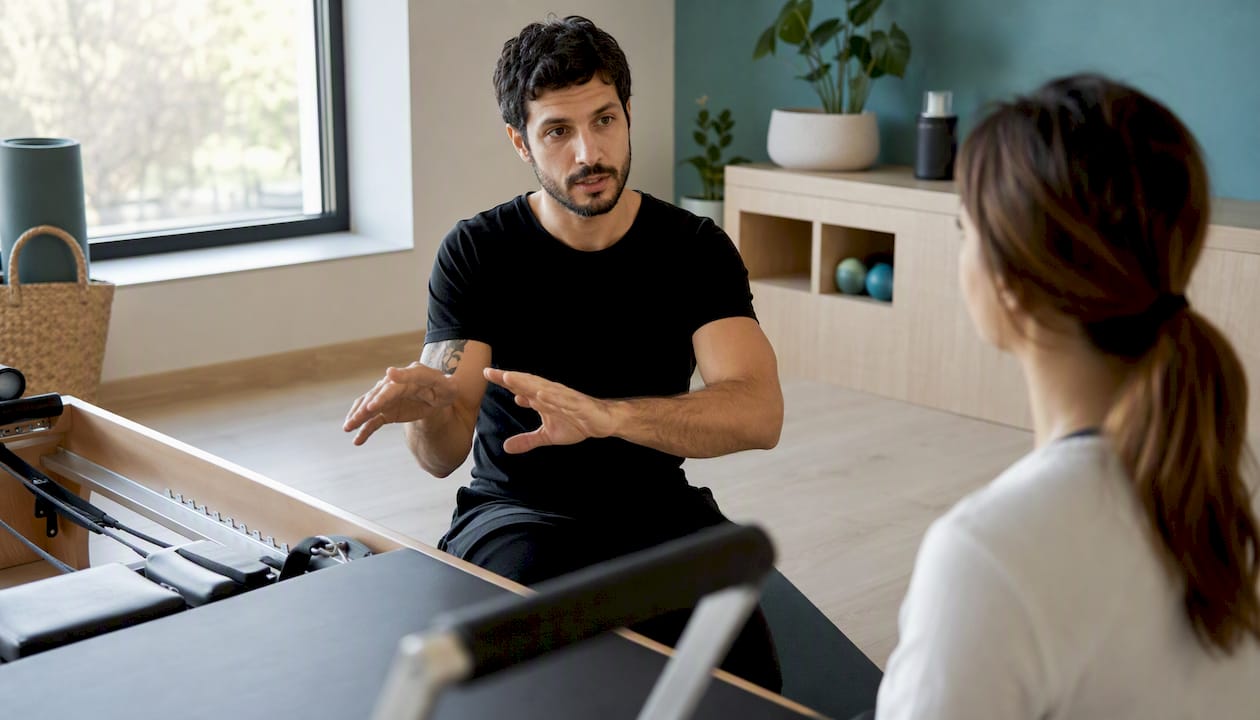
Ask directly: how would you modify a reformer exercise for a student with a herniated disc? What would you do if a student complains of pain midway through class? How do you structure a group class with mixed levels of experience? Concrete and nuanced (not absolute) answers often indicate real experience versus memorized knowledge.
It is also useful to ask about their relationship with other health professionals: whether they have coordinated exercise plans with physical therapists, how they handle communication when a student arrives with specific medical instructions. This interdisciplinary capability distinguishes the instructors that higher-level studios prefer to retain.
Pay attention to red flags during the interview and trial class: certifications that the candidate cannot verify with documentation, discomfort with questions about injuries or contraindications, lack of their own questions about the studio or students, and resistance to receiving feedback during the trial class. A defensive candidate during test corrections will likely also be defensive during ongoing supervision.
Performance evaluation: how to ensure quality after hiring
Class quality is not guaranteed at hiring; it is sustained with continuous evaluation. Design early verification metrics at 30, 60, and 90 days, reviewing both objective indicators and qualitative feedback from students.
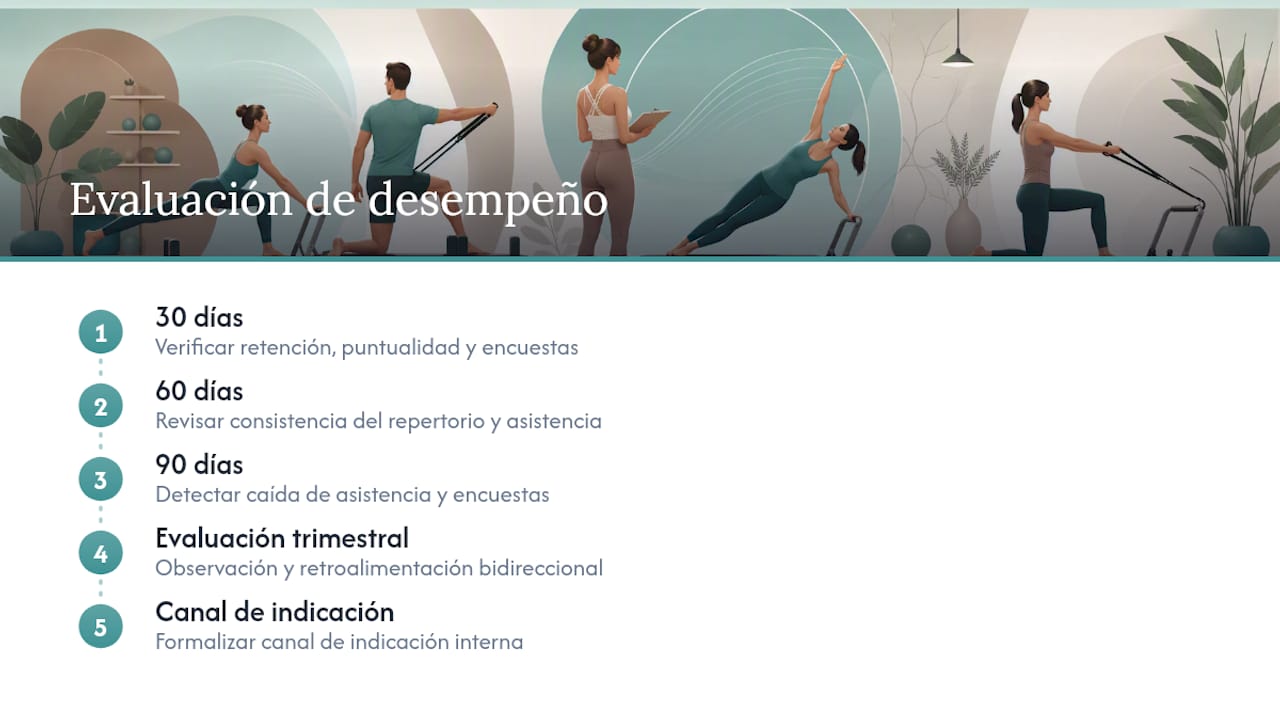
The most useful indicators include student retention rate per instructor, punctuality and consistency in executing the standard repertoire, and results from short surveys administered after the first classes. A noticeable drop in attendance for a specific instructor's classes is often the earliest sign of a problem, even before explicit complaints arise.
Beyond 90 days, maintain quarterly evaluations with direct class observation and bidirectional feedback. An instructor who does not receive periodic technical correction tends to gradually deviate from the studio's standard, without anyone noticing until a student complains. Also formalize an internal referral channel: the best instructors often know other good professionals, and activating this channel reduces the cost of the next hire.
Why a structured process protects more than it costs
A poorly executed hiring process doesn't just cost the salary of the wrong instructor. It costs lost students, team time correcting others' mistakes, and, in the worst case, an injury that could have been avoided with more rigorous credential verification.
I have seen enough studios operate without a trial class rubric to know that the owner's intuition, however good, does not replace a structured technical evaluation. The indicative salary figure of 192,000 pesos annually and a checklist like Pilatify's are not unnecessary bureaucracy: they are references that prevent negotiating blindly and deciding under time pressure. Define your technical standards and your integration plan before posting the vacancy, not after hiring.
Equipment, certifications, and consulting to scale your studio
Hiring good instructors solves only one part of the equation: you also need equipped studios for that talent to perform at its best. Pilates de México is the alternative to improvising the opening or expansion of a reformer studio, combining certified equipment, financing, and training from a single provider.
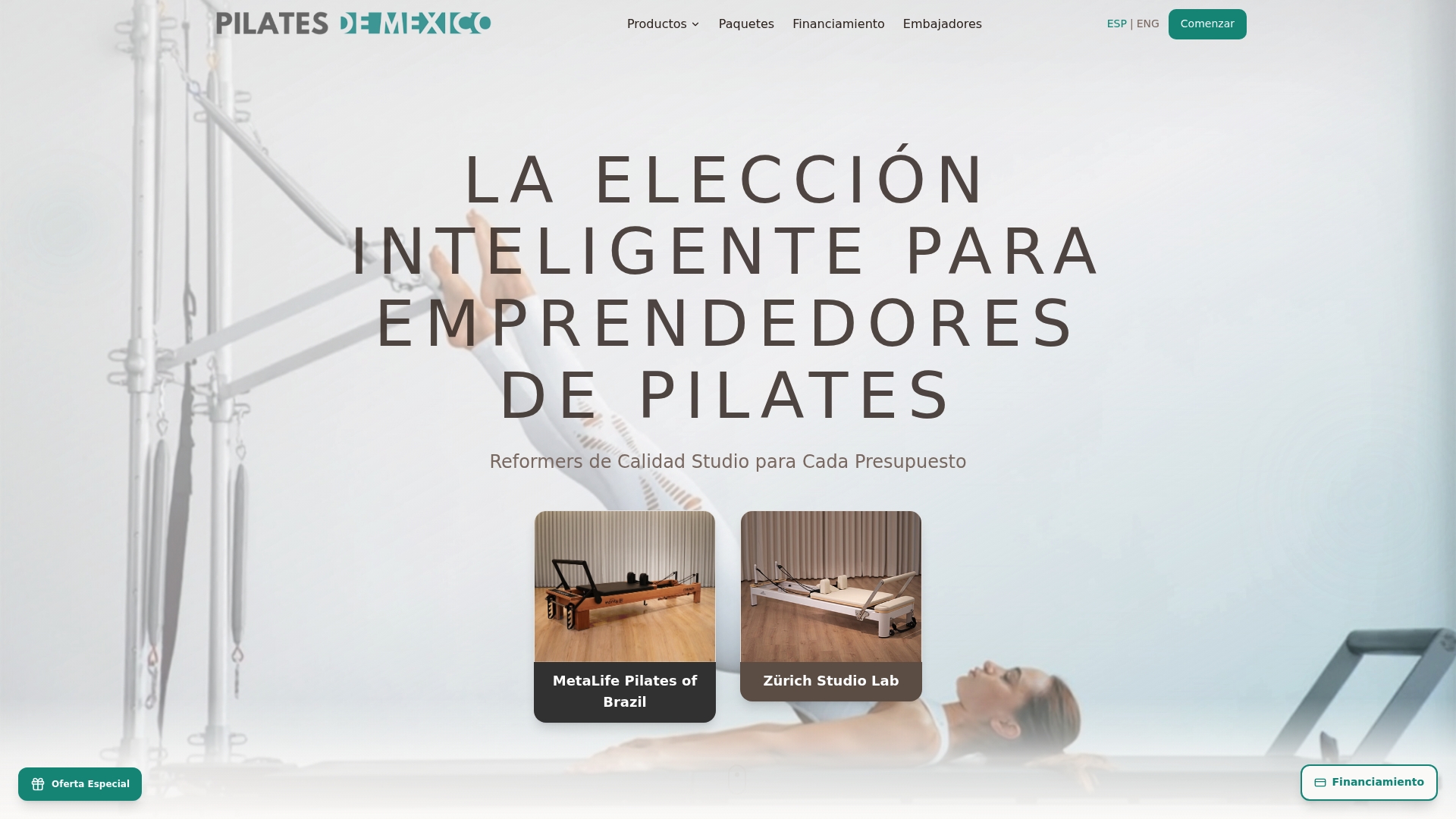
If you are training instructors internally or want to validate competencies with your own standard, Pilates de México's certification program integrates directly with your hiring plan. If, on the other hand, you need to equip a new studio or standardize several studios with the same reformer, our studio packages include consulting and financing so that the investment does not depend on paying everything upfront. And if the reformer you already have barely supports a fraction of the daily use required by a growing studio, the Balanced Body Reformer Zürich Labs is built for intensive daily classes without losing technical precision. Write to Pilates de México to receive an equipment or certification quote tailored to the actual size of your studio.
Sources
These resources directly support the recommendations in this guide and can be used immediately during your selection process:
- Checklist: 48 Items for Hiring a Pilates Teacher — Pilatify Studio
- Are you looking for a Pilates Instructor? - Fixando