Folding vs. Fixed Reformer: Which is Better for Studios and Gyms?

Folding vs. Fixed Reformer: What's Best for Studios and Gyms?
For studios and intensive daily use, we recommend professional fixed reformers: they offer stability, durability, and better client retention than any folding alternative. The priority in a commercial setting is simple: equipment that won't fail, a warranty that covers intensive use, and available local support. Some reformer lines meet these warranty and local support requirements.
In summary:
- A folding reformer is only worthwhile for multipurpose rooms, very small spaces, or itinerant classes; if it remains set up, its hinges add wear without providing portability.
- Before buying, demand that the warranty explicitly cover commercial use and confirm the availability of spare parts and technical service response times.
- Check straps, pulleys, and rails daily, adjust springs and screws monthly, and document a complete annual inspection to maintain coverage.
- Small business credit usually offers terms of one to three years; compare the total annual cost, commissions, and prepayment conditions.
Table of Contents
- Fixed or Professional Folding Reformer: Real Advantages and Disadvantages
- What to Demand When Buying Reformers for Your Studio
- How to Maintain Your Reformers to Make Them Last Longer
- Total Cost of Ownership and Financing Options Worth Comparing
- Installation and Logistics to Equip Your Studio Seamlessly
- Comfort and Ergonomics: What the Client Feels on the Reformer
- Versatility of the Fixed Reformer for Different Exercises and Users
- Key Differences in Functionality Between Folding and Fixed Reformers
- Transport and Storage: The Real Advantage of the Folding Reformer
- Limitations of the Folding Reformer Compared to the Fixed Reformer in Commercial Use
- What We Learned Equipping Expanding Studios
- MetaLife Line, Packages, and Financing to Equip Your Studio
- Frequently Asked Questions
- Sources
Fixed or Professional Folding Reformer: Real Advantages and Disadvantages
The difference between a fixed and a professional foldable reformer begins with the frame. Fixed equipment is typically constructed with certified wood, such as the Lyptus® FAS we use in the MetaLife line, combined with stainless steel hardware that resists constant friction from carriages and pulleys. This mass and structural rigidity matter more than it seems: a thicker frame and heavier equipment better absorb kinetic energy in dynamic exercises, reduce vibrations, and extend the life of moving components.
That stability is noticeable in class. A sequence of jumps or quick transitions on a reformer with structural play generates lateral movement that clients perceive as insecurity, and this sensation directly affects retention. Foldable equipment, by incorporating hinges and locking mechanisms, introduces additional wear points that do not exist in a fixed frame.
Durability translates into concrete operational numbers:
- Fewer technical stoppages due to corrective maintenance during peak class hours.
- Lower frequency of calibration adjustments on rails and pulleys.
- Longer lifespan of springs and straps due to reduced structural fatigue.
- Better perceived quality by clients who pay premium memberships.
That said, there are scenarios where a professional foldable alternative might be justified: multipurpose rooms that alternate Pilates with other disciplines and need to clear floor space several times a week, or satellite studios with very restricted space. Outside of these specific cases, intensive daily use almost always favors fixed equipment.
Pro tip: If your room combines disciplines, consider a fixed area for reformers and a separate, foldable area for the rest of the equipment, instead of mixing both mechanisms in the same units.
What to demand when buying reformers for your studio
Before signing a purchase order, especially for wholesale, it's wise to review a concrete list of technical and contractual points:
- Confirm that the warranty explicitly includes the clause for commercial or intensive use; without this specification, a claim for wear and tear from daily classes may be invalidated.
- Ask for exact specifications for frame thickness, total equipment weight, and certified quality of springs and straps.
- Verify the availability of spare parts in the country and the actual response time of technical service, not just the sales promise.
- For wholesale orders, inquire about volume discounts, manufacturing times, and coordinated delivery logistics for multiple units.
National suppliers who include space design, professional installation, and maintenance policies in the same package significantly reduce operational risk during the first few months, which is precisely when new equipment is most demanded and when there is least room for improvisation.
Pro tip: Request in writing the delivery time for critical spare parts, such as springs and pulleys, before closing the contract: this figure matters more than the list price.
How to maintain your reformers to make them last longer
A well-designed preventive maintenance plan avoids most unexpected breakdowns. The basic routine is organized into three frequencies:
- Daily check: quick visual inspection of straps, pulleys, and rails before opening the studio.
- Monthly check: adjustment of spring tension, cleaning of rails, and verification of screws at load points.
- Annual check: thorough inspection of the frame, preventive replacement of straps showing signs of fatigue, and complete calibration of the sliding system.
It is advisable to request a basic spare parts kit at the time of purchase: a complete set of springs, additional straps, and compatible hardware, so as not to depend on an urgent shipment in case of a minor failure. Good instructor practices also count: teaching clients to get on and off the carriage with control, instead of letting themselves drop, reduces premature wear on rails and bearings.
This maintenance is not only preventive but also contractual: almost all commercial use warranties require evidence of regular service, and a documented maintenance history is also one of the first documents a buyer requests when it's time to sell the equipment. We delve deeper into these lifespan factors in our guide on professional reformer durability.
Total Cost of Ownership and Financing Routes to Compare
The list price of a reformer is only part of the actual expense. The total cost of ownership includes installation, scheduled maintenance, staff training, and, in many cases, equipment insurance. Ignoring these components when comparing quotes often leads to underestimating the actual budget for opening or expansion.
Regarding financing, the most common schemes for studio equipment are:
- SME Credit: finances direct purchases with terms usually between one and three years, as reported by ANCapital Financiera for distributors and retailers in the commercial sector.
- Operating Lease: preserves liquidity by not committing working capital, useful when the goal is to scale quickly without decapitalizing the operation.
- Financial Lease: combines periodic payments with a purchase option at the end of the term.
- Direct Distributor Financing: usually includes specific conditions for the equipment being purchased, without banking intermediaries.
When choosing between these schemes, it's advisable to compare the CAT (Total Annual Cost), prepayment conditions, and hidden fees, as recommended by specialized articles on SME credit for machinery: the nominal rate alone does not reflect the true cost of the credit. An operating lease is convenient when the goal is to maintain available cash, while a simple credit is preferable when the intention is to retain the asset for years.
A final operational tip: if a supplier offers a volume discount with a limited time window, an agile pre-approval scheme can be the difference between taking advantage of that offer or losing it due to slow processing.
Installation and Logistics to Equip Your Studio Without Hitches
Before receiving the order, it's worth reviewing physical access to the space: hallways, elevators, and floor load resistance where the units will be installed. A complete professional reformer weighs enough for this to matter in older buildings or upper floors without an adequate freight elevator.
Professional installation should include:
- Initial calibration of rails, pulleys, and spring tension.
- Functional testing under load before formal delivery.
- Brief initial training for instructors on basic adjustment and care.
For a typical studio with 6 to 8 reformers, it's usual to leave between 1.5 and 2 meters (5 to 6.5 feet) of separation per unit, considering the full travel of the carriage and the transit space between equipment. For wholesale orders, coordinating delivery within a single logistics window avoids repeated interruptions in daily operations. If you're still deciding on the general layout of the space, our guide on how to decide your studio configuration delves deeper into that planning.
Comfort and Ergonomics: What the Client Feels on the Reformer
User experience largely depends on the carriage surface, headrest padding, and the smoothness of the glide on the rails. In a well-built fixed reformer, the carriage moves without perceptible vibration, allowing the client to concentrate on technique instead of compensating for instability.
Folding mechanisms, by design, introduce hinge points that over time can generate a slight perceptible play under load, especially in high-amplitude exercises like *footwork* or *long stretch*. For an occasional practitioner, this difference is almost imperceptible; for a client who trains several times a week, it becomes noticeable.
Ergonomics also includes the height of the headrest, the angle of the bars, and the arrangement of foot and hand straps. Premium fixed equipment usually offers more fine-tuning options at these points, precisely because they don't need to sacrifice mechanism space in the frame design to allow for folding. This design freedom translates into more available working positions for instructors who serve very different body types throughout the day.
Versatility of the Fixed Reformer for Different Exercises and Users
A well-equipped fixed reformer supports a wide range of exercises, from gentle rehabilitation work to dynamic high-intensity sequences, thanks to the variety of springs, bars, and accessories it accommodates without compromising the structure. This versatility is why lines like MetaLife are designed to support over 200 different exercises on the same platform.
Professional folding reformers, although capable, often limit certain accessories or extreme positions due to the hinge mechanism itself, which imposes weight or range of motion restrictions that do not exist in a solid frame. This is especially important in studios that serve mixed populations: rehabilitation clients who need very low and controlled resistance, along with athletes seeking high loads and explosive movements.
For a studio that receives clients of very different ages and physical conditions on the same day, having equipment capable of adapting without mechanical restrictions reduces the need for multiple studio configurations. This flexibility of use is one of the strongest arguments in favor of fixed equipment when the goal is to maximize the occupancy of each unit throughout the week.
Key Differences in Functionality Between Folding and Fixed Reformers
The most significant functional difference lies in the resistance system and the stiffness of the carriage rail. A fixed reformer maintains a constant and predictable spring tension session after session because the structure is not subjected to repeated assembly and disassembly cycles. A foldable reformer, in contrast, relies on the locking mechanism being perfectly seated each time it is unfolded, and any minimal variation in that adjustment affects the resistance sensation.
Another practical difference is in the anchor points for accessories such as a jump board, box, or additional bars. On fixed equipment, these anchor points are usually more numerous and robust because the design does not compete for space with folding hinges.
Finally, the sliding rail on a fixed reformer tends to be continuous and a single piece, which promotes more uniform carriage movement. In foldable models, the rail is often divided into segments to allow for closing, and this joint creates a transition point that some users notice, especially during full carriage range of motion movements.

Transport and Storage: The Real Advantage of the Foldable Reformer
This is where the professional foldable reformer has an objective advantage: it can be folded, moved between rooms, and stored in a small space when the studio needs to free up floor space for other activities. For instructors who teach at home or in shared spaces, this portability solves a real daily logistics problem.

In a studio dedicated exclusively to Pilates, however, this advantage loses weight. If the equipment remains installed every day of the year, the folding capability offers no operational benefit and, in return, incurs the cost of an additional mechanism that introduces wear and tear. The fixed reformer, not needing to be moved, can be more firmly anchored to the floor, adding stability exactly where it's most needed: in daily use under load.
The decision, then, depends on the business model. A fixed studio with high class turnover benefits more from structural rigidity than portability; an itinerant instructor or a truly multi-purpose space benefits more from the ability to store the equipment between sessions.
Limitations of the Foldable Reformer vs. Fixed in Commercial Use
The most important limitation of the foldable reformer in a commercial setting is the accumulated fatigue in the hinge mechanism. Each folding and unfolding cycle subjects this part to stress that a fixed frame simply does not experience, and in a room with several daily classes, these cycles multiply rapidly throughout the year.
Another practical limitation is the weight or range of motion limit that some foldable models impose to protect the closing mechanism, which can restrict certain high-load exercises or extreme positions that a fixed apparatus allows without reservations.
Finally, the commercial use warranty for foldable equipment often has stricter conditions precisely because of this additional wear and tear on the mechanism, which in practice can translate into shorter coverage or specific exclusions for hinges. Before equipping a high-traffic studio with foldable units, it's worth reading that fine print with the same care as a financing agreement.
What We Learned Equipping Expanding Studios
The most frequent mistake we see in new operators is buying at list price without asking about after-sales support or spare parts availability. A cheap reformer that sits for two weeks waiting for a strap costs more, in lost classes and frustrated clients, than the price difference compared to equipment with solid local support.
We also notice a consistent pattern among the fastest-growing studios: they invest in robust equipment from the first order, even if that means opening with fewer units. This decision protects client retention from the first month and better preserves resale value when it's time to renovate or expand the studio. Buying well once still beats, over time, buying cheap multiple times.
— Armen
MetaLife Line, Packages, and Financing to Equip Your Studio
We work with both the MetaLife line and more accessible professional options, so your first studio doesn't have to depend on always choosing the highest price. Each order, whether an individual unit or a wholesale package, can be accompanied by direct financing and consulting on what it truly costs to open and fill a studio.
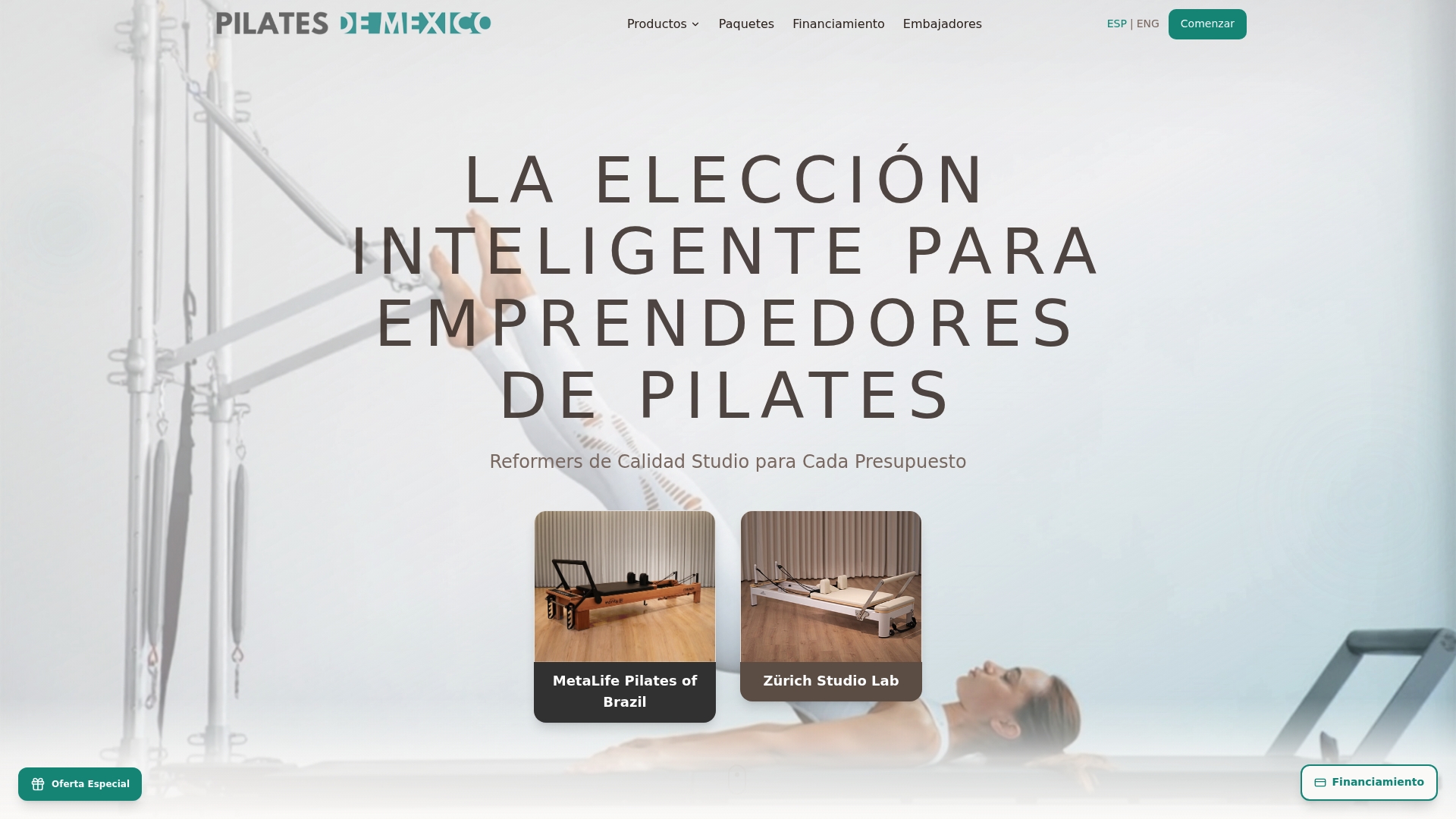
- The Infinity Line offers premium MetaLife equipment with certified wood frames and stainless steel hardware.
- The Advanced Line covers studios looking for professional quality with a lower initial investment.
- Studio packages include installation and support to equip complete rooms, with financing options reviewed on a case-by-case basis.
If you're comparing payment schemes for your next order, check the terms on our financing page and decide which term best suits your cash flow before completing the purchase.
Frequently Asked Questions
Does a fixed reformer really last longer than a folding one with daily use?
Generally, yes, because the fixed frame does not accumulate the wear and tear of the hinge mechanism that a folding reformer suffers with intensive daily use. The difference is more noticeable in studios with several consecutive classes, where the load cycles on that part are constantly repeated.
What should a reformer's warranty for commercial use include?
It must explicitly state that it covers commercial or intensive use, not just domestic or occasional use. Without that clause, a claim for wear and tear from daily classes may be outside coverage.
Is a SME loan or leasing more convenient for buying reformers?
It depends on the objective: an SME loan is usually convenient when seeking to own the equipment from the start, with terms typically between one and three years, while leasing preserves liquidity when the priority is to scale without decapitalizing the operation. It's advisable to compare the APR and prepayment conditions before deciding.
What does professional reformer installation include when buying in bulk?
It usually includes calibration of rails and pulleys, functional testing under load, and a brief initial training for staff. For bulk orders, it's convenient to coordinate delivery in a single logistical window to minimize impact on daily operations.
Is a professional folding reformer suitable for a studio dedicated only to Pilates?
It can work, but it loses its main advantage, which is portability, if the equipment remains set up every day. In that scenario, a fixed reformer usually offers better stability and less accumulated wear and tear in the long term.
Sources
- SME Loan for Commerce and Distribution | ANCapital Financiera
- SME Loan for Machinery and Equipment in Mexico: Options - Dinero MX