Financing Rates for Fitness Equipment in Mexico

Financing Rates for Fitness Equipment in Mexico
Financing fitness equipment in Mexico costs, depending on the route, anywhere from low double-digit entry fixed rates to structures equivalent to more than 30% annually. A standard bank loan for fixed assets advertises an annual fixed rate starting at 16.0%, while equipment financial leasing can feature a 20.00% rate before VAT and an average CAT of 35.07%. The interest rate alone doesn't tell the whole story: CAT, fees, down payment, loan term, and how much of the monthly payment your studio can sustain all matter. If you're outfitting your studio with reformers, financing is part of every purchase at Pilates de México, and this guide gives you the framework to evaluate any offer—ours included.
Key Takeaways
- Fixed rates advertised by banks for equipment purchases start at 16.0% annually in HSBC's example; financial leases can have an average CAT exceeding 35%.
- Always compare by CAT and total cost (down payment, monthly installments, fees, insurance, VAT, and final buyout value), using the exact same term.
- A healthy monthly payment leaves breathing room: measure the installment against your studio's net profit, not against gross revenue.
- If you're opening from scratch, traditional banking time-in-business requirements present a major hurdle; vendor financing and equipment leasing are often the most viable routes.
- At Pilates de México, you can get a quote on reformers with direct financing and expert guidance to build out your studio plan.
Table of Contents
- Current Fitness Equipment Financing Rates in Mexico
- Interest Rate, CAT, and Total Cost: What to Compare
- Requirements: The Real Hurdle Is Time in Business
- Interest-Free Installments vs. Interest-Bearing Loans
- How Much to Finance: Monthly Payments Must Fit Your Profit Margins
- Which Option Is Best for Your Situation
- Good Financing Starts with the Right Equipment
- Before You Sign: Checklist
- Frequently Asked Questions
- Sources
Current Fitness Equipment Financing Rates in Mexico
There is no single financing rate for fitness equipment. Four main product categories exist, and each charges differently.
Traditional commercial bank loan. Funds are disbursed in a single lump sum to purchase fixed assets (machinery, equipment, tools). HSBC Mexico lists its Crédito Simple Fusion featuring a credit line of up to $10,000,000 MXN, fixed terms from 36 to 60 months, an annual fixed rate starting at 16.0%, no mortgage collateral required, and no prepayment penalties. This is an example of what commercial banks offer; each institution sets its own terms.
Financial leasing (capital lease). You make lease payments and, at the end of the term, exercise a purchase option. QFS Financiera lists for equipment an average CAT (Total Annual Cost) of 35.07% before VAT, an interest rate of 20.00% before VAT, a 3% origination fee, terms of 12, 24, and 36 months, and financing amounts from $15,000 to $500,000 MXN.
Operating leasing (pure lease). This is a fixed rental agreement that does not transfer ownership by default. According to an SME credit guide, it allows you to finance up to 100% of the asset's value, with a buyout or refinancing option at the end, making it attractive when technology becomes obsolete quickly. However, a wood-and-steel reformer does not age like electronic gear, so it is worth assessing whether you want to end up owning the equipment. Our guide on Pilates equipment leasing in Mexico covers when this makes the most sense.
Vendor financing or interest-free monthly installments. Here, an interest rate might not be explicitly stated, but the financing cost is often built into the base price, the down payment, or a shorter repayment term. Below, you will see how to assess it.

What drives these interest rates
Variable rates track the TIIE (Interbank Equilibrium Interest Rate), which in turn responds to the target rate set by Banco de México. Banxico announced a 25-basis-point cut to its target rate on November 5, 2026, after holding it at 6.50% in September. Banxico announces monetary policy decisions several times a year, so be sure to review the current rates before signing. A fixed rate that seems high today will not drop on its own; a variable rate will fluctuate with every policy change.
Interest rate, CAT, and total cost: what to compare
The interest rate is only one piece of the puzzle. To compare financing proposals accurately, you need three key figures:
- The interest rate, whether fixed or variable. If it is variable, ask what benchmark rate is used and what spread applies.
- The CAT (Costo Anual Total / Total Annual Cost). It includes interest and commissions, although insurance and other costs may not be included. Use it as a benchmark whenever the financing institution discloses it.
- The total cost of the asset. Calculated by adding the down payment, all monthly payments, commissions, insurance, non-creditable VAT, and the buyout option cost, minus the equipment's remaining residual value at the end of the term.
That final point is essential for reformers. Equipment made with certified Lyptus® FAS hardwood and stainless steel hardware, like the MetaLife line we carry, retains strong resale value. That significantly lowers its true net cost compared to equipment that depreciates rapidly, even if both require the exact same monthly payment.
A practical example with numbers
Imagine you are outfitting a studio with $500,000 MXN over a 36-month term. These calculations are internal estimates based on equal installment loan formulas, excluding VAT, insurance, or additional commissions:
| Scenario | Interest Rate | Approx. Monthly Payment | Approx. Total Interest over 36 Months |
|---|---|---|---|
| Fixed-rate commercial bank loan | 16.0% annual | $17,580 | $132,700 |
| Financial leasing (capital lease) | 20.0% annual, plus 3% commission | $18,580 | $168,900 (plus $15,000 commission) |
A four-percentage-point difference in interest rate might seem small, but over three years it adds up to more than $50,000 MXN between the two options before fees. That is why you should always compare offers using the same payment table, loan term, and cost components, and request written confirmation for any unclear charges.
Requirements: the real barrier is operating history
Many studio owners focus solely on the interest rate and forget that you first need to qualify. As a reference, HSBC Fusion's commercial loan requires being an individual with business activity (PFAE) or a legal entity (corporation), tax registration with the SAT with at least 2 years of operating history, positive credit references, and a joint obligor/co-signer, among other sales and shareholder requirements.
This means that:
- If your studio is already operating, your tax history and financial statements work in your favor, allowing you to qualify for traditional bank rates.
- If you are just opening, you likely won’t meet the minimum operating history requirements. In this case, vendor financing, leasing, or an equipment-backed plan tends to be more accessible, even if the overall cost is higher.
- If you are a clinic, gym, or studio from another discipline adding reformers, you already have an established tax history, which serves as strong leverage to negotiate better terms.
We detail the required paperwork in reformer financing requirements.
Interest-free installments vs. interest-bearing credit
Interest-free monthly installments (MSI) are useful, but almost always come with short repayment windows. In the fitness market, you'll see offers for up to 3 interest-free months with credit cards, as well as wellness retailers that allow splitting payments into 3 interest-free months via Mercado Pago. These work well for accessories or small purchases. For a fully equipped room, however, 3 months concentrates an enormous payment and drains your cash flow right when you need working capital for marketing and launch.
To compare an interest-free offer with a 36-month loan:
- Calculate the total payment for each option, not just the monthly installment.
- Evaluate both over the same timeframe to make a fair comparison.
- Consider what happens to your liquidity: an upfront cash payment or a 3-month term leaves you without a cash cushion.
- Check whether the list price changes depending on the payment method.
A longer-term loan costs more in total interest, but preserves working capital. When opening a studio, that liquidity is usually worth far more than saving a few thousand pesos on interest.
How much to finance: the payment must fit within your profit margins
The most common mistake is sizing debt based on what “feels affordable” relative to gross revenue. Profit pays off loans, not top-line revenue.
A practical rule of thumb:
- Estimate your monthly net profit after rent, payroll, utilities, and marketing.
- Ensure your equipment payment does not consume the majority of that profit; leave a safety margin for low-occupancy months.
- Keep a cash reserve covering at least two months of fixed expenses before committing to recurring payments.
- Finance what generates revenue: reformers filled with group classes deliver far more value than lavish interior decor.
To put the size of the investment into perspective, AgendaPro estimates that basic gym equipment in Mexico costs between $200,000 and $800,000 MXN, within a total initial investment of $535,000 to $1,820,000 MXN. The amount you finance depends on how many reformers you put to work from day one. Starting with fewer units and scaling in phases reduces your monthly commitment. If you need to map out the entire project, check out how much it costs to open a Pilates studio in Mexico City.
It is also worth thinking about how your revenue scales. Planning for extra revenue through membership add-ons helps cover monthly equipment payments from multiple income streams, rather than relying solely on class package sales.
Which route makes sense for your situation
Established studio upgrading or expanding
You have a track record, so explore fixed-rate commercial loans and compare them with vendor financing. Your top priorities should be durability and resale value: equipment that withstands years of daily classes retains its value when it is time to scale up again. For this approach, read financing for Pilates studio expansion.
Instructor opening their first studio
Your primary hurdle is business operating history, not just interest rates. Look for an equipment-backed financing structure with a reasonable down payment, and launch with a smaller number of reformers. Every dollar saved on interest is capital that can go directly into your first-month marketing budget.
Gym, yoga, CrossFit, HYROX, barre, or dance studio
You are already operating, which makes qualifying much easier. Adding a reformer room is an expansion of your business line: finance on an equipment basis and calculate exactly how many additional classes per week you need to run to cover each monthly payment.
Clinic, physical therapist, or chiropractor
You are integrating reformers into clinical practice. Choose a term that aligns with clinical equipment usage and review the tax treatment with your accountant. How to invoice and write off Pilates equipment outlines the key takeaways.
Investor without a Pilates background
Your decision comes down to return on investment. Ask for a plan that lays out equipment investment, financing, and operating costs all on a single page, and don’t sign until you know the minimum occupancy rate required to cover the monthly payment. A clear business model matters more than the interest rate; business models for a Pilates studio can help guide your choice.
Good financing starts with the right equipment
The lowest interest rate won't help if your equipment wears out or loses its value before you finish paying it off. At Pilates de México, we carry MetaLife—crafted with certified Lyptus® FAS wood, stainless steel hardware, and an engineering structure built to support over 200 exercises—as well as accessible options so setting up your first studio room doesn't require starting at the highest price point. Every piece of equipment includes financing options, studio packages, and expert consulting from a team that knows what it takes to open and fill a studio.
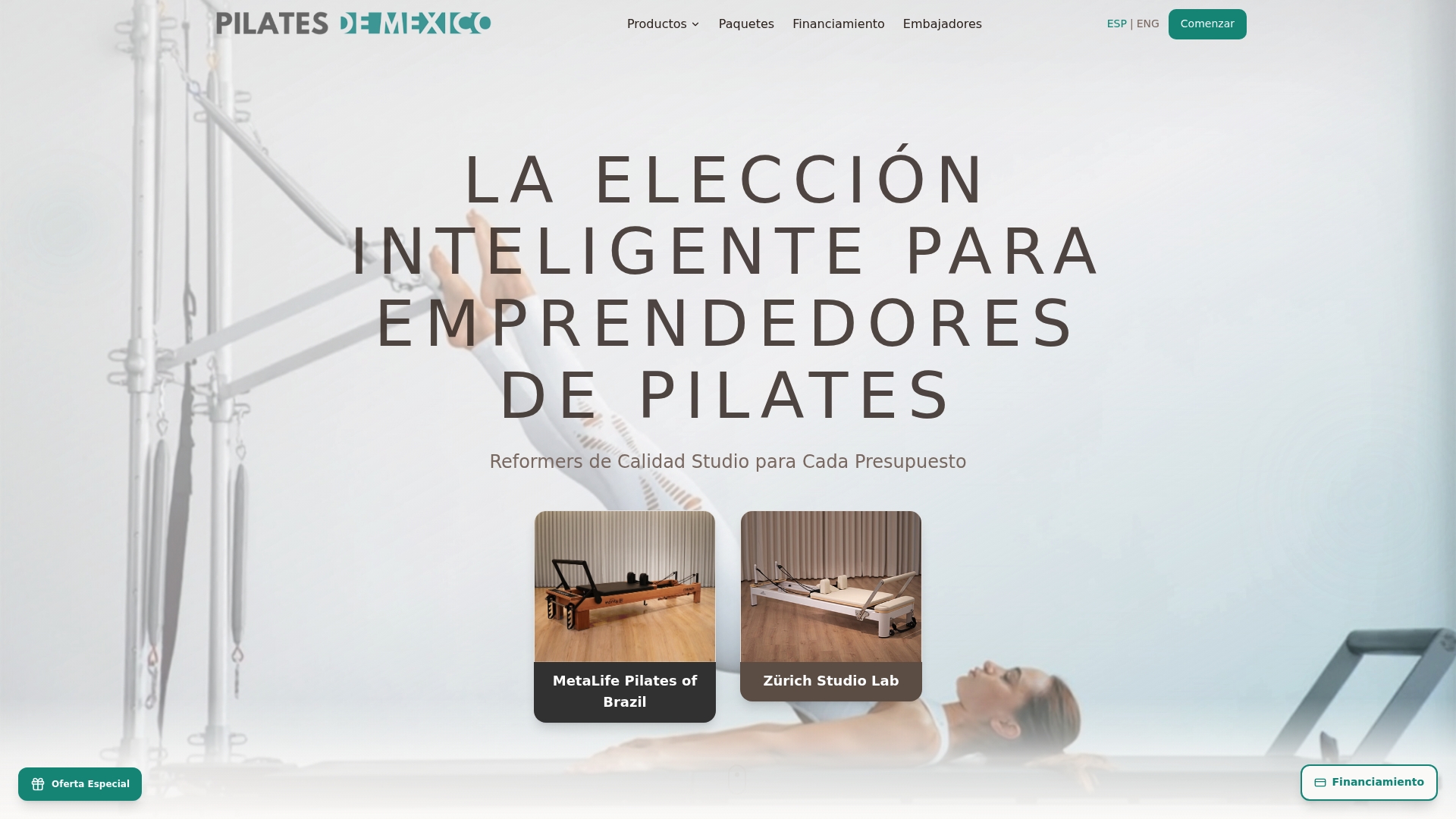
You can explore our Infinity and Advanced lines, learn how our financing works, or request a Pilates equipment quote tailored to the package you need.
Before signing: a pre-flight checklist
- Request the APR (CAT) and the interest rate in writing, and confirm whether it is fixed or variable.
- Add up the down payment, origination fees, insurance, and VAT to calculate your total cost.
- Check for prepayment penalties; certain loans, such as the referenced HSBC Fusion loan, state they carry no prepayment penalty.
- Confirm tax implications with your accountant: VAT and depreciation rules vary between loans, capital leases, and operating leases.
- Determine what percentage of your monthly net profit will go toward the payment and how much cash reserve you will retain.
- Review warranty terms, installation, and local equipment support—idle equipment generates no revenue to service debt.
Frequently Asked Questions
What is the lowest financing rate for fitness equipment?
It depends on your financial profile and the lending institution. Among published benchmarks, simple business loans like HSBC Fusion start at a fixed 16.0% annually, whereas an equipment capital lease may carry a 20.00% rate before VAT and an average CAT (Total Annual Cost) of 35.07%. Always compare options using the total annual cost and overall expenditure.
Can I finance equipment if my studio is just opening?
Yes, though traditional banks usually require operating history; in HSBC's case, a minimum of 2 years in business. For brand-new studios, equipment-backed vendor financing or leasing is generally far more accessible. At Pilates de México, you can get a quote and explore financing options tailored to your new space.
Is interest-free financing better than an interest-bearing loan?
Interest-free installments are great for small purchases, but short repayment periods like 3 months concentrate cash outlays and drain working capital. For a fully equipped studio room, a longer term may protect your cash flow far better, even with interest. Always compare total costs across equivalent timelines.
How much should I finance?
Ensure your monthly installment comfortably fits within your monthly net profit—not your gross revenue—leaving a healthy safety margin. Maintain a cash reserve covering at least a couple of months of fixed operating expenses, and finance the core equipment that directly drives classes and revenue.
Sources
- HSBC México: Crédito Simple Fusion
- QFS Financiera: Equipment Capital Lease
- Banco de México: Monetary Policy Announcements
- Elementum Capital: Total Cost of Asset Acquisition
- Dinero MX: SME Loans for Machinery and Equipment
- AgendaPro: How to Open a Gym in Mexico
- Bywell: Wellness Equipment Online Store