Are Reformer Accessories Compatible Between Brands?
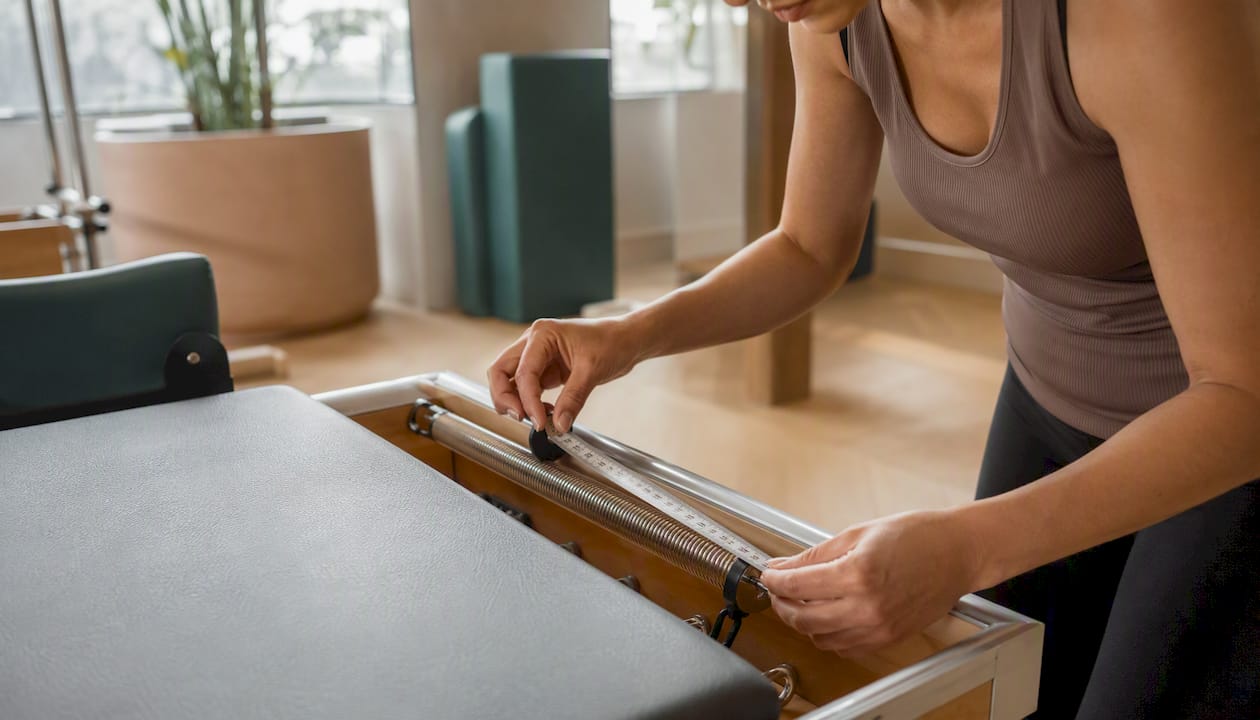
Are Reformer Accessories Compatible Across Brands?
The short answer is: it depends, and in most cases, they are not interchangeable without first verifying exact measurements. Accessory compatibility on a Reformer is not a matter of taste or aesthetics: it's an engineering issue. Each manufacturer calibrates their springs, defines their anchor points, and dimensions their platform and carriage according to their own specifications, and these differences determine whether a part functions safely on your equipment or if it ends up causing a mechanical failure.
The technical reason is easy to understand, though nuanced. Springs vary in tension, length, and anchoring system from one brand to another, so a "generic" spring can alter the force trajectory that the user's body expects to feel. The same applies to ropes, handles, and mechanical accessories like the jumpboard or box: if their dimensions do not match the reformer's mounting brackets, the part can be loose, forced, or simply not fit.
Before buying or installing any accessory, it's good to be clear about which parts cause the most compatibility problems in practice:
- Springs: tension, length, and hook type change depending on the manufacturer, and this is what causes the most safety incidents.
- Jumpboard: its attachment to the carriage and its thickness must exactly match the reformer's rail.
- Box (raised platform): dimensions and height vary, and a poorly adjusted box compromises balance during exercise.
- Straps and foot straps: the attachment point and adjustment length are not always universal between models.
Key Points
Reformer accessory compatibility depends on exact anchor measurements, tension, and physical dimensions, not on assumptions between brands.
| Point | Details |
|---|---|
| Direct Answer | Accessories are not universally compatible: verify measurements and anchors before installing any part. |
| Springs as Primary Risk | Spring tension, length, and anchoring change between manufacturers and alter the force trajectory. |
| Checklist Before Buying | Measure anchor points, check maximum load, and test carriage travel before approving an accessory. |
| Investment Priority | First, buy certified springs and straps, then footbar and headrest, leaving jumpboard and box for later. |
| One Line Reduces Risk | Maintaining a single brand of equipment in the studio simplifies inventory and prevents compatibility issues. |
| Certified Option Available | Pilates de México offers MetaLife and Balanced Body with certified spare parts and documented technical specifications. |
Table of Contents
- Reformer accessory compatibility: complete list and what to measure for each part
- How to check if an accessory is compatible with your reformer
- Which accessories to buy first for your studio or home practice
- Risks of using non-compatible accessories and their effect on warranty
- Why choose manufacturer-certified accessories
- What I learned about compatibility after reviewing hundreds of studio configurations
- How Pilates de México helps you solve this without guessing measurements
- Frequently asked questions about reformer accessory compatibility
- Sources
Reformer accessory compatibility: complete list and what to measure for each part
Before buying any accessory, it's wise to map out the parts that make up your equipment and what technical parameter determines whether an external piece fits well or poorly. Pilates reformer accessory compatibility is almost always resolved with a tape measure and a bit of patience, not guesswork.
Springs are the most delicate component because they work under constant tension and absorb most of the body's load. As documented by the Pilates Anytime help center, springs made by one brand are not compatible with another because they vary in tension, length, attachment, and calibration, and this variation directly changes the force path received by the user.
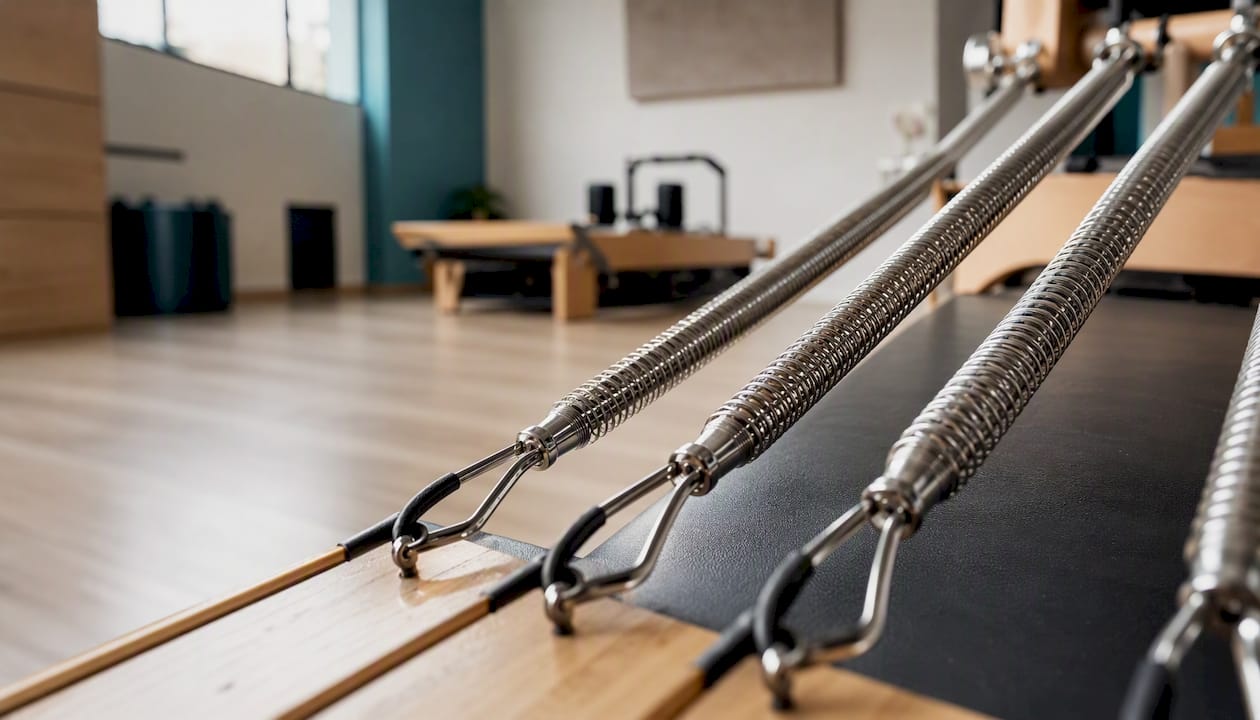
Ropes or straps, and hand straps, depend less on tension and more on adjustable length and the type of hook or carabiner. A strap shorter than expected can limit range of motion; one with a different diameter hook may not attach securely to the rail.
The jumpboard and box are mechanical accessories that require exact physical matching. According to NordicTrack, these attachments are not universal: they must match the physical dimensions and mounting brackets of the reformer, without exception. The same applies to the headrest, footbar, and extension platform, which usually have attachment points specific to each product line.
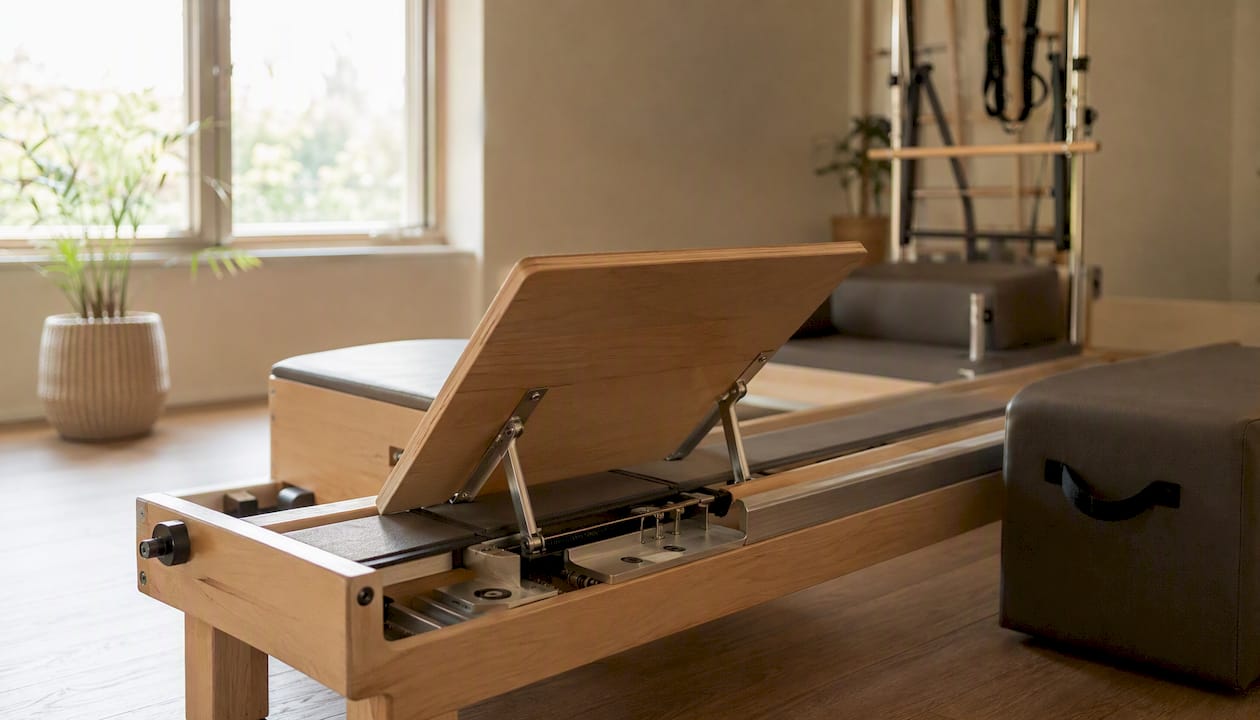
The tower or Cadillac, when installed as a reformer attachment, adds another layer of verification: the height of the vertical rails and the pulley system must be compatible with the base frame. Practical industry sources confirm that these accessories increase training versatility; however, this only occurs when physical and mounting compatibility is guaranteed, as stated by Infancia Deportiva.
| Accessory | What to measure before buying |
|---|---|
| Springs | Resting length, wire diameter, hook type, tension level (color or code) |
| Straps and handles | Adjustable length, carabiner diameter, attachment point on the carriage |
| Jumpboard | Rail width, interlocking system, platform thickness |
| Box | Height, length, compatibility with the carriage and platform |
| Headrest / footbar | Distance between supports, inclination angle, screw type |
| Tower / Cadillac | Rail height, pulley system, compatibility with the base frame |
How to check if an accessory is compatible with your reformer
Verifying compatibility before purchasing doesn't require expensive tools, but it does require an organized process. This checklist almost completely reduces the risk of ending up with a part that doesn't fit.
- Identify the exact model of your reformer, including the year of manufacture if the manufacturer has updated the design of its attachments.
- Measure the attachment points with calipers or a tape measure: distance between supports, diameter of the holes, and type of screws.
- Check the maximum load supported by the accessory and compare it with the capacity of your carriage and platform.
- Test the carriage's range of motion with the accessory installed, looking for looseness, rubbing, or points where movement stops prematurely.
- Consult the manufacturer's manual or request the technical data sheet if you have doubts about a specific measurement.
To measure accurately, you need little more than a digital or vernier caliper, a flexible tape measure, and, if possible, the reformer's original technical data sheet. The range of motion test is the most revealing: slide the carriage from one end to the other several times with the accessory attached and pay attention to any change in resistance.
There are signs that should immediately stop the installation:
- Metallic noise or squeaking when moving the carriage with the accessory attached.
- Partial or total blockage of movement at any point on the rail.
- Visible deformation in the spring hook or the strap's carabiner.
- Excessive play that allows the part to move on its own during exercise.
Which accessories to buy first for your studio or home practice
Not all accessories have the same impact on safety and training versatility, so prioritizing investment makes sense for both someone setting up their first studio and someone practicing at home.
- Springs and straps compatible with your exact model. They are the basis of every exercise, and the point where a compatibility error generates the most risk. Investing here first, and doing so with certified parts, avoids the most common and most expensive problem to correct later.
- Footbar and headrest. They determine the basic ergonomics for a large part of the exercises. A poorly adjusted footbar limits full movements, and an unstable headrest affects cervical alignment throughout the session.
- Jumpboard and box. They significantly expand the exercise repertoire, but their purchase can wait until the basic equipment is fully verified and functioning flawlessly.
- Complementary accessories such as extender platforms or Cadillac-style towers. They provide advanced variety, and it's advisable to add them when the studio already has a solid base of bookings and recurring clientele.
For studios planning to grow, the key is to purchase spring sets and spare parts designed for multiple units from the start. This simplifies inventory and ensures that each Reformer in the room offers the same experience to the student, something that Pilates de Mexico studio packages are designed to solve from the first order.
Risks of using incompatible accessories and their effect on the warranty
A poorly fitted spring or anchor is not just a performance problem: it changes the force trajectory that the system was designed to handle, and that can lead to mechanical failures with the equipment in use. The literature on exercise safety is clear on this point: incorrect adjustment of equipment and accessories increases the risk of injury and mechanical failure, a finding that applies directly to any reformer where parts of different origin are mixed without prior verification.
Beyond the physical risk, there is a practical problem that many studio managers overlook: almost no manufacturer covers damages caused by unauthorized third-party accessories under warranty. If a carriage becomes misaligned or a rail wears prematurely due to using a generic jumpboard, the warranty claim may be automatically invalidated.
Accessory compatibility is not just a matter of user comfort: it's a decision about who assumes responsibility if something goes wrong during class. A studio that documents which parts it uses, with which supplier, and under what technical specification, is in a much stronger position to handle any incident than one that buys "whatever fits" without a record.
Professional tip: Before installing any new accessory, perform a controlled load test with known weight and no actual user on it. Ten minutes of testing avoids months of warranty claims or, worse, an injury during a class with students.
To mitigate these risks, it is advisable to establish a routine for periodic inspection of springs, hooks, and anchors, and always prioritize manufacturer-certified parts over generic alternatives of uncertain origin.
Why choose manufacturer-certified accessories
A certified accessory is not simply a label with the brand name. It means that the manufacturer has calibrated that part specifically for the tolerances of its own anchoring system, ensuring repeatability in every class and maintaining warranty coverage intact.
Professional lines that prioritize standardized mounting points greatly facilitate the life of an expanding studio, because each new unit integrates with the existing spare parts inventory without surprises. This is precisely what distinguishes reformers designed for commercial use from home models, which do not always prioritize the expandability and anchorage repeatability that a studio needs to operate multiple machines simultaneously.
At Pilates de México, we work with two lines that address this issue from the design stage: MetaLife, the leading line in South America and now available in Mexico, and Balanced Body, with its professional line for studios seeking standardization across units. Both offer something that generic parts cannot guarantee: technical traceability and documented compatibility.
Before purchasing any accessory, it is advisable to ask the supplier for the complete technical data sheet. This should include, at a minimum:
- Exact specifications of spring tension and length.
- Anchoring point diagram with measurements in millimeters.
- Certified maximum load capacity of the carriage and rail.
- Explicit warranty on the use of third-party accessories.
What I learned about compatibility after reviewing hundreds of studio configurations
If there's one thing that becomes clear when analyzing how Pilates equipment fails, it's that almost never is the reformer the first thing to break. It's the cheap part someone added later, thinking "a spring is a spring." That assumption is, in my opinion, the most expensive mistake a new studio makes, because it doesn't get paid at the time of purchase but months later, in the form of a rejected warranty claim or a class interrupted by mechanical failure.
My practical recommendation for any studio manager is simple: choose a single line of equipment from the beginning, even if it means waiting a little longer before opening. The interchangeability between units of the same brand is worth more in the long run than saving a few pesos on the initial purchase. When all your machines share the same anchoring system, your spare parts inventory is cut in half, and your instructor team no longer has to memorize exceptions per machine.
The immediate action I suggest to any manager is to conduct a physical inventory of anchors: note the model, year, and exact measurements of each reformer in your room, and define a spare parts plan with your supplier before the first part fails, not after. That document, which takes an afternoon to build, is the difference between reacting to a problem and preventing it.
The initial cost of certified equipment always seems higher on the spreadsheet. But the operating cost of incompatible parts, lost warranties, and classes canceled due to emergency maintenance almost always ends up being higher.
How Pilates de México Helps You Solve This Without Guessing Measurements
Pilates de México is the direct way to equip your studio without the trial and error of mixing parts of uncertain origin. Unlike buying loose accessories from different suppliers and hoping they fit, here every part comes documented and calibrated for the same anchoring system from the factory.
We carry MetaLife, built with certified Lyptus® FAS wood and stainless steel hardware, designed to withstand numerous exercises and years of daily classes without losing calibration. We also work with the professional Balanced Body line, and offer more accessible options for those opening their first studio and needing to start without committing their entire budget to entry-level equipment.
Every purchase includes access to certified spare parts, technical consultancy on compatibility, and, for studios that grow in stages, multi-equipment packages with direct financing. If you are evaluating which reformer suits your studio or need to confirm if your current accessories are compatible with a new unit, review the specifications of the Infinity line and request the technical data sheet before deciding.
Frequently Asked Questions About Reformer Accessory Compatibility
Can I use springs from another brand on my Reformer? It is not advisable without first verifying tension, length, and hook type. A spring not calibrated for your model can alter the force trajectory and cause mechanical failures over time.
How do I know if a jumpboard is compatible with my equipment? Measure the rail width and the carriage's engagement system, and compare it with the exact specifications of the jumpboard before installing it. If they don't match down to the millimeter, do not force the fit.
What happens if I install an incompatible accessory and something fails? Most manufacturers do not cover damages caused by unauthorized third-party accessories under warranty. Furthermore, the risk of injury during a class increases if the equipment does not respond as designed.
Are MetaLife and Balanced Body accessories interchangeable with each other? No, each line has its own anchoring and calibration system. It is advisable to maintain consistency within the same brand across all units in a studio.
What should I buy first if I am setting up my first studio? Start with certified springs and straps for your exact model, then footbar and headrest, and save the jumpboard, box, and tower for a second stage of investment.
Sources
Before making any purchasing decision, it is advisable to consult the technical documentation directly rather than relying solely on reviews or advertising.
- What Pilates Reformer Springs Should I Use? – Pilates Anytime Help Center
- Pmc
- Pilates Reformer Machine Overview: Home vs. Commercial Setups for Studio Buyers
- Reformer Accessories: What to Buy First - NordicTrack