Alternatives for Equipping Your Reformer Studio in Mexico

Alternatives for Outfitting Your Reformer Studio in Mexico
If you arrived here looking for alternatives to a general gym equipment supplier, the short answer is this: for a reformer studio, you need a specialized Pilates supplier with equipment engineered for daily classes, replacement parts available locally in Mexico, professional installation, and financing tailored for studios. A broad catalog of free weights, racks, and treadmills works for a gym. A Pilates studio needs something entirely different: a reformer built to withstand thousands of cycles, easy to maintain, and capable of retaining its value when you are ready to scale.
In this guide, we break down what to compare, how much each tier of equipment costs based on public benchmarks, and how to make the right choice for your specific business model.
In summary
- Compare total cost of ownership, not just the upfront machine price: factor in shipping, installation, maintenance, replacement parts, and local support.
- According to Amyra, reformers in Mexico range from $35,000 to $120,000 MXN per unit, depending on the brand and origin.
- Carefully review structural and component warranties, the availability of springs, straps, and pulleys, as well as long-term resale value.
- At Pilates de México, we offer MetaLife (Infinity and Advanced lines) alongside accessible options, complete with financing, bundled packages, and consulting.
- Your business profile defines your criteria: an established studio, a startup studio, a gym, or a clinic each have distinct priorities.
Table of contents
- Why a Studio Needs Something Different from a General Supplier
- What to Compare Before Requesting a Quote
- How Much Does a Reformer Cost in Mexico: Benchmark Pricing
- Materials and Construction: Built for Years of Classes
- Warranty, Replacement Parts, and Local Support
- High-End vs. Entry-Level Equipment: How to Decide
- Financing: Launching Without Compromising Cash Flow
- How Your Project Type Changes the Equation
- Alternatives to Other Brands: Related Guides
- Outfit Your Studio with Pilates de México
- How to Decide in Five Steps
- Frequently Asked Questions
- Sources
Why a Studio Needs Something Different from a General Supplier
General fitness equipment suppliers are great for building out free weight zones, cardio floors, or strength-focused boutique gyms. What changes in a reformer studio is the nature of use. Every single machine handles back-to-back classes each day with clients of varying body shapes and sizes, putting the carriage, springs, and straps to work across every single repetition.
Because of this, a studio requires answers to questions that a general supplier's catalog simply cannot provide:
- How many exercises does the reformer accommodate, and what accessories does it support?
- How long does it take for a replacement spring or strap to arrive?
- Who handles installation, training, and follow-up support in Mexico?
- How much will the equipment be worth when you want to sell or upgrade it?
- Is there financing specifically designed for a studio, rather than just consumer installment plans?
If you're opening, expanding, or renovating a studio, these answers carry far more weight than day-one discounts.
What to Compare Before Requesting a Quote
Before asking for pricing, determine how many daily classes each reformer will handle, whether you'll offer private or group sessions, what your target clientele looks like, how much space you have, and your expected payback period. With these details in hand, your evaluation shifts from a simple price comparison to a strategic business decision.
This table outlines the key criteria that truly set one supplier apart from another:
| Criterion | What to Look For | Why It Matters |
|---|---|---|
| Price per unit | Cost of the reformer, shipping, and installation | The machine's price tag isn't the total cost |
| Build quality | Wood, hardware, frame, carriage, and springs | Determines how many years of daily use it can withstand |
| Warranty | Coverage period for frame and components, plus who services it | A local warranty gets resolved without waiting on imports |
| Replacement parts | Springs, straps, pulleys, and delivery lead times | Downtime in your studio means lost revenue |
| Versatility | Number of exercises and compatible accessories | Expands your class schedule and your offerings |
| Financing | Terms, contract type, and equipment packages | Protects your cash flow during launch |
| Resale value | Established brand recognition and equipment condition | Recovers part of your investment when upgrading |
How Much Does a Reformer Cost in Mexico? Benchmark Pricing
Prices vary depending on the country of origin and the brand. According to Amyra's guide to opening a studio, updated in September 2026, reformers range from $35,000 to $120,000 MXN per unit. The same guide places Mexican and Brazilian brands between $40,000 and $60,000 MXN, compared to $80,000 to $120,000 MXN for models imported from the United States. It also highlights 24- to 36-month leasing options, with payments ranging from $1,500 to $3,000 MXN per month per machine.

For a fully equipped studio, the same source estimates an initial investment between $500,000 and $1,500,000 MXN. Reformers make up the largest expense, but they aren't the only one: leasehold improvements, furniture, permits, and grand opening marketing must also be factored in.
A widely used industry rule of thumb, proposed by Crossfy, suggests allocating 70% to 75% of your equipment budget to the Reformer and Chair, 15% to 20% to accessories, and the remainder to studio furnishings. While not an official standard in Mexico, it serves as a solid starting point for structuring your budget.
These figures are public benchmarks from third-party sources, not prices from our catalog. To see pricing for each line, request a quote on our Infinity Line and Advanced Line page.
Materials and Construction: Built to Last Through Years of Classes
In high-traffic studios, structural durability is essential, according to GYM FACTORY Magazine. The publication highlights heavy-duty frames, carriage and spring systems engineered for thousands of cycles, and rock-solid stability even during high-intensity sessions.
In practice, when evaluating a reformer, focus on:
- The frame. High-grade wood and hardware that won't loosen over time.
- The carriage. It should glide smoothly and silently from day one and stay that way months down the road.
- Springs and straps. These are wear-and-tear components: ask about their lifespan and how easily replacements can be sourced.
- Stability. The machine shouldn't shift or wobble during fast-paced workouts.
- Carriage height. For older adults or clients with limited mobility, this can matter far more than aesthetics.
That is precisely how MetaLife, the line we carry, is built: certified Lyptus® FAS hardwood, stainless steel hardware, and a structure engineered to support over 200 exercises and withstand years of back-to-back classes. If you'd like to learn more about expected lifespan, read our guide on professional reformer durability.
Warranty, Replacement Parts, and Local Support
A reformer that loses its smooth glide or constantly requires adjustments harms the client experience and, consequently, retention. That is the warning from GYM FACTORY Revista, which recommends brands with fast component replacement, easy maintenance, and simple access to wear-and-tear parts like springs, straps, and pulleys.
The Crossfy guide recommends checking for at least a 24-month structural warranty and 12 months on components, in addition to spring and strap lifecycles, replacement part inventory, response times, installation, training, and resale value.
Use this checklist when comparing proposals:
- Is warranty service handled by a company in Mexico, or do parts have to be shipped abroad?
- Is installation performed by the supplier's own team?
- Is training provided to the instructor team on equipment use and maintenance?
- Which replacement parts are kept in stock locally?
- What is the response time when an issue arises?
That’s exactly our approach: MetaLife and Zürich Studio Lab equipment with certifications and dedicated support in Mexico, local warranty, professional installation, and consulting from layout and paperwork to daily operations. To know what to look for on paper, check out what warranty to ask for before buying Pilates equipment and our guide on after-sales support for reformers. Daily care also extends the equipment's lifespan: check out our reformer cleaning and maintenance guide.
High-End vs. Entry-Level Equipment: How to Decide
There is no single answer. Amyra advises against assuming that the most expensive reformer is always the best, recommending instead that part of the savings go toward launch marketing. That’s a valid strategy when starting on a tight budget. At the same time, a studio running multiple back-to-back classes every day will benefit from equipment engineered for heavy commercial use that retains its resale value.
That’s why we offer two clear paths:
- MetaLife, Infinity and Advanced lines. For studios that prioritize durability, versatility, and resale value.
- Affordable options manufactured in China and other countries. So your first studio doesn’t have to start at the highest price point.
You can also start with a package and expand later. If you’re currently comparing brands, our article on the top 5 reformer brands gives you a broader perspective.
Financing: Open Your Studio Without Compromising Cash Flow
Purchasing equipment is typically the largest initial expense. That makes financing a core selection criterion rather than an afterthought. An installment plan allows you to equip more reformers from day one and cover payments with class revenue.
At Pilates de México, all equipment includes financing options, packages, and consulting from a team that understands what it takes to open and fill a studio. Terms and conditions are customized to your project on our financing page.
When comparing plans from any vendor, ask:
- Total term length and payment amounts.
- Whether the contract is a lease or an equipment financing agreement.
- What happens at the end of the term.
- Whether the plan includes installation and warranty coverage.
- Whether you can bundle financing with multi-unit equipment packages.
Key Considerations by Project Type
Established Studio Renovating or Expanding
Your priority is durability and resale value. You already understand the real-world wear and tear on your equipment. Look for a rock-solid frame, readily available replacement parts, and consistency with your existing beds so transitioning between reformers is seamless for your clients.
Instructor Opening Their First Studio
Financing and entry-level pricing are key. Start with the number of reformers your schedule can realistically fill in the first few months, while leaving room to grow. Before purchasing, calculate the floor space required for each bed using our guide to reformer room dimensions, and carefully select your studio location.
Gym, CrossFit Box, Yoga, Barre, or Dance Studio
Adding a reformer studio expands your offerings without changing locations. If space is limited, evaluate whether a folding or stationary model works best in our comparison of folding vs. stationary reformers. Also consider class flow: a room with fewer beds and a well-optimized schedule yields better returns than a room full of empty reformers.
Physical Therapy, Chiropractic, or Rehabilitation Clinic
Carriage height, ease of spring adjustment, and stability carry more weight than in a high-energy group class studio. A Cadillac or a reformer with tower broadens the range of exercises you can offer in one-on-one sessions. Check out the Infinity Cadillac and the Infinity Reformer with Tower.

Investor with no Pilates background
Your decision comes down to business fundamentals: occupancy, cost per class, and return on investment. You need a partner who supports you with studio layout, permits, and operations—not just someone who drops off boxes at your door. That ongoing consulting is a core part of what we offer.
Alternatives to other brands: related guides
If you're evaluating multiple suppliers, these guides will help you compare them using the same criteria: alternatives to WindsorFitness for studios and alternatives to KCG for Pilates studios in Mexico.
Equip your studio with Pilates de México
We are the equipment partner behind reformer studios nationwide. We carry MetaLife, a leading line across South America that is now available in Mexico, along with cost-effective options so you can get started with the budget you have today. Every piece of equipment comes with financing options, bundles, and expert consulting. Buy once, buy right, and protect your resale value when the time comes to expand.
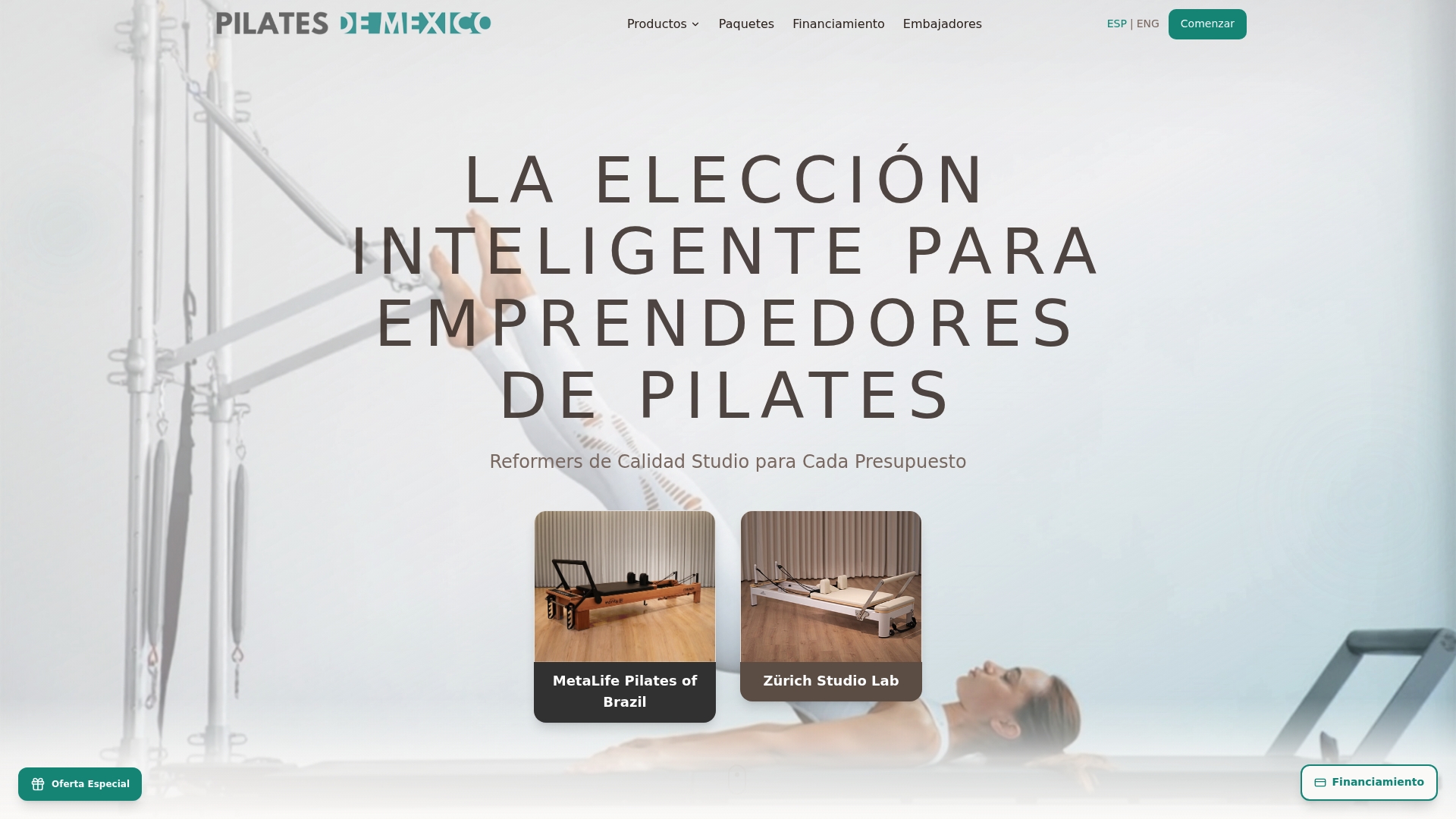
Discover the Infinity Line and the Advanced Line, explore the Advanced Reformer or the Infinity Reformer, complete your studio with accessories, and request your custom plan at pilatesdemexico.com.
How to decide in five steps
- Define your class model: daily classes per reformer, private vs. group sessions, student demographics.
- Measure your space and calculate how many reformers fit comfortably.
- Set a total budget, including equipment, shipping, installation, accessories, and launch costs.
- Request apples-to-apples quotes: same equipment specs, same accessories, same warranty terms.
- Choose a payment structure that protects your cash flow during the critical first few months.
Frequently asked questions
How much does it cost to equip a reformer studio in Mexico?
It depends on the number of reformers and the brand. According to Amyra, a reformer costs between $35,000 and $120,000 MXN per unit, and a complete studio requires an initial investment between $500,000 and $1,500,000 MXN. For your specific project, request a customized quote including equipment, accessories, and installation.
Is it worth buying the most expensive reformer right from the start?
Not necessarily. What matters most is that the equipment matches your intended usage: more daily classes demand greater durability. If you are starting on a tight budget, an accessible option lets you invest more into your grand opening, and you can always upgrade to a premium line later on.
What warranty should I look for when buying reformers?
Ask for a written warranty covering both the frame and moving components, and confirm who services it locally in Mexico. A 2025 Mexican industry benchmark recommends at least 24 months on the frame and 12 months on components. Be sure to also check replacement part availability and response times.
Can I finance my reformers?
Yes. At Pilates de México, every piece of equipment includes financing options, and we also build custom multi-unit studio packages. Terms are tailored to your project through our financing page.
Which reformer is best for a physical therapy clinic?
Look for a comfortable carriage height, smooth and easy spring adjustments, and exceptional stability. Models with a tower or a full Cadillac significantly expand the range of therapeutic exercises for private sessions. Our team can guide you based on your patient care needs.
Sources
- How to Open a Pilates or Yoga Studio in Mexico, Amyra
- Keys to Choosing a Reformer and Maximizing Return on Investment, GYM FACTORY Magazine
- How Much It Costs to Equip a Pilates Studio in 2025, Crossfy