6–8 Reformers in 40–80 m² for Owners and Managers
6–8 Reformers in 40–80 m² for Owners and Managers
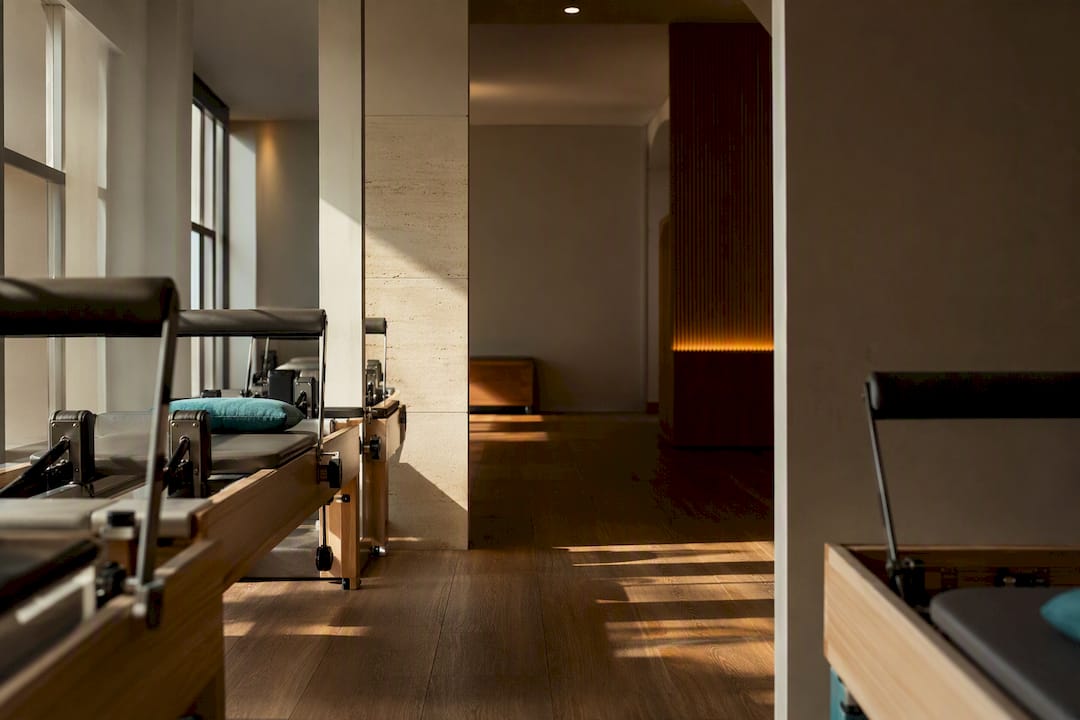
The best way to set up a reformer room in a small space begins with six to eight pieces of compact equipment, aligned along a wide wall or as an island if the premises are wider than six meters. With less capacity, the investment isn't recouped; with more, the space between machines becomes uncomfortable. The next step is to measure the premises, confirm the clear height, request a room plan from the supplier, and review financing options before committing the full budget.
In summary:
- A space less than six meters wide and between 40 and 60 m² can only accommodate a single row of reformers aligned against the wall without affecting circulation.
- It is crucial to verify that the clear height is at least 2.8 meters and that there is a minimum passage of 1.2 meters between equipment before signing the lease.
- Reformers with a removable or compact tower facilitate the adaptation and expansion of the studio, optimizing future space usage.
- Investing in durable equipment, with materials like certified Lyptus wood and stainless steel hardware, reduces maintenance and replacement part costs.
- Correct distribution, measurement, and prior planning allow for maximizing a small space and avoiding construction work that could increase opening costs.
Table of Contents
- Layouts and Capacity: How many reformers fit in a narrow space
- Technical Space Checklist Before Signing the Lease
- What to Prioritize When Choosing Reformers for a Compact Room
- How Much Does it Cost to Equip the Room and How to Finance It
- Installation and Logistics: From Measurement to First Class
- Design Tricks to Make the Room Feel Bigger
- Specific Maintenance for Reformers in Small Spaces
- Modular Reformers: Adapting as Space Changes
- Case Studies: What Works in Real Small Rooms
- Reflection on the Most Costly Mistakes
- How Pilates de México Supports Your Project
- Sources
Layouts and Capacity: How many reformers fit in a narrow space
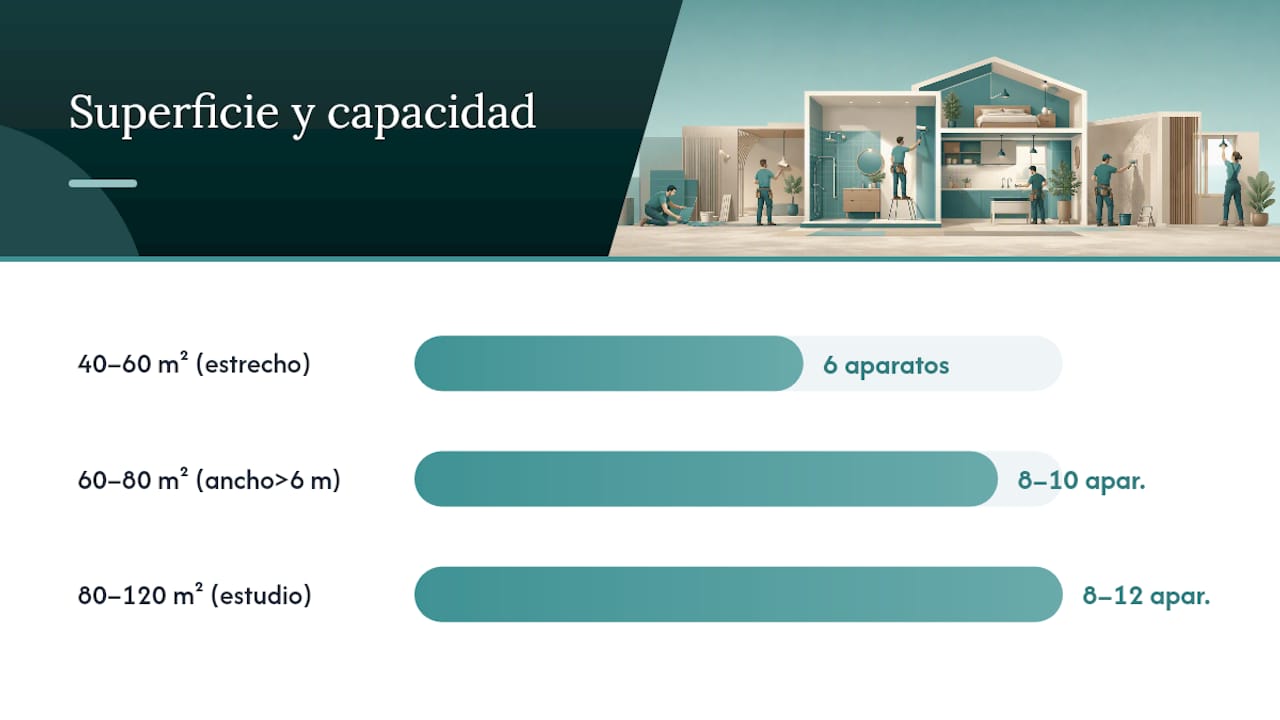
A reformer studio needs between 80 and 120 m² to operate with 8 to 12 machines, according to figures from Bookicorn. In smaller spaces, the same study recommends starting with eight reformers as a balance between investment and class capacity.
Each standard reformer measures approximately 2.4 meters long. Adding circulation space at the ends, a line of machines requires between 3.6 and 4 meters of total depth. The width per unit, including side separation, usually averages around 90 centimeters.
The three most common configurations for small studios are:
- Wall-aligned: all reformers in a single row against the longest wall. This is the most space-efficient option and works well in spaces less than six meters wide.
- Two rows facing each other: doubles capacity in the same length but requires a central aisle of at least 1.2 meters and good visibility for the instructor.
- Central island: groups the equipment in the center of the room, ideal for wide spaces where circulation is possible on all four sides; improves supervision but reduces the margin for error in measurements.
For a 40 to 60 m² space less than six meters wide, a wall-aligned setup with six reformers is usually the only viable option without compromising circulation. In layouts of 60 to 80 m² with a width greater than six meters, a central island or two facing rows allow for eight or ten units without saturating circulation.
Space Technical Checklist Before Signing the Lease
Before committing to a lease or purchase agreement, it's advisable to review five points that determine if the space can accommodate a functional reformer studio:
- Minimum clear height of 2.8 to 3.0 meters; with less height, some tower equipment may not fit comfortably, as Discla Pilates notes.
- At least 1.2 to 1.5 meters of clear passage between the end of the reformer and the wall or the next apparatus.
- Minimum lateral separation between reformers to prevent arms or straps from getting caught during exercise.
- Condition of the electrical installation, especially if dimmable lighting or additional climate control is planned.
- Sufficient natural or mechanical ventilation for a studio with high class rotation; lack of extraction accelerates the wear of straps and upholstery.
Discla Pilates also recommends checking the activity license and the general condition of the facilities (plumbing, electricity, ventilation) before signing, because unforeseen adaptation work can double the initial budget.
Professional tip: Bring a tape measure and mark the actual outline of each reformer on the floor with adhesive tape before deciding on the final layout. Seeing the physically occupied space avoids surprises that a floor plan on paper doesn't always reveal.
What to Prioritize When Choosing Reformers for a Compact Studio
In a small space, every centimeter of equipment counts. Critical dimensions to check before buying are total length, base width, and tower height, when the model includes one.
Models with a removable or compact tower greatly simplify life in small studios: they allow the accessory to be stored when not in use and free up space during mixed mat classes. Our guide on reformers with towers explains how to evaluate this component based on the type of classes you plan to offer.
Beyond measurements, GYM FACTORY points out that the most common mistake when buying is prioritizing aesthetics over durability and maintenance. A beautiful reformer with a noisy carriage or hard-to-replace parts becomes a problem after a few months of intensive use.
When comparing materials, certified Lyptus® FAS wood with stainless steel hardware offers quieter carriage movement and less corrective maintenance than economical metal structures, which tend to vibrate and require more frequent adjustments.
Return per square meter directly depends on ease of maintenance and access to spare parts, according to the same GYM FACTORY source: a machine that stops due to a missing part loses class hours that cannot be recovered.
Before deciding between economic and premium ranges, it's worth reviewing our comparison of the best reformer brands and confirming if the supplier offers wholesale packages to reduce the cost per unit.
How Much Does It Cost to Equip the Studio and How to Finance It
The cost per reformer varies greatly depending on the range: from accessible entry-level units to high-end professional equipment, with differences that can multiply the price several times. Equipping a complete studio can cost from tens of thousands of pesos to much higher figures, depending on the scope of the project, according to Bookicorn.
To reduce the entry barrier without sacrificing quality, it's advisable to evaluate three levers:
- Compare the cost per unit within a studio package versus buying each reformer separately.
- Review if equipment financing allows for distributing the investment into monthly payments aligned with the studio's cash flow.
- Calculate the return per hour and per square meter: divide the expected monthly class revenue by the number of active reformers and the meters they occupy; this fairly compares a small space with a larger one.
Our post on how to set up your first studio details examples of starter packages designed to begin with six to eight units without exhausting your initial capital.
Installation and logistics: from measurement to the first class
- Measurement and height validation: confirm square meters, usable width, and clear height before requesting any equipment quote.
- Request for distribution plan (room plan): the supplier proposes the optimal configuration according to your actual measurements.
- Minimal construction work: adjustments to flooring, electricity, or ventilation if the technical checklist detected deficiencies.
- Staggered delivery: phased receipt of equipment if the order includes several packages or suppliers.
- Technical installation: assembly, leveling, and adjustment of straps and springs by trained personnel.
- Pilot test: one or two trial classes with instructors before opening to the public, to detect noises or misalignments.
This order prevents construction work from delaying equipment delivery or equipment arriving before the space is ready, which often generates unnecessary storage costs.
Design tricks to make the room feel larger
Without expanding by a single square meter, architectural design can completely change the perception of available space. The JOCLA project, documented by Áurea Arquitectura, used double height and large windows to make a small commercial space feel considerably larger, without altering the floor plan.
Some replicable tactics for any small reformer room:
- Utilize height with shelves or mezzanines for accessories, leaving the floor free only for equipment.
- Use mirrors and indirect lighting on short walls, which visually widen the room.
- Choose floor and ceiling finishes with good acoustic absorption, because in small rooms, the echo of straps and springs is much more noticeable than in a large space.
For additional inspiration on storage and finishes in small spaces, the One Day Doors & Closets designer program offers ideas applicable to studio rooms with limited space.
Specific maintenance for reformers in small spaces
In a compact room, wear and tear are not distributed the same way as in a large studio. The proximity between machines means that dust, humidity, and constant friction affect all reformers almost simultaneously, not in isolation.
Straps and springs are the parts that suffer the most when the passage between equipment is narrow, as users tend to rub against them when getting on and off the carriage. Checking tension and wear every two or three weeks, instead of waiting for standard quarterly maintenance, prevents a strap from breaking in the middle of a full class.
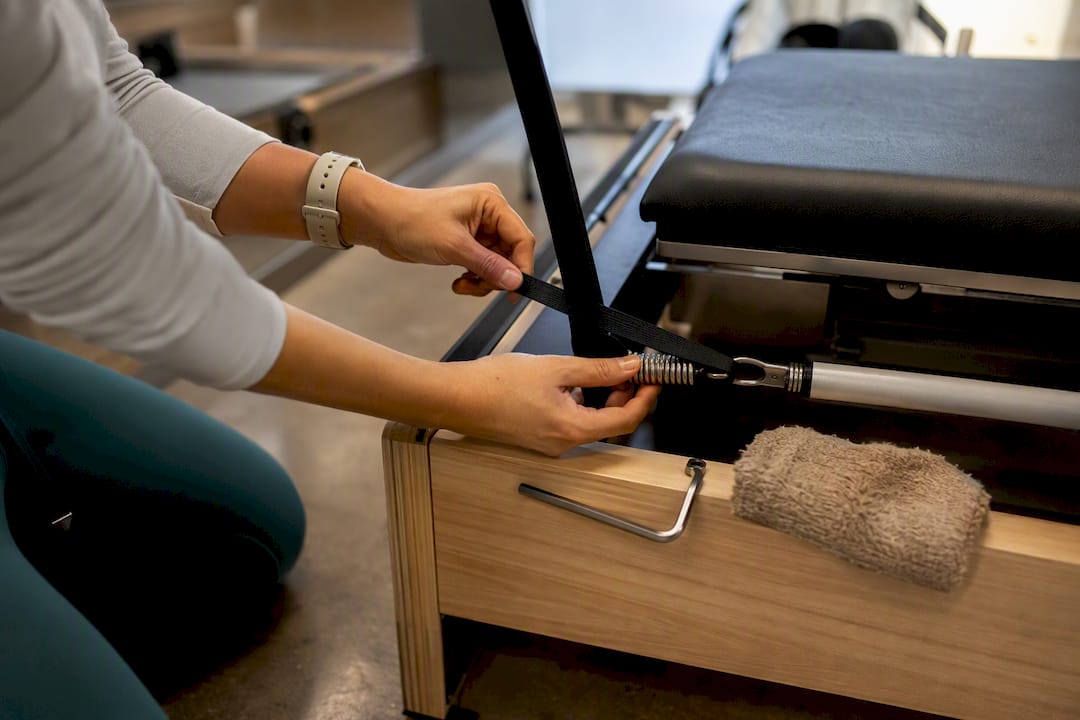
Insufficient ventilation, a common problem in small premises without mechanical extraction, accelerates the deterioration of upholstery and wooden parts. A humid, enclosed environment causes the protective varnish to degrade prematurely, even on quality structures.
Another overlooked point is cleaning under the carriage. In rooms where reformers are very close together, access for cleaning rails and wheels becomes complicated, and the accumulation of lint or dried sweat ends up affecting the smoothness of the glide. Scheduling monthly technical cleaning, with the equipment temporarily moved if necessary, maintains performance without relying on major repairs.
Modular reformers: adapting when space changes
A studio starting with six reformers in a small space almost always plans to grow. That's why the modularity of the equipment matters as much as its initial quality.
Reformers with a detachable tower allow an apparatus class to be transformed into a mixed mat class in minutes, simply by removing the vertical accessory. This flexibility is key when the same room must serve for apparatus Pilates in the morning and group mat classes in the afternoon.
Modularity also applies to physical layout. A reformer with transport wheels makes it easy to rearrange the room from aligned to island configuration in minutes, which is useful if the studio alternates between individual and group classes depending on the schedule. This layout flexibility is one of the biggest factors influencing how a small space can expand its offerings without expanding its walls.
When planning for future expansion, it is advisable to purchase equipment whose model remains in the catalog for several years, so that identical units can be added later without mixing different generations of carriages or towers. This cross-generational compatibility also facilitates maintenance, because spare parts remain the same.
Case studies: what works in real small rooms
The JOCLA case, mentioned earlier in the design section, shows how a small commercial space was transformed into a functional Pilates studio by taking advantage of its double height and large natural light openings, as documented by Áurea Arquitectura. The result was not more square meters, but a perception of spaciousness that completely changed the experience of those entering the room.
Another recurring pattern in studios that start small is to begin with a core of six to eight reformers and gradually complement them with additional apparatus or mat classes, rather than trying to fill the space from day one. Bookicorn documents this strategy as a way to validate real demand before committing capital to an expansion that may not be needed yet.
In practice, studios that best manage small spaces combine three decisions: a room configuration designed from the initial plan, equipment with a good balance between durability and maintenance, and a phased growth plan that doesn't rely on filling the space all at once. This order of priorities often makes the difference between a studio that becomes saturated in six months and one that grows with room to spare.
Reflection on the most costly mistakes
The most expensive mistake is not buying too little equipment, but buying it without measuring the actual height or without requesting a layout plan before paying. Always ask the supplier for the room plan and the contractor for the exact clear height, not the approximate one. Buying with resale in mind, using durable materials, protects your investment the day you need to expand or move.
How Pilates de México supports your project
We are an ally for studios, gyms, and clinics that need to equip a reformer room without guessing measurements or compromising the budget on the first try. We offer consulting and room plans adapted to your space, in addition to equipment packages and direct financing options to spread out the initial investment.
If your space measures between 40 and 80 m² and you have doubts about how many reformers will fit, check out the Zürich Labs Reformer, a compact model designed for small rooms, or consult our studio packages with volume discounts. You can send us your room measurements so we can prepare a layout proposal before you purchase a single piece.
Sources
To expand on the data in this article, consult Bookicorn's equipment guide, Discla Pilates' studio checklist, and our entry on layout alternatives for small rooms.
- Pilates Studio: equipment and guide | Bookicorn
- What kind of space do you need for a Pilates studio? (real guide) - Discla Pilates
- Keys to choosing a Reformer and maximizing return on investment in a sports center - GYM FACTORY Magazine
- JOCLA PILATES DESIGN — AUREA arquitectura