5 Shortcuts to Recoup Your Reformer Investment
5 Shortcuts to Recover Your Reformer Investment
These are the five actions that recover your reformer investment faster: launches with guaranteed occupancy, formats that increase hourly revenue, complementary sales, financing and packages, and corporate partnerships. In studios with 6 to 12 reformers, financing combined with packages often moves up the break-even point, because it tackles the real problem from day one: lack of liquidity, not lack of clients. A professional reformer costs between $3,000 and $6,000, so every empty spot has a concrete opportunity cost.
Pro Tip: *Before applying any shortcut, calculate your target occupancy.
- Launches and introductory offers
- Formats that maximize hourly revenue
- Complementary sales (retail, workshops, private sessions)
- Financing and equipment packages
- Corporate partnerships and events
If you only have time for one action this week: open an automated waiting list and publish your launch offer with a deadline.
Key Points
Recovering your reformer investment depends on combining early occupancy, optimized hourly revenue, complementary sales, and a financing structure that doesn't drain your initial cash flow.
| Point | Details |
|---|---|
| Launch with limited spots | Open 10 to 15 spots in the first week with a bonus and a closing date, not indefinite discounts. |
| Measure RevPCH | Aim for $150-200 per hour and rearrange your schedule according to the time slots with lower occupancy. |
| Sell beyond the class | Combine accessories, workshops, and private sessions to increase the average revenue per client. |
| Use financing with clear clauses | Negotiate terms, rates, and resale guarantees before signing any package. |
| Rely on Pilates de México | Their studio packages and direct financing reduce purchase friction and accelerate opening. |
Table of Contents
- Shortcut 1: Launches and introductory offers to fill the room quickly
- Shortcut 2: Maximize usage hours to increase revenue per reformer
- Shortcut 3: Monetize add-ons with retail, workshops, and internal sales
- Shortcut 4: Use financing and packages to reduce purchase friction
- Shortcut 5: Partnerships, corporate deals, and events for scalable occupancy
- How to measure and project your investment recovery
- How Pilates de México accelerates your investment recovery
- Sources
- Frequently Asked Questions
Shortcut 1: Launches and Introductory Offers to Fill the Room Quickly
A well-designed launch doesn't give away classes: it creates real urgency with a limited number of spots. The structure that works best combines a valuable bonus (a postural assessment, a private session) with a moderate discount and a visible closing date. Giving away too much destroys the price you'll need to charge by month three.
For the first week:
- Publish a simple landing page with the bonus, price, and offer deadline.
- Launch a local campaign (social media, neighborhood partnerships, referrals from your current network).
- Activate an automated waiting list for sold-out spots.
- Open 10 to 15 initial spots, not your full capacity all at once.
Setting up launch packages with bonuses like three private sessions plus five group sessions improves initial conversion and increases the lifetime value of those first clients. Measure the conversion from trial to member and the projected revenue from your first 30 clients: that number tells you if the launch paid its own acquisition cost.
Pro Tip: Communicate scarcity with a real, not invented, limited number of spots. If you sell 15 spots and then "find" 10 more the following week, your next offer loses credibility.
Shortcut 2: Maximize Usage Hours to Increase Revenue Per Reformer
Revenue per reformer per hour, or RevPCH, is calculated as follows: price per spot multiplied by occupancy, divided by the available hours for that machine. A well-managed studio should aim for a RevPCH of between $150 and $200 with over 80% utilization during peak hours.
Formats that achieve this figure:
- 30-minute express classes during off-peak hours, with proportional pricing but higher turnover.
- Intensive morning blocks to capture demand before work.
- Private sessions per reformer outside of group hours.
- Hybrid models that combine on-demand video classes with in-person sessions.
Reorganize your schedule over two weeks, prioritizing the slots with currently lowest occupancy. Each reformer needs 45 to 60 centimeters of free space around it for the instructor to circulate, so the actual capacity of your room limits how many formats you can run simultaneously.
Pro Tip: Try a slightly lower rate for the two worst-performing time slots for one month. If occupancy increases more than revenue per spot decreases, keep it.
Shortcut 3: Monetize Add-ons with Retail, Workshops, and Internal Sales
Revenue per class has a ceiling. Average revenue per client does not. The products and services that most quickly raise this average are everyday accessories, specialized workshops (mobility, postpartum, rehabilitation), and follow-up private sessions.
- Bands, balls, and rollers that clients also use at home.
- Weekend thematic workshops with limited spots and premium pricing.
- Packages of private sessions sold immediately after a group class.
Combining high-margin activities like private sessions and workshops with physical products reduces dependence on group class volume and accelerates returns. The sales script works best when presented as progress, not a transaction: "to sustain what you achieved today, this helps you at home" converts better than a counter with prices.
Pro Tip: Curate a small catalog of accessories. Ten well-chosen products sell more than forty that overwhelm.
Shortcut 4: Use Financing and Packages to Lower Purchase Friction
Financing is not a patch for studios with cash flow problems: it's a tool to deploy capital more intelligently. The most common options are direct installment payments with the provider, leasing, and packages with staggered equipment delivery.
- Review terms, rates, and requirements of each offer before signing. 2. Calculate the real impact on your monthly cash flow, not just the total financed amount. 3. Confirm how financing is accounted for compared to a direct purchase. 4. Negotiate resale and warranty clauses before closing the contract.
A studio that combines an equipment package with direct financing can reach its break-even point months earlier compared to paying everything upfront, because it frees up capital needed for marketing and payroll during the critical initial months. Pilates de México offers studio packages and direct financing designed specifically for this initial liquidity challenge.
Pro Tip: Always negotiate resale and warranty clauses. They protect the asset's value if you need to scale or change locations in two years.
Shortcut 5: Partnerships, Corporate Clients, and Events for Scalable Occupancy
B2B channels fill spots in bulk, without relying on individual clients discovering your studio through social media. The models that work best are corporate wellness programs with local businesses, agreements with gyms that don't have their own reformers, and partnerships with boutique hotels.
- Local companies with an employee wellness budget.
- Gyms that want to offer reformer classes without buying equipment.
- Hotels or spas looking for a differentiated experience for guests.
To activate an agreement in two to four weeks:
- Identify three nearby companies or businesses with a compatible profile.
- Send a brief proposal with a group rate and a free trial slot.
- Organize a pilot session and follow up within seven days. 4. Convert participants with the best attendance into individual memberships.
Set corporate rates with a guaranteed minimum number of participants, not per individual, to protect your margin.
Pro Tip: Require a minimum session commitment in the corporate contract. Without it, the event ends up being free advertising and not recurring revenue.
How to Measure and Project Your Return on Investment
The payback formula is simple: net investment divided by incremental net income per period. You need four indicators for the number to be reliable: occupancy percentage, RevPCH, cost per class (including instructor pay), and three-month retention.
Keeping personnel costs between 30% and 40% of revenue, with a target occupancy of 70%, is the usual benchmark for sustained profitability. A studio with 8 to 10 daily classes, 6 to 8 participants per class, and a price of $35 to $45 per spot can generate between $30,000 and $40,000 per month; one or two empty machines per class significantly shifts that number.
| Scenario | Occupancy | Recommended action |
|---|---|---|
| Conservative | 45-60% | Strengthen launch and automate waitlist |
| Expected | 70-80% | Maintain current schedule and add complementary services |
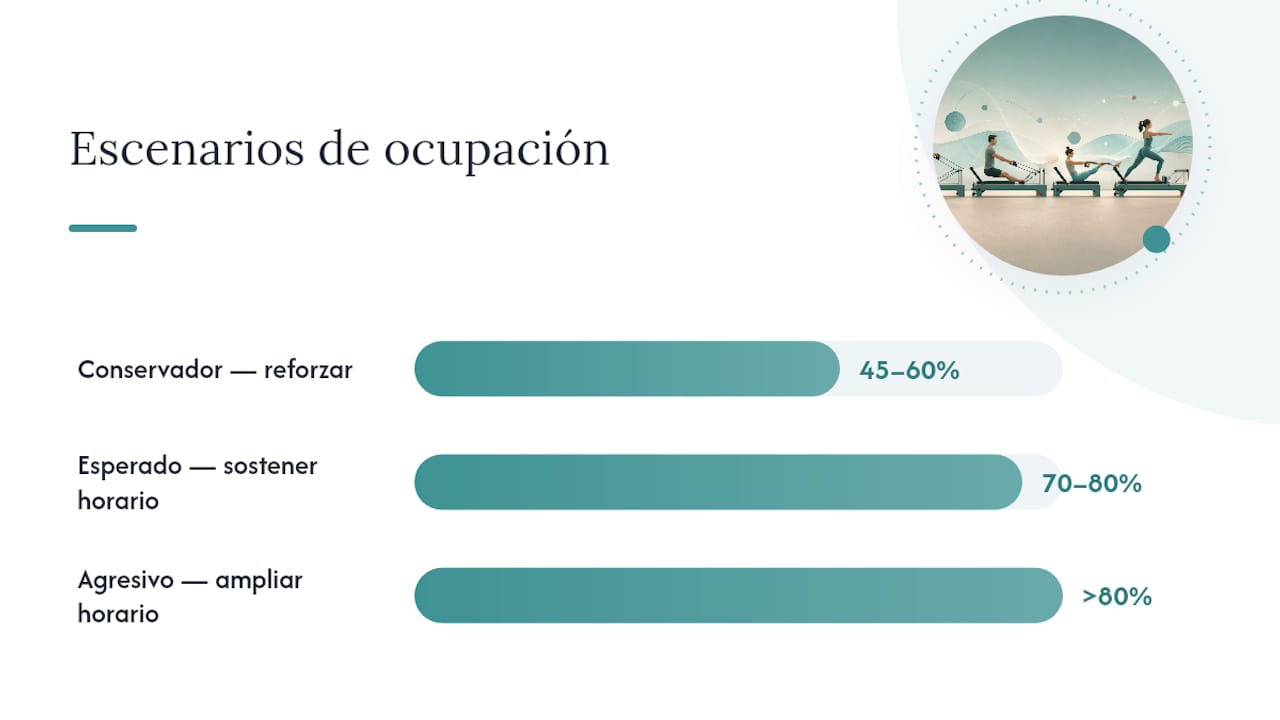
| Aggressive | over 80% | Evaluate extending hours or adding reformers |
The typical time to profitability ranges from 2 to 6 months in the initial phase, with consolidation between 6 and 18 months for most studios. Automating bookings and waitlists can increase utilization by 10% to 15%, one of the cheapest improvements to implement.
A note on practical experience with equipment and opening
After supporting reformer studio openings, the recurring lesson is this: equipment that survives years of daily classes matters more than the list price. Working with certified Lyptus® FAS wood and stainless steel hardware, like that of the Infinity line, reduces maintenance costs that erode margins just as the studio begins to stabilize. If you are about to open or expand, a practical consultation is worthwhile before signing any purchase.
How Pilates de México accelerates your return on investment
Pilates de México solves the real problem behind these five shortcuts: direct financing and studio packages reduce purchase friction from day one, without you having to choose between opening the studio or maintaining liquidity for marketing and payroll. The Infinity Reformer with Tower line is built with Lyptus® FAS and stainless steel to support over 200 exercises and years of daily use, so maintenance costs don't compete with your monthly margin.
Studio packages are designed for opening with several reformers at once, which directly aligns with shortcut 1: filling the studio from launch instead of growing machine by machine. And if initial capital is the bottleneck, equipment financing spreads that cost over manageable payments, as explained in shortcut 4. If you manage accessory inventory for your complementary sales, a practical guide to stock management for appointment-based businesses helps you keep that process organized.
Request a quote for your equipment package and review the available financing conditions for your project this week.
Sources
- Reformer Pilates Studio Pricing vs. Class Size | bsport
- Pilates studio profitability: how long it takes to become profitable - Discla Pilates
- Sheets
Use these sources to cross-reference your own numbers before committing capital.
This article provides general information and does not substitute the advice of a qualified financial advisor. Consult a qualified financial professional regarding your specific case before acting on this content.
Frequently Asked Questions
What are the 5 shortcuts to recover your reformer investment faster?
Launches with guaranteed occupancy, formats that increase hourly revenue, complementary sales, financing and packages, and corporate partnerships. Each targets a different lever: occupancy, price, revenue per client, liquidity, and volume of new clients.
How long does it take to recover the investment in a reformer studio?
It varies by occupancy and price, but the typical range is 2 to 6 months for the initial phase and up to 18 months for stable consolidation. A studio that combines financing with packages usually shortens this period by reducing the initial cash burden.
What is RevPCH and why does it matter?
It's the revenue per hour per reformer: price per spot multiplied by occupancy, divided by available hours. A healthy studio aims for between 150 and 200 dollars per machine per hour during its peak times.
Does financing really accelerate investment recovery, or just postpone it?
It accelerates it when it frees up capital to be allocated to marketing and filling the room in the first few months, which is when occupancy matters most. Negotiating good rates and resale clauses prevents the financial cost from nullifying that advantage.