3 Lighting Scenes That Elevate the Experience in Your Pilates Studio
3 Light Scenes That Elevate the Experience in Your Pilates Studio
The ideal lighting for a Pilates studio is warm, between 2700 and 3500 K, diffused, and dimmable. You should segment it by zones (Reformer, mat, reception, and changing room) and control the intensity with dimmers or pre-configured scenes. No cold fluorescents or direct spotlights on a student's face when lying down.
In summary:
- For a Pilates studio, the ideal color temperature is between 2700 and 3500 K, with a minimum Color Rendering Index (CRI) of 90 for visual accuracy.
- Lighting should be dimmable and distributed by specific zones, prioritizing soft and warm environments to generate calm and improve concentration.
- It is crucial to avoid cold fluorescents and direct spotlights on students, and instead use recessed LED panels, LED strips, and luminaires with backlighting that ensure uniformity and quality of light.
- Investment in control systems, such as adjustable dimmers and programmed scenes, has a greater impact on the quality of the space than the choice of brand-name luminaires.
- It is recommended to take advantage of natural light by filtering it with blinds or curtains, orienting mirrors, and using light sensors to reduce consumption and avoid glare.
Table of Contents
- Why Lighting Impacts Concentration, Posture, and Client Retention
- Color Temperature, CRI, and Light Levels That Really Work
- How to Light Each Area of the Studio Without Making Common Mistakes
- Types of Luminaires That Really Work in a Pilates Studio
- Dimmers, Scenes, and Efficiency: Control Matters More Than Power
- Practical Checklist and Estimated Budget for Equipping Your Studio
- Recommendations for Harnessing Natural Light and Managing Curtains and Blinds
- Author's Perspective: Lighting Design Priorities Based on Professional Practice
- Equip Your Studio with the Right Support: Packages and Financing
- Sources
Why Lighting Impacts Concentration, Posture, and Client Retention
Light is not decoration. It is a modulator of the nervous system, and in a practice that demands body control and conscious breathing, that weighs more than it seems. Neuro-architecture applied to Pilates studios confirms that spaces with soft light and visual simplicity better activate the prefrontal cortex, the area responsible for control and concentration during exercise.
Poorly calculated lighting has concrete and measurable effects:
- It causes visual fatigue in 50 or 60-minute sessions, especially when there is contrast between very brightly lit areas and others in shadow.
- It leads to postural errors because the instructor cannot clearly distinguish the student's body lines under lights with poor color rendering.
- It conveys an image of a neglected studio, even if the equipment is top-notch.
A coherent lighting environment, on the other hand, functions as a mark of quality. Studios that work with warm and uniform LED lighting report improvements in the perceived sense of calm by their students, which directly translates into retention.
Color Temperature, CRI, and Light Levels That Really Work
Pro tip: If you have to choose only one parameter to get right, choose color temperature before power. A room with fewer lux but well-calibrated in warm tones feels better than a very brightly lit room in cool white.
The three values you must set before buying any luminaire:
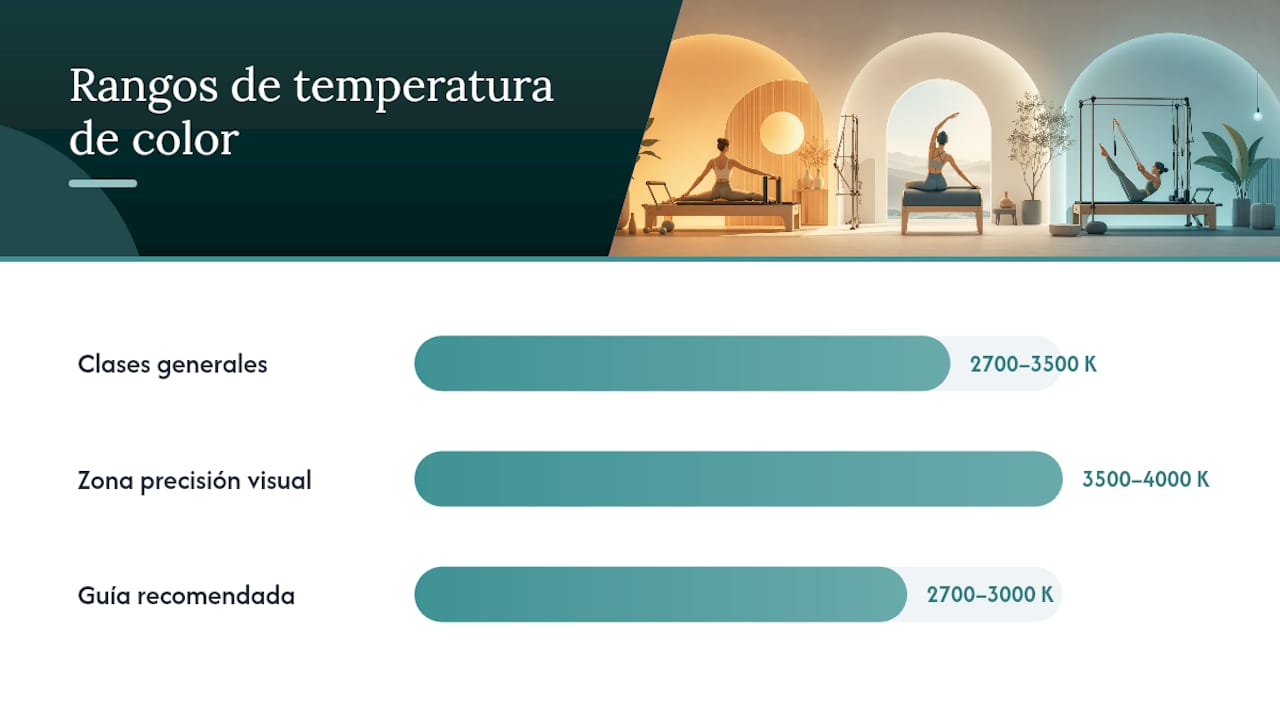
- Color Temperature: 2700 to 3500 K for most classes. Go up to 3500-4000 K only in areas requiring constant visual precision, such as an instructor training room.
- CRI (Color Rendering Index): Minimum 90. Below this threshold, skin tones appear dull, and it becomes more difficult to assess posture with the naked eye.
- Lux Level: Between 150 and 300 lux for relaxation and mat-based classes; increase the range when the class requires more visual detail, such as technical adjustments on the Reformer.
The Pilates studio equipment guide directly recommends discarding cool fluorescent lights and working in the 2700 to 3000 K range with dimmable control.
How to Light Each Area of Your Studio Without Making Common Mistakes
Each area of your studio serves a different function and needs its own lighting logic.
- Reformer Room. Prioritize uniform light without glare on the horizontal surfaces of the carriages. Combine recessed LED panels with backlighting behind mirrors to avoid harsh shadows on the student's body.
- Mat Room. Here, it's advisable to have at least three dimmable scenes: a more intense one for warm-up, an intermediate one for active work, and a softer one for final relaxation.
- Reception. A warm accent light visually anchors the space and conveys closeness, but you also need sufficient functional light to attend to clients and operate the cash register without eye strain.
- Changing Room and Restrooms. Here the priority changes: clear, uniform light with high CRI, because students apply makeup, check their skin, or simply need to see well without strange shadows.
A common mistake is to replicate the same solution across all four areas. The Reformer room and the changing room have opposite goals: one seeks calm, the other seeks functional clarity.
Types of Luminaires That Really Work in a Pilates Studio
You don't need a huge catalog. You need the right pieces, well-combined.
- Recessed LED Panels: The basis of general lighting. They distribute light evenly and avoid the hot spots generated by punctual bulbs.
- Perimeter LED Strips: Placed on the ceiling or behind mirrors, they provide indirect light that softens the ambiance without creating annoying reflections. Maintain the same color temperature as the rest of the room to avoid strange contrasts.
- Adjustable Spots: Use them only for accents in reception or decorative areas, never directly over the area where the student lies down. Always with a diffuser.
- Luminaires with Backlight: Ideal behind large mirrors in the Reformer room, because they eliminate shadows without dazzling.
For installation, don't skimp on the driver for each LED luminaire. A poor-quality driver generates almost imperceptible flickering that tires the eyes during long sessions and shortens the LED's lifespan. Also, verify electrical protection in damp areas like changing rooms.
Dimmers, Scenes, and Efficiency: Control Matters More Than Power
Buying good luminaires without an adequate control system is throwing away half the investment. Specialized suppliers for movement spaces consider dimmers practically essential in yoga and Pilates studios.
- Choose dimmers specific to LED, not universal ones designed for halogens: they prevent flickering and buzzing.
- Program at least three scenes per room: warm-up, active class, and final relaxation, to avoid relying on manual adjustments every time.
- Add presence sensors in changing rooms and hallways, and time programming in reception to reduce consumption outside of class hours.
Practical Checklist and Indicative Budget for Equipping Your Studio
Before calling an electrician, define what you need per room.
- Reformer Room: Recessed LED panels + backlight in mirrors + dimmer control. This is the area where it's worth investing in luminaires with a higher CRI, because the most delicate technical work is done there.
- Mat Room: Perimeter LED strips + three programmed scenes.
- Reception and Changing Rooms: A warm accent light in reception, high-CRI functional light in changing rooms and restrooms.
Investing in adjustable lighting recurrently appears among the recommended items when equipping a new studio, alongside exercise equipment. If you're calculating the full opening budget, it's worth reviewing first which equipment to prioritize and how much to invest in each item, and comparing against broader estimates on how much it costs to open a Pilates studio. The rule that works best: spend more on control (dimmers, drivers, scenes) than on branded luminaires without dimming capabilities.
Recommendations for leveraging natural light and managing curtains and blinds
Natural light is your best ally during the day, but also your biggest risk of glare. A large window facing the mat area can ruin a morning class if the sun shines directly into the eyes of students lying on their backs.
The solution is not to block natural light, but to filter it. Opaque curtains are less preferable as they completely darken the room and force reliance solely on artificial light during the day, increasing electricity consumption.
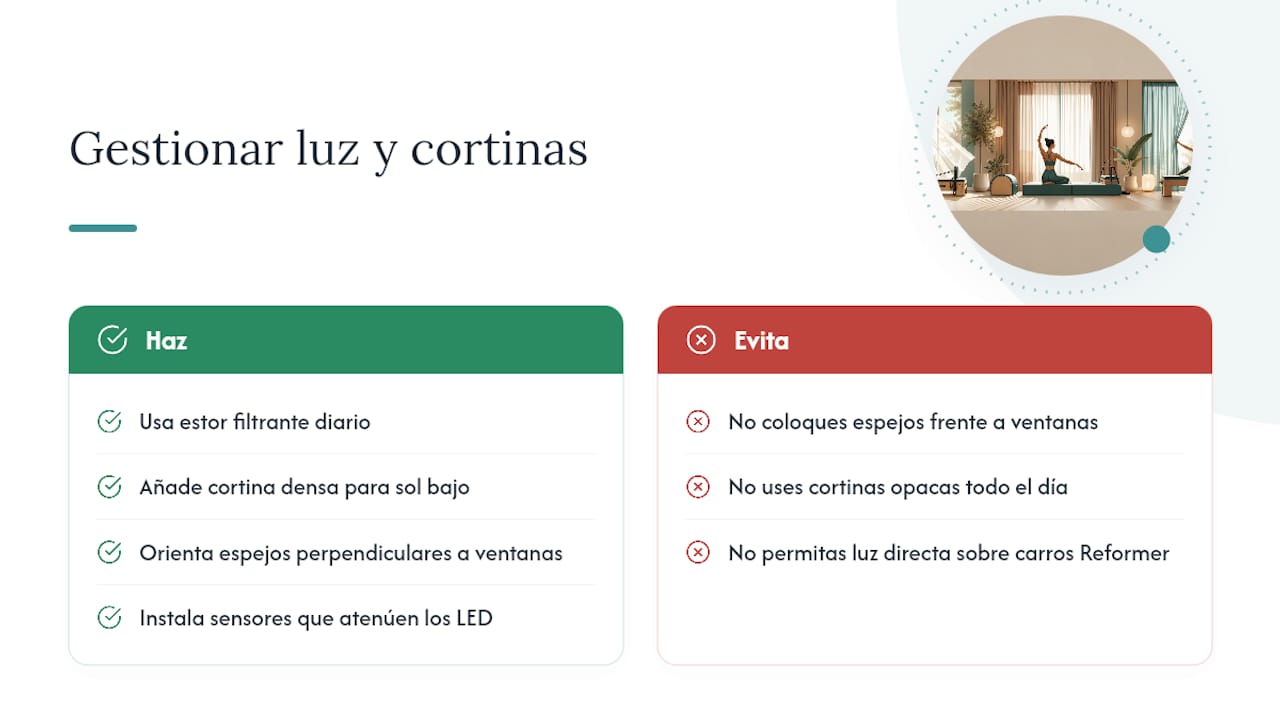
If your studio has windows facing east or west, consider a double layer: a filtering blind for daily use and a denser curtain for hours of low sun, when light enters almost horizontally. In Reformer rooms, avoid natural light directly hitting the surfaces of the carriages, as this creates reflections that make it difficult to clearly see the student's posture.
A good practical trick is to orient the studio mirrors perpendicular to the windows, never facing them. This way, you prevent direct sun glare from bouncing into the eyes of those practicing. And if your budget allows, install natural light sensors that automatically dim the LEDs when there's sufficient outdoor brightness, which also reduces energy consumption during the day.
Author's perspective: lighting design priorities based on professional practice
If I had to choose a single priority, it would be scene control over luminaire aesthetics. A well-programmed dimmer transforms a mediocre room; an expensive luminaire without control ruins a good one. Always coordinate the color temperature with the wall tone: warm surfaces with warm light avoid that artificial effect that betrays a newly set up studio lacking criteria.
Equipping your studio with the right support: packages and financing
Designing the correct lighting is only one part of the project. The other is choosing the equipment that will withstand years of daily classes, and that's where Pilates de México works as a partner, not just a supplier. We carry MetaLife, the leading line of reformers in South America, built with certified Lyptus® FAS wood and stainless steel hardware, along with more accessible professional options for those opening their first studio.
Our studio packages combine equipment with opening consultancy, so that lighting, setup, and equipment progress in coordination rather than as isolated decisions. If you need to distribute the investment, we offer direct financing designed for expanding studios and new projects. Check out the Zürich Labs reformer and request a quote from the team before finalizing your studio design.
Sources
Consult these guides on neuroarchitecture applied to Pilates and reform projects in Pilates centers to see real-world applications.
- Neuroarchitecture in Pilates studios: designing spaces that heal, inspire, and sell - Arquitectura Post
- Pilates Studio: equipment and guide | Bookicorn
- Jlrled