10% Annually: Deduct Reformer and Calculate MOI for Studios in Mexico
10% Annually: Deducting Reformers and Calculating MOI for Studios in Mexico
To apply it correctly, you need an invoice (CFDI), a properly integrated Original Investment Amount (MOI), and evidence that the equipment is strictly indispensable for your activity. Without these three elements, the deduction is vulnerable to review by the SAT.
In summary:
- An invoice, a well-integrated MOI, and evidence that the equipment is essential for the activity are required to justify the deduction to the SAT.
- The MOI includes more concepts than the purchase price, updated with INPC and prorated by full months in the fiscal year.
- The maximum annual deduction is 10% of the MOI, although a lower percentage can be chosen and modified according to tax planning.
- It is crucial to properly document the acquisition: CFDI, accounting record, evidence of use, and proof of transport, installation, and operation.
- Buying used equipment reduces the deductible base, but if it does not have a valid CFDI, it will not be possible to properly integrate the MOI and the deduction.
Table of Contents
- What the LISR says about deducting Pilates equipment
- What's included in the Original Investment Amount and how to update it
- How to calculate reformer depreciation step by step
- What documentation you need to support the deduction
- How equipment purchased with financing is deducted
- Common errors when deducting equipment and a checklist to avoid them
- When a reformer meets deductibility criteria
- Personal equipment vs. equipment for business activity: the line that defines the deduction
- Used vs. new Pilates equipment: what changes fiscally
- How to manage accumulated depreciation in your tax balances
- How to declare Pilates equipment on the annual return
- What a professional equipment supplier offers to support your deduction
- Quote your equipment and sort out tax paperwork from the start
- What almost no studio calculates correctly the first time
- Sources
What the LISR says about deducting Pilates equipment
Article 29 of the LISR treats reformers, chairs, or towers not as an expense that vanishes in the month of purchase, but as an investment that is recovered over several fiscal years. This investment has a technical name: Original Investment Amount (MOI), the basis on which you calculate how much you can deduct each year.
Article 31 of the LISR establishes the rules of the game: you apply a maximum annual percentage to the MOI, prorate it by complete months in the fiscal year the equipment enters service, and update the MOI according to inflation using the National Consumer Price Index (INPC).
For furniture and equipment, this maximum percentage is 10% annually. The annual deduction is calculated by applying the chosen percentage to the MOI, spread over the fiscal useful life of the equipment.
The law also gives you room to decide:
- You can opt for a percentage lower than the maximum authorized, for example, 5% instead of 10%.
- This choice becomes mandatory once exercised and has specific rules for modifying it later, according to the regulatory criteria of the SAT.
- Lowering the percentage extends the deduction period, which is useful if you expect future fiscal years with higher tax profits.
This flexibility turns depreciation into a planning tool, not just an accounting procedure.
What is included in the Original Investment Amount and how to update it
The MOI is not just the price on the reformer invoice. Article 29 of the LISR requires including all necessary costs to make the equipment operational.
- The price of the equipment, excluding VAT.
- Taxes effectively paid on the acquisition, with the exception of VAT.
- Freight and transportation to the studio.
- Insurance during transit.
- Installation and assembly costs.
- Fees and customs duties, when the equipment is imported.
A national reformer usually has a simpler MOI: price plus local freight and installation. An imported one entails more concepts, but also a higher depreciation base.
The MOI is updated by applying the corresponding INPC factor for the period between acquisition and the month it is deducted, or the month of disposal if you sell the equipment earlier. Omitting these concepts is not a minor error: undervaluing the MOI artificially reduces your annual deduction throughout the asset's fiscal life, an oversight that recurs year after year.
How to calculate the depreciation of a reformer step by step
Converting the MOI into a concrete annual deduction follows a simple sequence, although it requires order:
- Determine the complete MOI. Add price, taxes paid except VAT, freight, insurance, installation, and, if applicable, customs expenses.
- Apply the maximum authorized percentage. For furniture and equipment, multiply the MOI by 10% (or the lower percentage you have chosen).
- Prorate by full months if the equipment enters service mid-year. If a reformer begins operating in September, you only deduct the proportional part for the full months of use in that fiscal year, according to the SAT's prorating rules.
- Update the MOI each fiscal year with the INPC factor before applying the percentage for the following year.
- If you sell or retire the equipment before fully depreciating it, adjust the calculation: the part of the MOI not yet deducted can be recognized in the fiscal year of disposal, according to the rules of the same article.
Documenting the exact date of commissioning avoids calculation errors and lost deductions in the first and last year of the equipment's fiscal life.
What documentation do you need to support the deduction
A CFDI is not enough to secure the deduction. The deductibility requirements of the ISR demand demonstrating that the expense is directly related to your activity and is strictly indispensable for generating it.
The minimum file that should be kept includes, as explained by the NexoLab Blog:
- CFDI of the purchase, with the correct tax information of the studio.
- Accounting record of the asset with acquisition date, MOI, and applied percentage.
- Proof of payment by an authorized means when the amount exceeds 2,000 pesos, following the requirements for authorized deductions.
- Contract or purchase order, plus the equipment delivery receipt.
- Installation guides and photographic evidence of the reformer already assembled in the room.
- Usage records: class schedules, assignment of equipment to a specific room, attendance lists.
This operational evidence is what distinguishes a studio that survives a SAT review from one that only has an archived invoice without context.
Professional tip: talk to your accountant before closing the purchase, not after. Defining the depreciation percentage you will apply and what concepts will be included in the MOI from the outset avoids uncomfortable corrections at the close of the fiscal year.
How equipment purchased with financing is deducted
Financing a reformer does not change the underlying tax mechanics: the MOI is calculated the same way, based on the value of the equipment and associated costs to make it operational, regardless of whether you pay in cash or installments.
The common mistake is to think that financing installments replace the calculation of the MOI. This is not the case: the MOI is set at the time of acquisition, and monthly payments only reflect how you settle that obligation with the supplier or financial institution.
Additional documentation you need when financing:
- The complete financing contract, with a breakdown of principal and interest.
- Proof of each monthly payment made.
- The certificate of receipt of the equipment, which marks the moment when it can begin to depreciate.
Financing interest usually has a different tax treatment than asset depreciation: it is recorded as a financial expense, not as part of the MOI. Coordinating this with your accountant from the start avoids mixing two concepts that the LISR treats separately, and this separation prevents costly retroactive adjustments.
Common Errors When Deducting Equipment and a Checklist to Avoid Them
The most frequent oversights in deducting reformers and professional equipment are common among both large and small studios:
- Deducting 100% of the MOI in a single fiscal year, instead of applying the corresponding annual percentage over several years.
- Not including the complete MOI, forgetting shipping, insurance, or customs expenses and leaving the calculation basis undervalued.
- Omitting prorating by months in the initial or final fiscal year of the equipment, which leads to deducting too much or too little.
- Paying in cash amounts that exceed the allowed limit for authorized payment methods, invalidating the deduction even if a CFDI exists.
- Not updating the MOI with the INPC factor in fiscal years subsequent to the purchase.
A checklist before filing reduces almost all these risks:
- Do you have the correct and valid CFDI?
- Was the payment made using an authorized method?
- Is there a contract or purchase order?
- Do you keep evidence of the operational use of the equipment?
- Did you update the MOI from the previous fiscal year?
- Did your accountant review the file before the fiscal closing?
Professional Tip: review the tax file for each reformer at least once a year, not just when you file. If you plan to sell or replace equipment, do it before the alienation: adjusting the undeducted MOI is much simpler with complete paperwork.
When a Reformer Meets Deductibility Criteria
Not all Pilates equipment purchased by the studio automatically qualifies. The LISR requires that the expense be strictly essential for the activity that generates your income, and that relationship must be demonstrable, not just assumed.
A reformer operating in a room where you teach regular classes, with documented schedules and clear assignment within the studio, meets this criterion without question. The link between the asset and income generation is established by the very use of the equipment within the business operation.
The criterion becomes complicated when the equipment remains unused, is acquired in quantities that do not correspond to the actual size of the room, or when the invoice does not match the declared destination of the asset. The SAT may question the indispensability of three additional reformers purchased in the same month you opened a two-bed studio, for example.
Other elements that strengthen the deductibility criterion:
- The equipment must be in the name of the legal entity or individual with business activity that deducts it, not a partner or family member.
- The declared destination on the invoice must match the actual use: equipment for a studio or clinic, not for domestic use.
- The quantity of equipment acquired must be reasonable compared to the capacity of the space and the number of clients you serve.
A file with installation photos, lists of equipment assigned to each room, and class records builds that direct relationship between the asset and income, exactly what an auditor looks to confirm.
Personal Equipment vs. Business Activity Equipment: The Line That Marks Deduction
The difference between a deductible reformer and one that is not is rarely about the model or brand. It's about its purpose and who uses it.
A reformer installed in your home for your personal practice is not deductible under any circumstances, regardless of whether you are also a certified instructor. The LISR does not allow deducting expenses of a personal nature even if the taxpayer has related business activity.
However, that same reformer installed in your studio, available for your students to take class or for you to teach sessions that you invoice, does qualify as an asset for business activity. The key is its availability for the business, not who uses it at a given moment.
Intermediate cases generate more doubts: an independent instructor who teaches at home with a foldable reformer, or a physiotherapist who adds Pilates equipment to their office. In both cases, deductibility depends on the equipment being formally incorporated into the declared business activity, with invoicing for services that supports its professional use.
Some signs that help draw that line:
- The equipment is used to generate invoiced revenue, not just for personal practice.
- It is located in a space identified as part of the business's operation (studio, clinic, office).
- There is evidence of clients or patients using that specific equipment.
When the activity mixes personal and professional use, it is advisable to document the proportion of business use with special care, because that is where the SAT usually focuses its observations.
Used vs. New Pilates Equipment: What Changes Tax-wise
Buying a used reformer doesn't exempt you from the depreciation regime, but it does change how the ICV (Initial Cost Value) is constructed and how solid your documentary evidence is.
The ICV of used equipment is calculated the same way as new equipment: acquisition price, taxes paid except VAT, freight, and installation. The difference is that the market price of a used reformer is usually lower, which reduces the depreciation base and, with it, the available annual deduction.
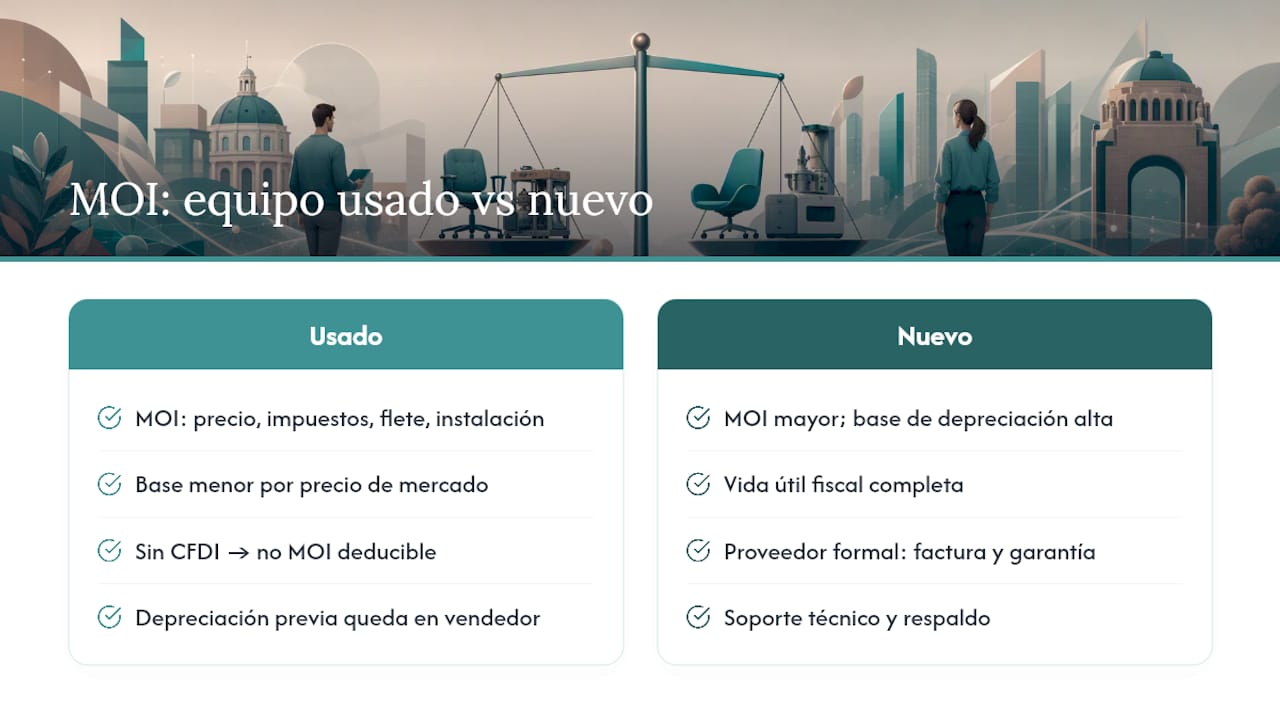
A practical problem arises when the seller cannot issue a CFDI (digital tax receipt), which is common among studios that informally sell second-hand equipment. Without a valid invoice, there is no deductible ICV, no matter how much you actually paid. This makes the seller's tax formality as important a factor as the price or condition of the equipment.
Another point to consider: if the used reformer was already partially or fully depreciated by its previous owner, that tax history belongs to the seller, not to you. Your deduction starts from zero based on the ICV you paid, documented with your own CFDI.
Buying new, on the other hand, gives you a higher ICV, a full tax useful life ahead, and a formal business relationship with the supplier, which facilitates obtaining an invoice, warranty, and technical support. For studios that plan to grow and need a clean documentary record from day one, this formality often outweighs the initial savings of buying used.
How to Manage Accumulated Depreciation in Your Tax Balances
Accumulated depreciation is the record of how much ICV you have already deducted from each reformer over the fiscal years. It's not just a decorative detail: it determines how much fiscal value the asset retains and what happens if you sell or replace it.
Maintaining a detailed control for each piece of equipment, with acquisition date, updated ICV, applied percentage, and accumulated depreciation, is the practice recommended by specialists to avoid calculation errors and facilitate any review.
This control becomes indispensable when a studio has several reformers purchased on different dates, some imported and others domestic, each with its own ICV and its own depreciation schedule. Mixing everything into a single generic record is the quickest way to lose track of each asset's tax traceability.
When maintaining this control, it is advisable to record for each piece of equipment:
- Exact in-service date.
- Original ICV and ICV updated by INPC (National Consumer Price Index) in each fiscal year.
- Chosen and applied depreciation percentage.
- Accumulated amount deducted to date.
- Pending fiscal value to deduct.
When you decide to sell or decommission a reformer, that pending fiscal value is exactly what you can adjust in the year of disposal. Without that clear record, calculating the correct adjustment becomes much more complicated, and the risk of declaring an incorrect amount increases.
How to Declare Pilates Equipment in Your Annual Tax Return
The deduction for investments is reflected in the annual tax return for the fiscal year, not in each monthly provisional return, although the calculation of the provisional payment also takes into account the accumulated depreciation for the period.
The practical procedure follows this logic: during the year, your accountant calculates the monthly or accumulated depreciation of each reformer for the purpose of provisional ISR (Income Tax) payments. At the end of the fiscal year, this figure is consolidated in the annual return as part of the authorized deductions that reduce your taxable profit.
For this calculation to be correct in the annual return, you need to have ready, before year-end:
- The updated ICV of each piece of equipment acquired during the fiscal year.
- The depreciation percentage applied to each one.
- The prorated amount by months if any equipment came into service halfway through the year.
- The accumulated depreciation of equipment acquired in previous fiscal years.
If you acquired several reformers on different dates within the same year, each one enters the declaration with its own calculation of full months of use.
Presenting this information in an organized manner, with complete documentary support behind each figure, is what allows the deduction to withstand a subsequent review without generating observations or clarification requests from the SAT.
What a Professional Equipment Supplier Offers to Support Your Deduction
Buying the equipment is only half of the tax work; the other half is the paperwork that supports it. Support in this area can include organized CFDI invoicing, clear financing contracts, and installation guides that serve as documentary evidence for your records.
The choice between different equipment lines can affect the tax reading: a higher MOI implies a larger annual deduction over more years, something worth planning with your accountant before deciding which reformer to buy.
Before finalizing any purchase, it's worth reviewing the strategy with a specialist who understands both the equipment and your studio's tax calendar.
Get a quote for your equipment and handle tax paperwork from the start
A professional equipment company can offer reformers with CFDI, contract, and installation guide ready to be integrated into the file your accountant needs.
If you're outfitting an entire studio, studio packages allow you to calculate the MOI for several pieces of equipment at once, with volume discounts that also make it easier to plan for joint annual depreciation. For those seeking the premium option with a longer fiscal useful life, the Infinity Reformer with Tower by MetaLife offers a higher MOI and a sustained deduction basis over more fiscal years. And if you prefer a specific configuration for a professional studio, the Zürich Labs Reformer is available with direct financing.
The recommended path is simple: get a quote for the equipment you need, review the MOI calculation with your accountant before signing, and formalize financing if you decide to pay in installments. Always ask for the complete tax file (CFDI, contract, and installation guide) from your first contact with the provider.
What almost no studio calculates correctly the first time
Most studios opening in Mexico focus on negotiating the price of the reformer and forget that the real tax savings lie in how the MOI is structured, not in the discount they got on the purchase. A studio that correctly integrates freight, insurance, and installation into its depreciation base can end up deducting thousands of pesos more over the equipment's lifespan than another that bought cheaper but misregistered its investment.
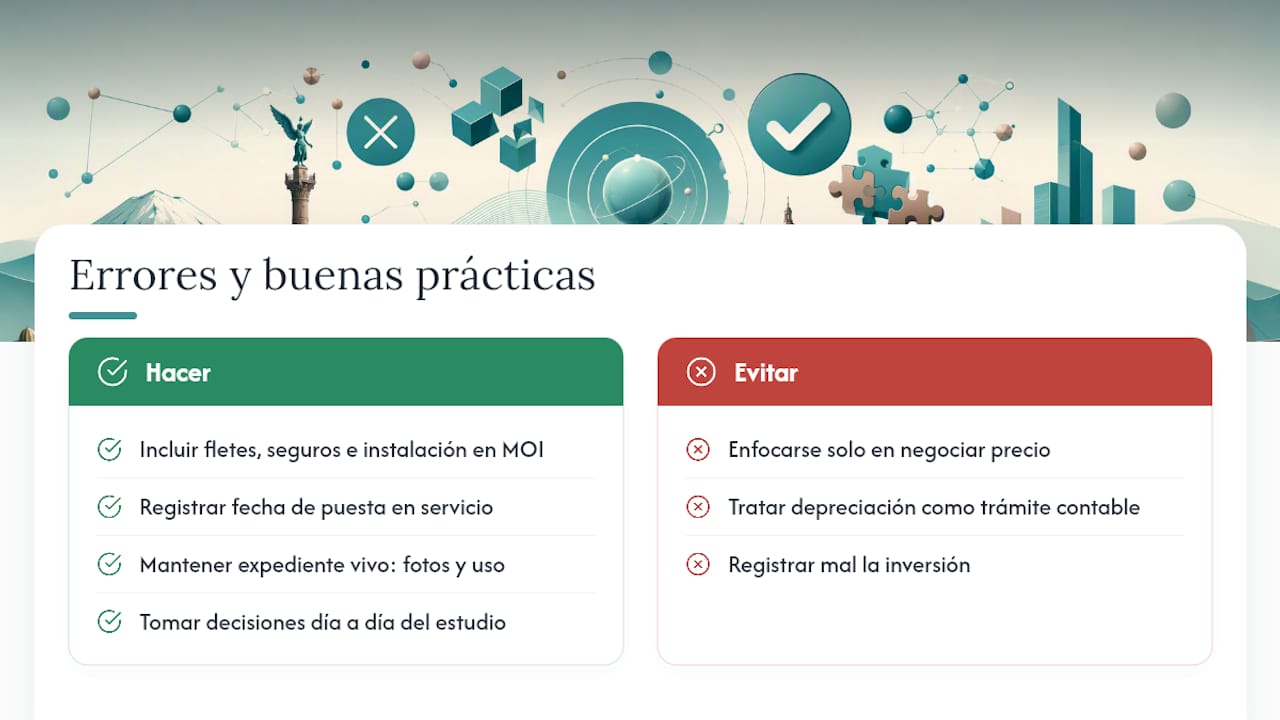
There's also a tendency to treat depreciation as a task exclusive to the accountant, something resolved only at year-end. This distance is a mistake: the decisions that determine the quality of the deduction (in-service date, chosen percentage, usage documentation) are made daily in the studio, not in the accounting office. The accountant can calculate perfectly based on incomplete data, and the result will still be a weak deduction.
What does work, and what few studios apply systematically, is treating each reformer as a living file from its installation day: photos, dates, room assignment, usage records. This isn't bureaucracy for bureaucracy's sake. It's the difference between a deduction that stands on its own during a review and one that depends on no one asking questions.
This article provides general information and does not substitute for advice from a qualified financial advisor. Consult a qualified financial professional about your specific case before acting on this content.