Pilates Studio Marketing: The Tactic That Fills Classes

Marketing for a Pilates Studio: The Tactic That Fills Rooms
The fastest way to fill and retain students is to combine an optimized Instagram profile with a 3-class introductory offer and active onboarding with a 7-day follow-up. This combination usually converts a significant proportion of trials into memberships when the experience is well-designed. The KPI to monitor from the first month is attendance frequency: those who train three times a week during the first four weeks are much more likely to stay for two years or more.
In summary:
- Attendance frequency, especially training three times a week in the first four weeks, significantly increases the likelihood of retaining students for more than two years.
- Implementing an optimized Instagram profile with consistent content and a complete Google My Business listing can capture high-intent local searches at low cost.
- Membership conversion largely depends on a well-designed introductory offer, with active follow-up and initial assessment, which converts between 50% and 65% of trials.
- Long-term retention is strengthened with referral programs, internal events, and public recognition, focusing on keeping students motivated and connected.
- Before investing in advertising, the studio must ensure adequate equipment, sufficient resources, and a professional environment to uphold the promise of quality in every class.
Table of Contents
- Marketing strategies for a Pilates studio that actually generate students
- How to convert a trial class into a membership
- Retention: How to get students to stay
- Why a higher price can be your best positioning strategy
- 90-day timeline to launch your Pilates studio marketing
- What your studio needs before investing in advertising
- Events and workshops that put your studio on the map
- Long-term loyalty: What keeps a student after the first year
- WhatsApp Business: The channel that closes bookings faster than any form
- Why real testimonials convert more than any ad
- Author's perspective: What separates a full studio from an empty one
- Equip your studio with financing and real support from Pilates de México
- Sources
- Frequently asked questions
Marketing Strategies for a Pilates Studio That Actually Generate Clients
Not all channels carry the same weight. Instagram influences many new client purchase decisions, according to Glofox, making it the first place to invest time before spending on advertising.
Instagram Optimization
- Username with clear location (e.g., @pilatesreformer.cdmx) to appear in local searches.
- Bio with a direct call to action: "Book your first class" with a centralized link (Linktree or similar).
- Highlights organized by category: facilities, testimonials, equipment, and schedules.
- Before investing in advertising, it's advisable to have a consistent feed of at least a dozen posts that convey a premium, professional, and serene atmosphere.
Google My Business and Local SEO
A complete listing, with the correct category, updated hours, professional photos of the space, and active responses to reviews, remains the cheapest channel to capture high-intent searches like "Pilates classes near me." The studio's website should load quickly on mobile and display prices, schedules, and a visible booking button without scrolling.
Meta Ads with a Simple Structure
- Awareness campaign targeting a 5 to 8-kilometer radius, offering a trial class.
- Remarketing campaign for those who visited the website or interacted with the profile without booking.
- Lookalike audience campaign (1%) built from your best clients, a tactic that Pilotium recommends for scaling without wasting budget.
A moderate initial budget is usually enough to test these three layers before scaling.
Strategic Alliances
Physical therapists, nutritionists, and local wellness micro-influencers can bring in up to 40% of new clients when the referral agreement is well-structured, with a commission or free class for each confirmed student, according to Trainingym.
Professional Tip: Limit spots on platforms like ClassPass to one or two per class. Reserve peak demand hours for your direct members and thus protect premium revenue.
How to Convert a Trial Class into a Membership
The introductory offer works best when presented as a value opportunity, not a clearance sale. The "3 classes for $49" format (or the equivalent you decide based on your market) lowers the barrier to entry without giving away the service, and converts between 50% and 65% of participants when onboarding accompanies each step, according to Shortway.
The operational process should follow this sequence:
- Initial assessment in the first class: level, previous injuries, and personal goals.
- 7-day check-in, via message or short call, to answer questions and reinforce the habit.
- Invitation to sign up on the same day of the third class, with a clear and pressure-free continuity offer.
Key Data: Well-designed trials convert between 50% and 65%. If your studio is below that range, first review the quality of instruction in the first class and the promptness of the check-in, before touching the offer price.
If conversion drops below 40%, the problem is almost never the price: it's usually the in-studio experience or the lack of follow-up in the first few days.
Retention: How to Keep Students Coming Back
Community is the most powerful retention tool a small studio has, even more so than any discount.
- Referral Program: a free class or a discount for both the referrer and the referred person, recorded in your management system to measure its real impact.
- Level and Schedule Based Groups: help students get to know each other and generate a social commitment to the group, not just to the instructor.
- Internal Events (month-long challenges, themed classes, anniversary celebrations) that provide reasons to attend beyond the routine.
- Membership Tiers that offer exclusive benefits to the most committed students, acting as an anchor to justify higher prices.
The metric that matters here is not just how many students join, but how many stay after 90 and 180 days. Studios that master their local marketing can achieve high retention rates at 12 months, according to Pilotium.
Professional Tip: In your monthly report, separate the retention of new students (first 90 days) from the retention of veteran students. These are two distinct problems and require distinct tactics.
Why a Higher Price Can Be Your Best Positioning Strategy
The average studio charges between $25 and $40 per class, with a customer lifetime value of between $2,400 and $4,800, according to Pilotium figures. Charging less is rarely the winning strategy: what moves the needle is what justifies that price.
- Instructors with recognized certifications such as BASI, Stott, or Polestar, visible on your website and social media.
- Small groups (maximum 6 to 8 people per reformer class) that guarantee real attention.
- Professional and well-maintained equipment: a creaky or misaligned reformer damages the perception of value as much as a bad class.
- Professional photography of the space and real testimonials, not generic review screenshots.
Differentiating the message between mat and reformer also helps: the mat serves as an accessible entry point, while the reformer is communicated as the premium experience that anchors your positioning.
90-Day Timeline to Launch Your Pilates Studio Marketing
Executing in order avoids spending budget on advertising before having a solid foundation on social media and reviews.
- Weeks 1 to 4: Optimize Instagram, complete your Google Business Profile, hire a professional photo session, and launch the introductory 3-class offer.
- Weeks 5 to 8: Activate the first Meta Ads campaigns, close agreements with local physical therapists or nutritionists, and set up conversion tracking in your booking system.
- Weeks 9 to 12: Pause what isn't converting, double the budget on what is working, and document the onboarding process so any instructor can replicate it.
Weekly review should focus on two numbers: how many trials were booked and how many converted. The monthly review adds 90-day retention and revenue per active student.
What Your Studio Needs Before Investing in Advertising
Before spending on ads, the studio must uphold the promise made on social media. In the equipment stage, a real bottleneck behind poor conversion is often identified.
- Reformers from various lines, including options ranging from premium equipment to more accessible alternatives for a first studio.
- Specialized accessories to complete the equipment of each workstation.
- Financing options for those who prefer to spread the initial investment rather than pay it all at once.
Opening consultancy helps calculate how many pieces of equipment a studio needs based on its square footage and occupancy goal, a step that reduces the risk of overinvesting or falling short in the launch phase.
Events and Workshops That Put Your Studio on the Map
A monthly workshop open to the public, in-person or live-streamed, serves a purpose that no single social media post can achieve: it lets undecided people try your method without committing to a membership.
The formats that work best combine education with a taste of the real class experience. A "Pilates for Back Pain" workshop with a guest physical therapist, or a free "Reformer Introduction" session for those who only know mat, attract a different audience than your current followers.
The operational key is the event closing: every attendee should leave with a concrete offer in hand, not just a good impression. Offering the introductory 3-class deal right then and there, with limited spots for that week, turns interest into a booking before it cools down.
Virtual workshops work best for educational content (breathing, posture, injury prevention) which also serves as reusable material for your content calendar and newsletter. Recording these sessions and converting them into short videos for Instagram extends their reach long after the original event.
Two or three events a year, well-promoted at least two weeks in advance, generate a stream of new bookings that no ad campaign fully replaces, because they combine social validation with direct human contact.
Long-term Loyalty: What Keeps a Student After the First Year
Onboarding solves the first 90 days. After that point, the risk of attrition changes cause: it's no longer lack of habit, but lack of new reasons to continue.
A VIP program for students with more than one year of seniority, with benefits such as priority access to high-demand schedules, invitations to private events, or a complimentary class on their anniversary, keeps the recognition of that loyalty visible. This is not about permanent discounts, which erode the premium positioning built with higher prices, but about privileges that don't cost the studio much but are perceived as exclusive.
Quarterly challenges (a month of perfect attendance, a technical progress goal) renew the interest of those who have already mastered the basic routine and are looking for a different reason to stay. Combining them with public recognition, within the studio or on social media, strengthens the social bond we already mentioned as the strongest driver of retention.
Personalized communication matters more in this stage than in the initial one. A birthday note, a message when someone misses several classes in a row, or a brief call when low attendance is detected, cost little time and prevent disengagement from turning into cancellation. Measuring how many students remain active at month 18 and month 24 is the indicator that separates a studio with real retention from one that only fills the first membership.
WhatsApp Business: the channel that closes bookings faster than any form
No web form competes with the speed of a WhatsApp response. Setting up WhatsApp Business with a class catalog, quick replies for common questions (schedules, prices, location), and labels to classify each contact according to their stage (interested, trial, active member) turns this channel into the operational hub for daily communication.
Most trial bookings are lost in the first few hours after initial contact, when interest is highest and the response takes too long. Automating a welcome message with the introductory offer and booking link, followed by a human response in less than an hour, recovers a good portion of that interest that would otherwise cool off.
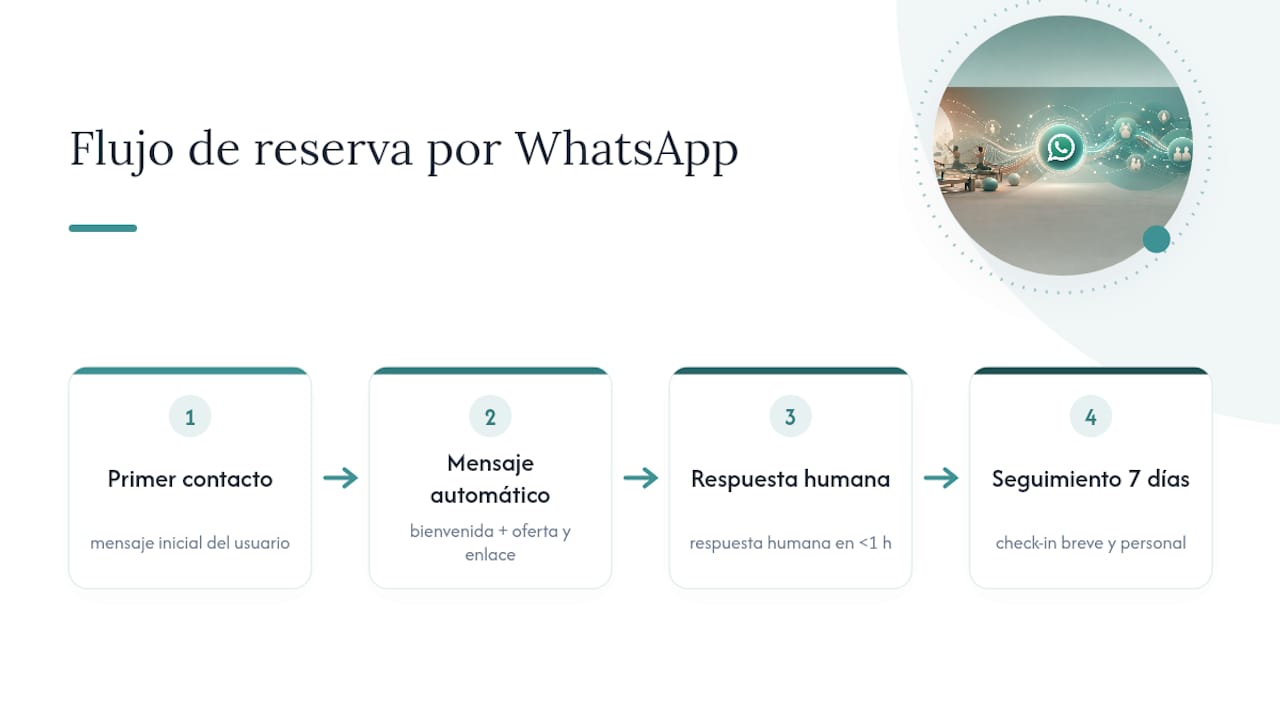
The 7-day check-in we mentioned during onboarding works especially well through this channel: a brief, personal message feels different from an automated email, and the response rate tends to be higher. The same applies to class reminders, payment confirmations, or schedule change notifications, functions that reduce absences without the need for calls.
For studios with more than one instructor, linking WhatsApp Business with the booking system avoids duplicating information and allows any team member to see the complete history of each student before responding.
Why real testimonials convert more than any advertisement
No paid campaign replaces the trust generated by seeing someone similar to you already training there. Video testimonials, recorded directly in the studio and not as generic text over a review, work better because they show the environment, the instructor's approach, and the real physical results of someone with a starting point similar to that of the viewer.

Asking for a testimonial at the right time matters as much as asking for it. The ideal point is usually after the 10th or 12th class, when the student already notices concrete changes in posture, pain, or strength, but still clearly remembers how they felt when they started. That contrast is what convinces someone who is evaluating whether it's worth trying.
Showing cases with real progression (a student with chronic lower back pain who now trains without discomfort, someone who arrived with no physical condition and today maintains a routine three times a week) builds credibility that no discount offer alone can achieve. These cases should appear distributed on Instagram, on your website's homepage, and in materials provided during in-person workshops, not concentrated in a single section that nobody visits.
Author's perspective: What separates a full studio from an empty one
Studios that fail almost never fail to attract people. They fail in the first four weeks after the trial, when no one follows up. Rapid execution and constant measurement matter more than any isolated acquisition tactic.
Equip your studio with financing and real support from Pilates de México
No marketing strategy can sustain a studio if the equipment fails in the twentieth class. Pilates de México is the alternative to buying loose equipment without support: it offers complete lines, direct financing, and opening consultancy designed for those who need to fill a room without risking all their capital on the first purchase.
If you are about to open or expand your reformer studio, the Infinity and Advanced lines cover both premium options and more accessible entry points, depending on your first-year budget. Specialized accessories complete each station without adding another vendor to your list. And if you prefer to spread out your investment rather than paying upfront, the financing page explains the available options before you commit your cash flow. Check out the studio packages if you are equipping a complete room from scratch and want installation included in the same purchase.
Sources
- Pilotium — Pilates Studio Marketing
- Shortway — Marketing for Pilates Studios
- Trainingym — 10 ways to improve your Pilates studio's marketing
Frequently Asked Questions
How profitable is a Pilates studio?
A studio with good local marketing can achieve between 80% and 95% occupancy and a customer lifetime value of $2,400 to $4,800, according to Pilotium. Profitability depends more on retention and premium positioning than on the gross number of new students.
What is the 3-3-3 rule in marketing?
There is no standard definition of this rule applied to Pilates studio marketing; different sources use it with different meanings depending on the sector, so it should be treated with caution outside its specific context.
What should a Pilates studio have?
It needs instructors with recognized certifications such as BASI, Stott, or Polestar, well-maintained professional equipment, small groups, and active onboarding with a 7-day check-in. Brands like Pilates de México offer equipment and financing to cover this operational base.
What are the 4 main marketing strategies?
In Pilates studio marketing, the four most influential levers are: Instagram optimization, local SEO with Google Business, a well-structured introductory offer, and a retention program based on community and referrals.